Best Commercial Rubber Roofing Material: EPDM vs TPO Compared
Compare the top commercial rubber roofing material options. We analyze EPDM vs TPO membranes on 2026 costs, lifespan, and installation methods.

Defining the Commercial Rubber Roofing Material Landscape
When facility managers and architects specify a commercial rubber roofing material, they are almost exclusively referring to single-ply membrane systems. While the colloquial term 'rubber roof' historically pointed directly to EPDM (Ethylene Propylene Diene Monomer), the modern market heavily cross-shops EPDM with TPO (Thermoplastic Polyolefin). Though TPO is technically a thermoplastic rather than a true elastomeric rubber, it competes in the exact same commercial low-slope sector.
Selecting the correct membrane requires moving beyond basic marketing claims. You must evaluate puncture resistance, thermal movement, seam integrity, and long-term weathering. According to the National Roofing Contractors Association (NRCA), single-ply membranes account for over 65% of the commercial low-slope roofing market, making the choice between EPDM and TPO one of the most critical procurement decisions in building envelope management.
Head-to-Head Comparison Matrix
The following matrix breaks down the core performance metrics and 2026 market pricing for standard 60-mil commercial membranes. Pricing reflects material and baseline installation costs for fully adhered systems on standard commercial decks.
| Feature | EPDM (Black) | EPDM (White) | TPO (White) |
|---|---|---|---|
| Material Cost (per sq. ft.) | $1.40 - $1.85 | $2.10 - $2.60 | $1.50 - $2.10 |
| Installed Cost (per sq. ft.) | $4.50 - $6.50 | $5.50 - $7.50 | $4.80 - $7.00 |
| Expected Lifespan | 25 - 30+ Years | 20 - 25 Years | 20 - 30 Years |
| Seam Method | Primer + Tape / Liquid | Primer + Tape / Liquid | Hot-Air Welding |
| Puncture Resistance | Excellent | Excellent | Good to Very Good |
| Solar Reflectance (SRI) | Low (Absorbs Heat) | High (Meets Energy Codes) | High (Meets Energy Codes) |
| Cold Weather Flexibility | Superior | Superior | Moderate (Stiffens) |
EPDM: The Elastomeric Standard
EPDM is a synthetic rubber derived from ethylene and propylene. It has been the dominant commercial rubber roofing material since the 1960s. Modern formulations, such as those produced by Holcim (formerly Firestone) and Carlisle SynTec, are manufactured to meet ASTM D4637 standards. The industry standard for commercial applications is 60-mil thickness, though 90-mil is specified for high-traffic roofs or ballasted systems.
Advantages of EPDM
- Unmatched Durability: Black EPDM is highly resistant to UV degradation and ozone exposure. It is not uncommon to see 30-year-old EPDM roofs still performing with basic maintenance.
- Cold Weather Performance: EPDM remains highly flexible in sub-zero temperatures, making it the premier choice for commercial facilities in northern climates where thermal shock is a concern.
- Flashing Complex Penetrations: Uncured EPDM flashing can be stretched and molded around complex roof penetrations, HVAC curbs, and irregular pipes, creating a seamless, watertight bond.
While white EPDM is available to meet cool-roof energy codes, it requires a titanium dioxide coating that can degrade over time, exposing the black rubber underneath. If your local energy code mandates a high Solar Reflectance Index (SRI), TPO is generally a more reliable and cost-effective white membrane choice than white EPDM.
Common Failure Modes
The primary vulnerability of EPDM lies in its seams. Because the material cannot be heat-welded, contractors rely on butyl-based seam tapes and liquid primers. If the roof surface is not perfectly clean, or if the primer flashes off too quickly in high heat, the tape can delaminate. Furthermore, EPDM is prone to long-term shrinkage. Over a 20-year period, the membrane can pull away from roof edges and penetrations if not properly secured with termination bars and adequate slack.
TPO: The Thermoplastic Evolution
TPO is a single-ply reflective roofing membrane made from polypropylene and ethylene-propylene rubber polymerized together. Governed by ASTM D6878, TPO has captured massive market share due to its energy efficiency and welded seams. Leading manufacturers like GAF (EverGuard) and Carlisle (Sure-Weld) have heavily invested in advanced polymer stabilizers to overcome early-generation flaws.
The Heat-Welding Advantage
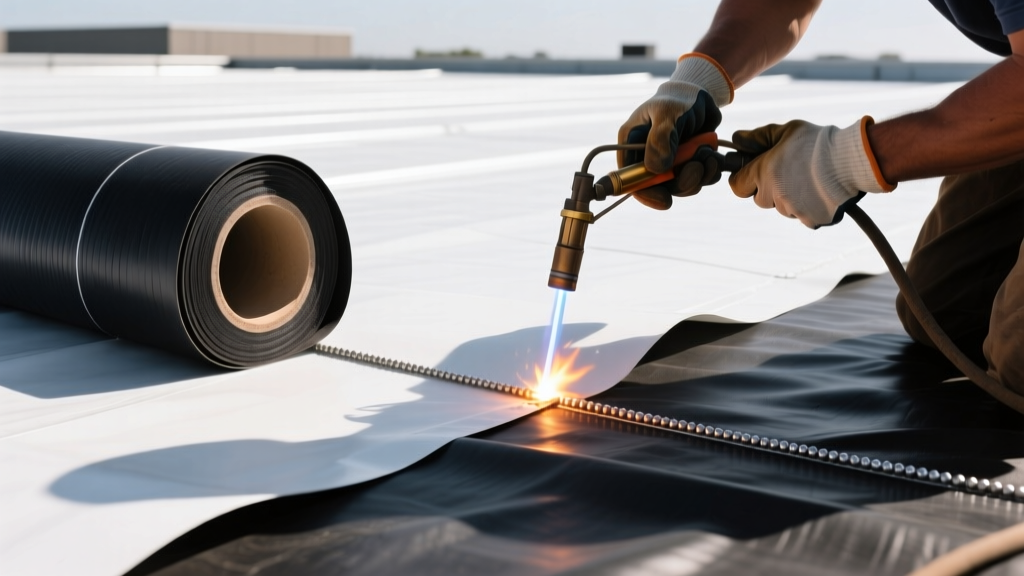
Unlike EPDM, TPO seams are fused together using hot-air welders operating at roughly 1,000°F to 1,200°F. This creates a monolithic, continuous bond that is actually stronger than the membrane itself. According to guidelines from the Single Ply Roofing Industry (SPRI), properly executed thermal welds virtually eliminate the seam-failure issues that plague taped systems, provided the welder speed and temperature are calibrated to the ambient weather conditions.
Addressing Early-Generation Cracking
Facility managers researching TPO will inevitably find historical reports of membrane cracking and premature failure from the late 1990s and early 2000s. Those failures were caused by inadequate UV stabilizers and the inability of early formulations to handle high thermal loading. Modern 2026 TPO formulations utilize advanced hindered amine light stabilizers (HALS) and thicker top plies (the layer above the polyester scrim reinforcement). When specifying TPO today, always verify the top-ply thickness; a 60-mil membrane with a 20-mil top ply will vastly outperform one with a 12-mil top ply.
Attachment Systems and Seam Integrity
The longevity of any commercial rubber roofing material is dictated as much by how it is attached to the deck as by the membrane itself. There are three primary attachment methods:
- Fully Adhered: The membrane is glued directly to the insulation board using water-based or polyurethane adhesives. This method provides the highest wind-uplift resistance (often achieving FM 1-90 or UL Class 90 ratings) and prevents wind billowing, but it is the most labor-intensive and expensive.
- Mechanically Attached: The membrane is fastened to the structural deck using screws and stress plates, with the fastener lines covered by the overlapping membrane and welded or taped. This is the most cost-effective method but requires strict adherence to fastener spacing patterns (e.g., 12 inches on-center in the field, 6 inches in the perimeter).
- Ballasted: The membrane is laid loose over the deck and held in place by river-washed stone or concrete pavers. This is the fastest installation method and protects the membrane from UV and physical damage, but it requires a structurally robust deck to support the immense weight (10 to 15 lbs per square foot).
2026 Procurement and Decision Framework
Do not default to the cheapest bid. Use this framework to select the correct commercial rubber roofing material for your specific facility profile:
Choose EPDM When:
- Your facility is located in a northern climate with extreme temperature fluctuations and frequent freeze-thaw cycles.
- The roof features a high density of complex penetrations, pipes, and irregular HVAC curbs that require custom flashing.
- You are utilizing a ballasted system with heavy river-washed stone, where the superior puncture resistance of 90-mil EPDM is required.
- Budget constraints prioritize lowest initial installed cost over long-term energy savings (specifically with black EPDM).
Choose TPO When:
- Local building codes mandate compliance with ASHRAE 90.1 or LEED cool-roof requirements, necessitating a highly reflective white surface.
- The roof features long, straight, unobstructed runs where automated hot-air welding can be deployed for rapid, monolithic seam creation.
- The facility operates in a hot, southern climate where reducing HVAC cooling loads via high SRI reflectivity yields a measurable ROI.
- You want to eliminate the risk of seam-tape delamination caused by improper primer application or long-term adhesive degradation.
Final Specification Note: Regardless of whether you select EPDM or TPO, always mandate a 60-mil minimum thickness for commercial applications, require the contractor to perform destructive seam testing (peel tests) at the start of each workday, and ensure the warranty explicitly covers wind uplift up to your building's specific ASCE 7 calculated requirements.
Written by
Priya KapoorPriya Kapoor is a real estate market analyst and construction economics researcher with expertise in housing affordability, development feasibility, and infrastructure investment. She holds a Master of Regional Planning from Cornell University and previously worked as a senior analyst at CBRE's Investment Properties group, where she modeled returns for $4B in mixed-use development pipelines. Priya now runs an independent research practice advising developers, municipalities, and REITs on construction cost forecasting and market timing. She publishes the quarterly "BuildMat Market Pulse" report tracking material price indices across 12 commodity categories. Based in Austin, TX, Priya serves on the board of Habitat for Humanity Austin and is a marathon runner.
More from Priya Kapoor
View all
Construction Cost
Cost to Build a 1600 Sq Ft Home in 2026: Full Breakdown
Accurate 2026 cost to build a 1600 sq ft home—material, labor, and regional pricing breakdowns included. Plan your budget with real-time estimates.
Aug 11, 2026

Wood & Lumber
Name the Types of Wood for Pressure Treatment and Preservation
Learn how to name the types of wood best suited for pressure treatment. Compare species treatability, chemical retention levels, and 2026 preservation costs.
Aug 4, 2026

Stone & Masonry
Stone Veneer Suppliers Lindenhurst: 2026 Cost Analysis
Analyze 2026 stone veneer costs in Lindenhurst, NY. Compare local supplier pricing, delivery fees, and Suffolk County installation labor rates.
Aug 4, 2026