Composition Roofing Material Lifespan: Durability and Failure Modes
Discover the true lifespan of composition roofing material. Explore degradation factors, shingle grades, environmental failure modes, and maintenance tips.

The Anatomy of Composition Shingle Degradation
Composition roofing material—primarily fiberglass-reinforced asphalt shingles—dominates the North American residential market due to its balance of cost, fire resistance, and aesthetic versatility. However, manufacturer warranties of 25 to 50 years rarely reflect the functional lifespan in real-world conditions. The actual durability of a composition roof is dictated by the chemical stability of the asphalt binder, the integrity of the fiberglass mat, and the retention of ceramic-coated mineral granules.
Asphalt is a petroleum-based polymer that naturally oxidizes when exposed to ultraviolet (UV) radiation and oxygen. This oxidation process causes the shingles to lose their volatile oils, transitioning from a flexible, waterproof membrane into a brittle, rigid sheet. The mineral granules embedded in the surface act as a sacrificial UV shield. Once granule loss exposes the underlying asphalt to direct sunlight, the degradation curve accelerates exponentially, leading to micro-cracking, moisture intrusion, and eventual mat failure.
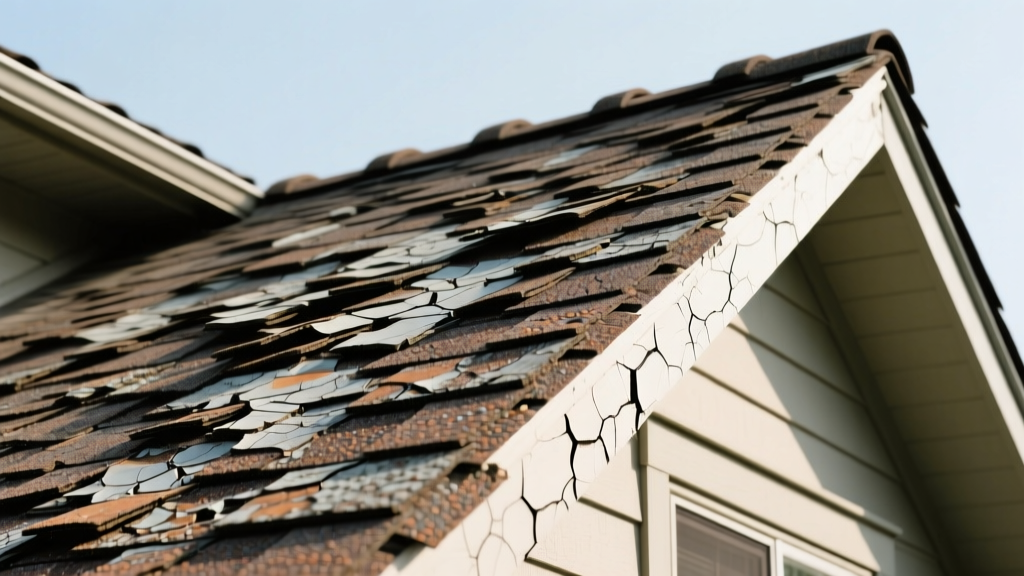
Lifespan Matrix: Shingle Grades vs. Real-World Durability
Not all composition roofing material is manufactured equally. The thickness of the asphalt coating and the type of polymer modifiers used drastically alter the expected service life. The following matrix breaks down the realistic lifespan and material costs for the three primary grades of composition shingles available in 2026.
| Shingle Grade | Construction Profile | ASTM Standard | Realistic Lifespan | Material Cost (per 100 sq ft) |
|---|---|---|---|---|
| 3-Tab Strip | Single-layer, flat profile, uniform cutouts | ASTM D3462 | 12 – 18 Years | $90 – $120 |
| Architectural (Dimensional) | Dual-layer fiberglass mat, dimensional shadow lines | ASTM D3462 / D7158 | 22 – 28 Years | $130 – $180 |
| Luxury (Premium) | Multi-layer, heavy-weight, slate/shake mimicking | ASTM D3462 | 30 – 40 Years | $250 – $400 |
| SBS-Modified (Impact Resistant) | Rubberized asphalt polymer blend, Class 4 impact | UL 2218 Class 4 | 30 – 45 Years | $220 – $350 |
Environmental Stressors and Regional Failure Modes
The geographic location of a structure dictates the primary failure mode of composition roofing material. A shingle system that lasts 30 years in the Pacific Northwest may fail in 15 years in the Sonoran Desert due to entirely different environmental stressors.
Thermal Shock in Desert and High-Altitude Climates
In regions with extreme diurnal temperature swings, composition shingles undergo rapid expansion and contraction. A roof surface can reach 160°F (71°C) at peak solar noon and drop to 60°F (15°C) after sunset. This daily thermal shock causes transverse cracking—horizontal splits that run parallel to the shingle exposure line. To mitigate this, specify cool-roof rated shingles with high solar reflectance. According to the U.S. Department of Energy, cool roofing materials can reduce peak cooling demand by 10-15%, which concurrently lowers the thermal expansion stress on the asphalt binder.
Wind Uplift and Sealant Failure in Coastal Corridors
Composition shingles rely on thermally activated asphalt sealant strips to bond overlapping courses. In high-wind coastal zones, cyclic wind uplift can fatigue these seals, leading to shingle tabbing and tear-offs. For homes in hurricane-prone regions, standard ASTM D7158 Class D (90 mph) ratings are insufficient. Require shingles tested to Class H (150 mph) and ensure installation follows the Insurance Institute for Business & Home Safety (IBHS) FORTIFIED Home standards, which mandate six nails per shingle rather than the standard four, and specific nailing patterns to prevent pull-through.
Biological Growth in Humid and Forested Zones
The dark streaks commonly seen on composition roofs in humid climates are not dirt, but Gloeocapsa magma, a cyanobacteria that feeds on the calcium carbonate limestone filler used in asphalt shingle manufacturing. While primarily an aesthetic issue in the short term, prolonged biological growth retains moisture against the granules, accelerating frost damage in winter and promoting moss rhizomes that can physically lift shingle edges, breaking the weather seal.
The Attic Thermodynamics Factor
The most frequently overlooked variable in composition roofing material lifespan is attic ventilation. A composition shingle is designed to shed water from the top down; it is not designed to withstand heat from the bottom up. An under-ventilated attic can trap heat exceeding 140°F (60°C), effectively baking the shingles from underneath and halving their expected lifespan.
Proper ventilation requires a balanced intake and exhaust system calculated using the Net Free Ventilation Area (NFVA). The International Residential Code (IRC) mandates a minimum NFVA ratio of 1:150 (one square foot of ventilation for every 150 square feet of attic floor space). This can be reduced to 1:300 if a proper vapor barrier is installed on the warm side of the ceiling and at least 50% of the ventilation is located at the intake (soffit) level. Ridge vents paired with continuous soffit vents provide the most consistent convective airflow, preventing the localized heat pooling that causes premature shingle blistering.
Actionable Maintenance and the 25% Replacement Rule
To maximize the ROI on a composition roof, homeowners and facility managers must implement proactive maintenance protocols. Avoid pressure washing, which violently strips the protective granules. Instead, utilize a low-pressure soft wash system with a 50/50 sodium hypochlorite and water solution to eradicate biological growth, followed by the installation of zinc or copper ridge strips to prevent recurrence.
When assessing storm damage or end-of-life degradation, roofing professionals utilize the 25% Rule as a decision framework for partial versus full replacement:
- Assess the Roof Plane: Evaluate each distinct roof plane (slope) individually, rather than the entire roof system.
- Calculate Damage Density: If less than 25% of the shingles on a specific plane exhibit severe granule loss, creasing, or wind tears, localized repair and individual shingle replacement is structurally and financially viable.
- Trigger Full Plane Replacement: If damage or degradation exceeds 25% of the roof plane, the cost of labor to carefully weave new shingles into brittle, existing ones—combined with the inability to match faded colors—dictates that the entire plane must be stripped and replaced to maintain the integrity of the weather barrier.
By understanding the specific material grade, respecting regional environmental stressors, and maintaining strict attic thermodynamics, property owners can ensure their composition roofing material reaches the absolute upper limit of its engineered lifespan.
Written by
David NakamuraDavid Nakamura is a licensed architect (AIA) and construction technology writer focused on sustainable building methods, mass timber engineering, and high-performance building envelopes. He holds a Master of Architecture from the University of Washington and is a certified Passive House Consultant (CPHC). David spent eight years at the Seattle firm Mithun, where he led the design of three LEED Platinum projects, before founding his own practice specializing in net-zero residential design. He serves on the editorial advisory board of GreenBuilder Magazine and has authored peer-reviewed papers on cross-laminated timber (CLT) connections for the Journal of Structural Engineering. In his spare time, David teaches woodworking at Pratt Fine Arts Center and kayaks the Puget Sound.
More from David Nakamura
View all
Construction Cost
Labor Cost to Build a Deck Per Sq Ft: 2026 Installation Guide
Discover the exact labor cost to build a deck per sq ft in 2026. This installation guide breaks down contractor rates, complexity factors, and hidden fees.
Aug 4, 2026

Construction Cost
How Much Does It Cost to Build a 3 Bedroom House? Financing Guide
Learn exactly how much it costs to build a 3 bedroom house and explore 2026 financing options, construction loan types, and budget frameworks for your build.
Aug 4, 2026

Construction Cost
Cost to Build a Tennis Court: 2026 Guide
How much does it cost to build a tennis court in 2026? Breakdowns for asphalt, concrete, and synthetic surfaces plus fencing and lighting.
Jul 30, 2026