Copper Roofing Material Guide: Costs, Patina, and Installation Specs
Explore our complete guide to copper roofing material. Learn current costs, patina timeline stages, installation specs, and lifespan expectations.

The Metallurgy of Architectural Copper
Copper roofing material is not a monolithic product; its performance is dictated by specific alloy compositions and cold-rolling processes. For architectural applications, the industry relies on two primary alloys: UNS C11000 (Electrolytic Tough Pitch, or ETP copper) and UNS C12200 (Deoxidized High Phosphorus, or DHP copper). While C11000 is the standard for most sheet metal work, C12200 is preferred when extensive TIG welding or high-heat soldering is required, as the phosphorus deoxidation prevents hydrogen embrittlement.
The thickness of copper sheet metal is measured in ounces per square foot rather than standard gauges. Selecting the correct weight is critical for structural integrity and wind uplift resistance:
- 16 oz. (0.0216 inches): Used primarily for flashing, gutters, and interior decorative elements. It is too thin for primary roofing pans on commercial structures.
- 20 oz. (0.027 inches): The industry standard for residential and commercial standing seam roofs, flat-lock panels, and batten seam systems. It offers the optimal balance of malleability for seaming and rigidity for spanning.
- 24 oz. (0.0323 inches): Reserved for high-wind coastal zones, heavy snow-load regions, and complex architectural features requiring maximum durability.
The Patina Progression: A 30-Year Timeline
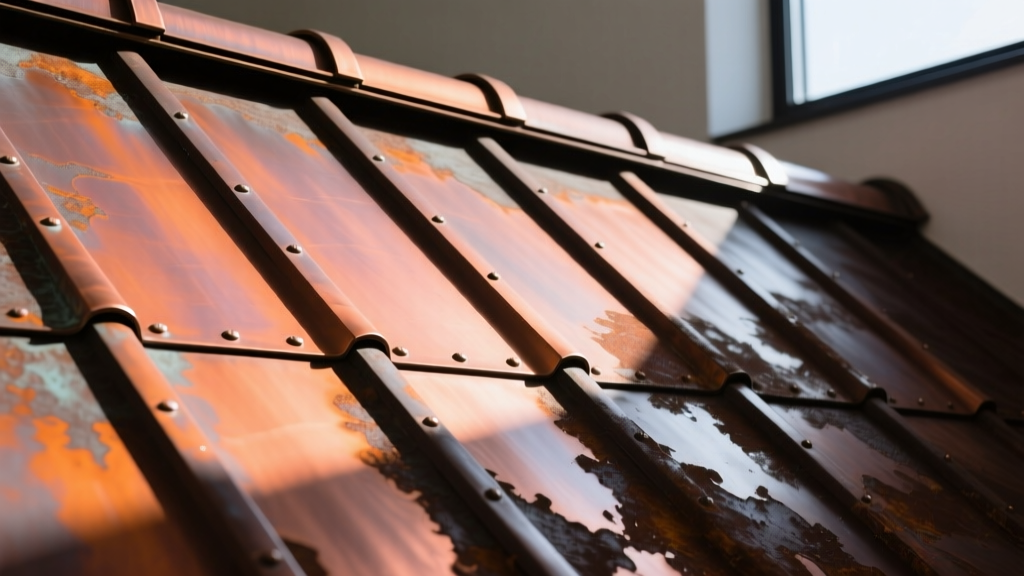
The most misunderstood aspect of copper roofing material is its oxidation process. The transition from bright metal to verdigris is a predictable chemical sequence driven by atmospheric moisture, sulfur compounds, and chlorides. According to the Copper Development Association, this progression occurs in distinct stages:
- Bright Metallic (0–6 months): The initial mill finish. Highly reflective but highly susceptible to water spotting and handling stains.
- Salmon/Oxidized (6–18 months): Cuprous oxide forms, giving the metal a warm, matte pinkish-orange hue.
- Russet Brown (18–36 months): As cuprous oxide converts to cupric oxide, the surface darkens to a rich, earthy brown.
- Matte Black/Dark Brown (3–10 years): The oxide layer thickens. In rural environments, the roof may remain in this dark stage indefinitely.
- Verdigris (10–30+ years): Basic copper sulfate (in industrial/urban areas) or basic copper chloride (in coastal areas) forms the iconic blue-green patina. This layer is highly stable and acts as a protective shield against further corrosion.
2026 Cost Breakdown: Material vs. Labor
Copper remains a premium investment. In 2026, global commodity fluctuations and a shortage of specialized sheet metal artisans (tinners) have kept labor costs high. Below is the current pricing structure for a standard 20 oz. standing seam copper roof system:
| Component | Cost per Sq. Ft. | Notes |
|---|---|---|
| Raw 20 oz. Copper Coil | $9.50 - $12.00 | Varies by LME commodity index |
| Underlayment & Fasteners | $1.50 - $2.50 | High-temp synthetic + copper cleats |
| Fabrication & Forming | $3.00 - $5.00 | Shop or on-site roll-forming |
| Specialized Labor (Tinning) | $8.00 - $14.00 | Highly dependent on roof pitch/complexity |
| Total Installed Cost | $22.00 - $33.50 | Excludes structural decking repairs |
Critical Installation Specifications
Improper installation is the leading cause of premature failure in copper roofing. Because copper has a high coefficient of thermal expansion (9.8 x 10^-6 in/in/°F), a 20-foot panel will expand and contract roughly 1/8 inch over a 100°F temperature swing. The system must be designed to accommodate this movement.
Underlayment and Slip Sheets
Never install copper directly over asphalt-based underlayments or rubberized ice-and-water shields. The asphalt can bond to the copper, restricting thermal movement and causing the metal to tear or buckle. The approved assembly consists of a base layer of 30 lb. asphalt felt, topped with a slip sheet of red rosin paper. Alternatively, high-temperature synthetic underlayments (rated for 250°F+) can be used, provided a rosin paper slip sheet is still incorporated.
Cleat Spacing and Fastener Rules
Standing seam panels are secured using continuous or individual cleats. For 20 oz. copper, cleats must be cut from 16 oz. copper stock, measuring 2 inches wide. Individual cleats should be spaced a maximum of 12 inches on center (8 inches in high-wind zones). Fasteners must be 1.5-inch copper or 304/316 stainless steel ring-shank nails. Never use galvanized steel, aluminum, or standard zinc fasteners.
Copper is highly cathodic. If it comes into direct contact with, or receives water runoff from, dissimilar metals like aluminum, untreated steel, or zinc, rapid galvanic corrosion will destroy the adjacent metal. Furthermore, never install copper flashing over pressure-treated wood containing ACQ (Alkaline Copper Quaternary) or copper azole preservatives, as the chemical salts will aggressively pit and corrode the copper sheeting.
Soldering Transverse Seams
Where panels meet end-to-end, transverse seams must be soldered. The standard practice involves a flat-lock lap joint, riveted every 2 inches, and then sweat-soldered. Use 50/50 tin-lead solder where local environmental codes permit, as it offers superior flow and fatigue resistance. In jurisdictions with strict potable water or environmental regulations, use lead-free 95/5 tin-antimony solder, noting that it requires higher torch temperatures and flux management.
Long-Term Maintenance and Failure Modes
While copper roofing material is often marketed as 'maintenance-free,' it requires specific design considerations to avoid common failure modes:
- Oil Canning: This refers to the visible waviness or buckling in the flat areas of the metal pans. It is caused by thermal stress and inadequate sub-structure support. To mitigate oil canning, specify a maximum pan width of 14 inches for 20 oz. copper, or incorporate stiffening beads/ribs into wider pans.
- Wind Uplift at Eaves: The eaves and rakes experience the highest wind pressures. Ensure that the starter cleats at the eave are continuous (not individual) and that the first panel is securely locked and soldered at the drip edge.
- Debris Accumulation: Wet leaves and pine needles hold moisture and organic acids against the copper, which can disrupt the patina formation and cause localized pitting. Annual clearing of valleys and gutters is mandatory.
For further technical detailing on architectural sheet metal, contractors should consult the Sheet Metal and Air Conditioning Contractors' National Association (SMACNA) Architectural Sheet Metal Manual, which provides exhaustive CAD details for copper roof transitions, copings, and flashings.
Frequently Asked Questions
Can I apply a clear coat to keep the copper bright and shiny?
Technically, yes, using specialized acrylic or polyurethane metal coatings (like Incralac). However, this is strongly discouraged for roofing. UV degradation will cause the clear coat to chalk, peel, and flake within 3 to 5 years. Removing the failing coating to allow natural patination is incredibly difficult, expensive, and often results in a permanently blotchy, ruined appearance.
How does coastal salt air affect the patina timeline?
In marine environments, the high concentration of chloride ions accelerates the oxidation process. Instead of forming basic copper sulfate (which is blue-green), coastal copper roofs tend to form basic copper chloride, which can yield a slightly more turquoise or pale green patina. The timeline to full patination is often halved, occurring in 7 to 12 years rather than 20+.
Is copper roofing energy efficient?
Unpatinated, bright copper has a high solar reflectance, but as it darkens to brown and black during the first decade, its solar reflectance drops significantly, increasing cooling loads. However, once the verdigris patina fully develops, it regains moderate reflectivity. For maximum energy efficiency in hot climates, copper should be installed over a ventilated batten or counter-batten system to create an air gap that dissipates heat before it reaches the roof deck.
Written by
James ThorntonJames Thornton is a construction industry veteran with 25 years of hands-on experience in wood framing, lumber grading, and residential building codes. He started as a framing carpenter in rural Oregon, earned his ICC Residential Building Inspector certification, and eventually became a senior plan reviewer for the City of Portland Bureau of Development Services. James holds a B.S. in Wood Science & Technology from Oregon State University and is a certified lumber grader through the West Coast Lumber Inspection Bureau (WCLIB). He has inspected over 3,000 residential construction sites and authored the city's internal guide on advanced framing techniques (2x6 at 24" O.C.). James lives in Bend, OR, where he builds custom timber-frame cabins and competes in lumberjack sports.
More from James Thornton
View all
Insulation
Best Home Insulation Materials: Complete 2026 Guide
Compare top home insulation materials for 2026. Find R-values, installed costs per square foot, and best uses for fiberglass, spray foam, and mineral wool.
Aug 4, 2026

Sustainable Building
Certify Your Green Building Material for LEED and WELL
Step-by-step guide to certifying a green building material for LEED v5 and WELL v2. Master EPDs, HPDs, and VOC limits for 2026 project specifications.
Aug 4, 2026

Stone & Masonry
Veneer Stacked Stone Panels: Interior Design & Style Showcase
Discover how veneer stacked stone panels transform interiors. Explore modern design profiles, material pairings, and technical installation specs.
Aug 4, 2026