2026 Cost Breakdown: Impact Resistant Roofing Materials
Detailed 2026 cost breakdown for impact resistant roofing materials, including Class 4 shingles, metal, and synthetic tiles, plus insurance savings.
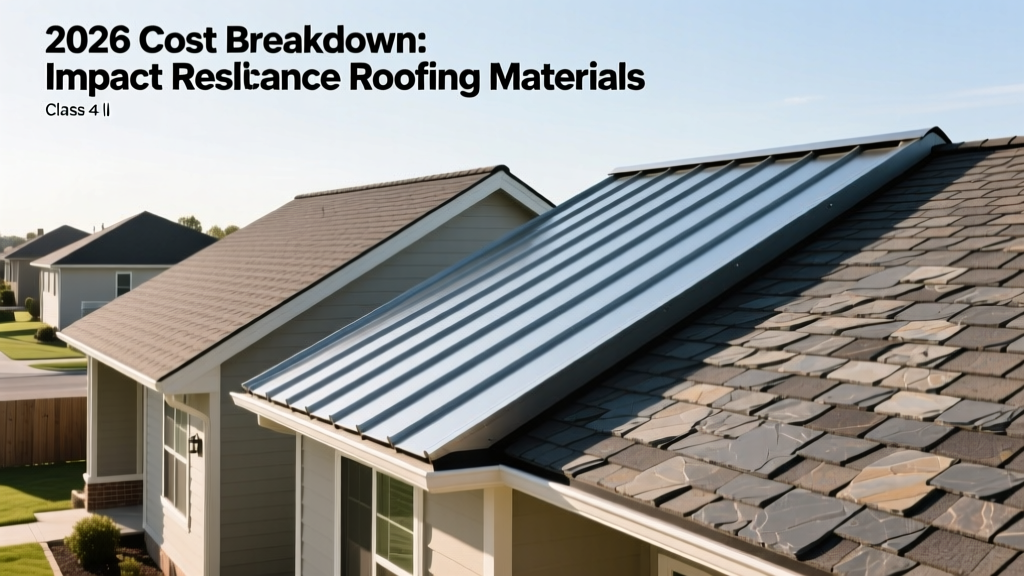
The Real Cost of Hail and Wind Damage
Severe convective storms cause over $18 billion in annual property damage across the United States, with roofing systems taking the brunt of the impact. Standard 3-tab asphalt shingles routinely fracture when subjected to 1-inch hail, leading to granule loss, UV degradation, and eventual water intrusion. Upgrading to impact resistant roofing materials is no longer just a niche preference for storm-prone regions; it is a fundamental structural investment. However, the premium associated with these materials requires a precise financial analysis to justify the upfront capital.
This 2026 cost breakdown dissects the material expenses, installation variables, and long-term insurance dividends of Class 4 and FM 4473 rated roofing systems, providing exact pricing and product specifications to guide your procurement strategy.
Decoding the Standards: UL 2218 vs. FM 4473
Before evaluating costs, it is critical to understand what you are paying for. The term 'impact resistant' is heavily regulated by two distinct testing methodologies:
- UL 2218 Class 4: A 2-inch steel ball is dropped from a height of 20 feet onto the roofing material in multiple locations. The material passes Class 4 if it exhibits no cracking, splitting, or tearing. This primarily tests blunt-force kinetic energy.
- FM 4473 Class 4: A 2x2-inch ice ball is fired from a cannon at 76 mph. This standard, governed by FM Approvals, simulates the actual aerodynamic and thermal shock of wind-driven hail, providing a more rigorous real-world simulation.
2026 Material Cost Matrix: Impact Resistant Systems
The following table outlines the current market pricing for impact resistant roofing materials, encompassing both material-only costs and fully installed pricing per roofing square (100 square feet).
| Material Type | Material Cost / Sq | Installed Cost / Sq | Expected Lifespan |
|---|---|---|---|
| Class 4 SBS Asphalt Shingles | $140 - $190 | $480 - $680 | 30 - 40 Years |
| Stone-Coated Steel (Class 4) | $380 - $520 | $950 - $1,450 | 40 - 50+ Years |
| Synthetic Polymer / Rubber | $420 - $650 | $1,100 - $1,700 | 50+ Years |
| Standing Seam Metal (24ga) | $450 - $700 | $1,200 - $1,800 | 40 - 60 Years |
Note: Installed costs assume a standard 2,000 sq. ft. roof with a 6/12 pitch. Complex roof geometries (multiple valleys, dormers, steep pitches over 9/12) will increase labor costs by 15% to 30%.
Deep Dive: Specific Products and Material Nuances
1. SBS Modified Asphalt Shingles
Standard architectural shingles use oxidized asphalt, which becomes brittle in cold weather and shatters upon hail impact. Impact resistant asphalt shingles are modified with SBS (Styrene-Butadiene-Styrene), a rubberized polymer that allows the shingle to absorb kinetic energy and rebound without fracturing.
- Owens Corning Duration® FLEX: Features a continuous SBS modified asphalt layer. Priced around $165 per square (material). Excellent for retrofits where budget is a primary constraint but Class 4 certification is required for insurance.
- Malarkey Vista® AR: Incorporates upcycled rubber polymers and 3M smog-reducing granules. Material costs hover near $185 per square. Offers superior flexibility in sub-zero temperatures compared to competitor models.
2. Stone-Coated Metal Roofing
For homeowners seeking the aesthetic of clay tile or wood shake with the resilience of steel, stone-coated metal is the optimal middle ground. These systems utilize a 26-gauge Galvalume® steel core, coated with an acrylic primer and embedded with basalt stone granules.
- DECRA Shake XD: Engineered to meet FM 4473 Class 4 and Miami-Dade NOA high-velocity hurricane zone (HVHZ) standards. The interlocking panels prevent wind uplift, while the stone coating dampens the acoustic resonance typically associated with bare metal roofs during rainstorms.
3. Synthetic Polymer and Recycled Rubber
Synthetic roofing represents the highest tier of impact resistance. These materials do not merely resist hail; they are virtually impervious to it.
- Euroshield® Rubber Roofing: Manufactured from 95% recycled materials (primarily post-consumer vehicle tires). A 2-inch hail strike will bounce off without leaving a mark. Material cost is approximately $450 per square. The heavy weight (up to 450 lbs per square) requires verification of the underlying roof truss load-bearing capacity.
- DaVinci Roofscapes Multi-Width Slate: A high-end polymer composite that mimics natural slate. Priced at $600+ per square (material), it is heavily favored in luxury residential builds and historic district retrofits where natural slate is too fragile or heavy.
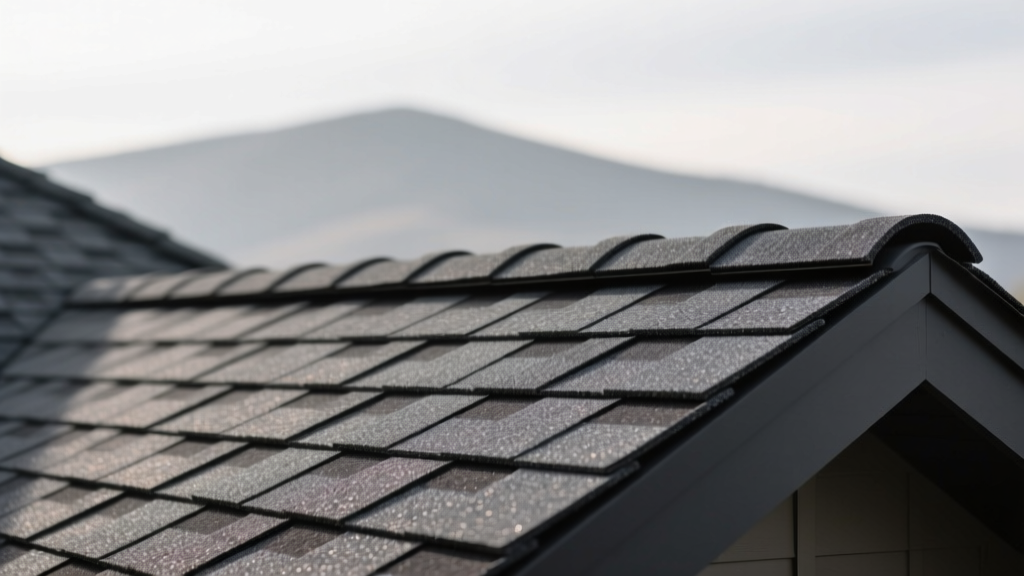
Hidden Installation Costs and Edge Cases
Budgeting for impact resistant roofing materials requires looking beyond the shingles or panels themselves. Upgrading the roof covering without upgrading the substrate often leads to catastrophic failure during severe weather events.
Installing Class 4 shingles with standard smooth-shank nails voids most high-wind warranties and compromises impact performance. You must specify 11-gauge or 12-gauge hot-dipped galvanized ring-shank roofing nails. Ring-shank nails provide up to 300% greater withdrawal resistance than smooth-shank nails. Expect a minor material upcharge of $15-$25 per square, but it is non-negotiable for system integrity.
Decking and Underlayment Upgrades:
- Solid Decking Replacement: If your existing roof utilizes skip sheathing (spaced boards), it must be replaced with solid 5/8-inch CDX plywood or OSB to support the weight of synthetic or stone-coated metal systems. Budget an additional $250 to $350 per square for decking replacement.
- Synthetic Underlayment & Ice/Water Shield: To achieve the IBHS FORTIFIED Home™ designation—which unlocks the highest tier of insurance discounts—you must seal the roof deck. This requires applying a self-adhering polymer-modified bitumen membrane (Ice & Water Shield) over the entire deck, not just the eaves and valleys. This adds $1.20 to $1.80 per square foot to the underlayment budget.
The Insurance Dividend: Calculating the ROI
The primary financial offset for impact resistant roofing materials is the reduction in homeowners insurance premiums. According to data from the Federal Emergency Management Agency (FEMA) and regional insurance underwriters, homes with verified Class 4 or FORTIFIED roofs qualify for premium discounts ranging from 15% to 35%, depending on the state and carrier.
ROI Payback Scenario
Consider a 2,500 sq. ft. home in Denver, Colorado (a high-hail risk zone).
- Standard Architectural Roof Cost: $11,000
- Class 4 SBS Asphalt Roof Cost: $14,500 (Upfront premium: $3,500)
- Annual Homeowners Premium: $4,200
- Class 4 Insurance Discount (25%): $1,050 saved annually
Payback Period: The $3,500 premium is recouped in 3.3 years through insurance savings alone. Given that the SBS shingles will last 30+ years, the net lifetime savings exceed $25,000, completely eclipsing the initial material upgrade cost.
Decision Framework: Selecting Your Impact Resistant System
Use the following matrix to determine the most cost-effective impact resistant roofing material for your specific scenario:
| Your Scenario | Recommended Material | Why? |
|---|---|---|
| Budget-conscious; planning to sell in 5-10 years; moderate hail risk. | Class 4 SBS Asphalt (e.g., Owens Corning FLEX) | Lowest upfront premium; immediate insurance ROI; highly recognizable to home appraisers. |
| Forever home; severe hail/wind corridor; complex roof geometry. | Stone-Coated Steel (e.g., DECRA) | Interlocking panels prevent wind uplift; FM 4473 rating survives golf-ball-sized hail; lifetime material warranty. |
| Luxury build; historic aesthetic requirements; extreme temperature swings. | Synthetic Polymer (e.g., DaVinci Slate) | Zero water absorption prevents freeze-thaw spalling; authentic visual profile; highest impact resistance rating. |
Investing in impact resistant roofing materials is a quantifiable risk-mitigation strategy. By aligning the specific material properties—such as SBS modification or Galvalume steel cores—with your regional climate data and insurance carrier requirements, you transform the roof from a vulnerable liability into a resilient, yield-generating asset.
Written by
Marcus ChenMarcus Chen is a licensed structural engineer (PE) and building materials analyst with over 12 years of experience across residential, commercial, and industrial construction. He holds a Master of Science in Civil Engineering from UC Berkeley and spent six years at Thornton Tomasetti before transitioning to independent consulting and technical writing. Marcus specializes in material selection for seismic-prone regions, concrete reinforcement strategies, and lifecycle cost analysis. His work has been cited by the American Concrete Institute (ACI) and the Structural Engineers Association of California (SEAOC). When he is not on a job site or at his desk, you will find him hiking the Sierra Nevada or restoring a 1920s craftsman bungalow in Oakland, CA.
More from Marcus Chen
View all
Construction Cost
How Much Did the Eiffel Tower Cost to Build?
How much did the Eiffel Tower cost to build in 1889? We adjust for inflation and compare its budget to modern skyscraper construction.
Aug 4, 2026

Fire Resistance
What Is a Fire Resistant Material? Testing & Certification Guide
Discover what is a fire resistant material through ASTM and UL testing. Learn how fire ratings, certifications, and assemblies work in construction.
Aug 4, 2026

Construction Cost
How Much Did the Burj Khalifa Cost to Build?
How much did the Burj Khalifa cost to build? We break down the $1.5B project and extract 5 money-saving strategies for your next build.
Jul 30, 2026