Top Roof Ventilation Brands: Cor-A-Vent vs Lomanco 2026
Compare Cor-A-Vent and Lomanco ridge vents for 2026. Deep dive into NFA ratings, polymer vs. baffled designs, pricing, and IRC code compliance.
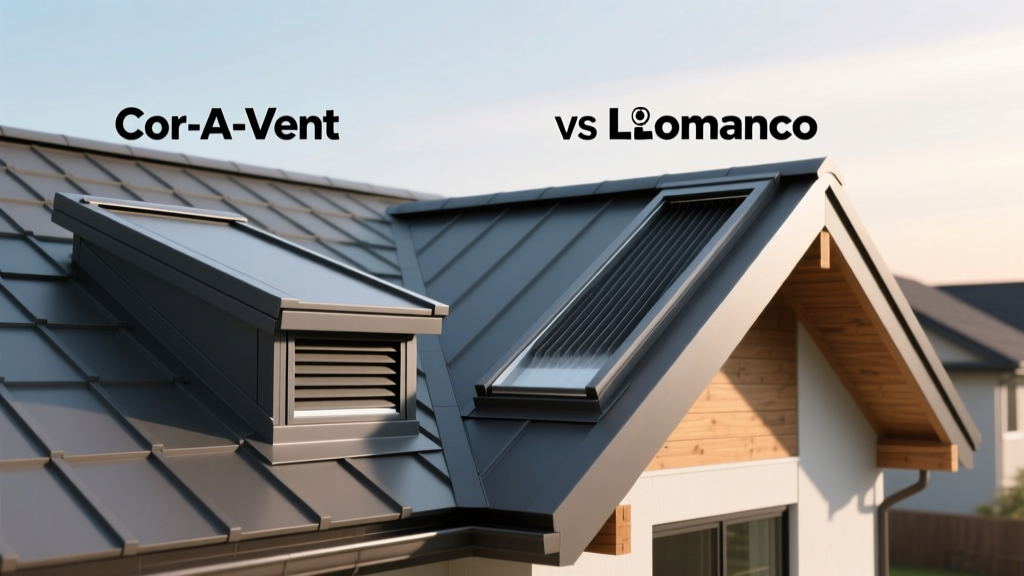
The Physics of Exhaust: Why Ridge Vent Selection Dictates Roof Lifespan
Modern roof ventilation relies on a continuous, balanced system to mitigate thermal shock, prevent ice damming, and extend asphalt shingle lifespans. While soffit vents handle intake, the exhaust mechanism at the roof peak is where system failures most frequently occur. Static box vents and turbines create localized exhaust points that leave dead air zones. Continuous ridge vents solve this by leveraging the entire peak length, but not all ridge vents perform equally under extreme weather conditions.
According to the U.S. Department of Energy, proper attic ventilation reduces cooling loads by up to 15% in summer and prevents moisture condensation that degrades roof decking in winter. When selecting a continuous ridge vent, contractors and homeowners are generally choosing between two dominant engineering philosophies: the crush-proof polymer matrix (championed by Cor-A-Vent) and the external aerodynamic baffle (pioneered by Lomanco). This deep-dive analyzes the flagship models from both brands to determine which system fits specific pitch, climate, and architectural requirements.
Brand Showdown: Cor-A-Vent vs. Lomanco Flagship Ridge Vents
Both manufacturers offer products that meet the 20 sq. inches of Net Free Area (NFA) per linear foot required to balance standard soffit intake ratios. However, their material composition and wind-rain filtration mechanisms differ drastically.
| Feature | Cor-A-Vent RV-20 Roll Vent | Lomanco ShingleVent II (SV-20) |
|---|---|---|
| Core Material | Extruded Polypropylene Polymer | Rigid High-Density Polyethylene |
| Filtration Design | Internal woven mesh / matrix | External aerodynamic baffle |
| NFA Rating | 20 sq. in. per linear ft. | 20 sq. in. per linear ft. |
| Crush Resistance | Exceptional (supports roofer foot traffic) | Moderate (can deform under heavy point loads) |
| Snow Infiltration | High resistance (tight mesh matrix) | Moderate (baffle deflects, but fine snow can enter) |
| Avg. 2026 Cost (20ft roll) | $52.00 - $58.00 | $40.00 - $46.00 |
Cor-A-Vent RV-20: The Polymer Matrix Pioneer
Cor-A-Vent’s RV-20 Roll Vent utilizes a corrugated polypropylene matrix. Instead of relying on an external plastic fin to block weather, the vent itself is a dense, porous web. Air passes through the microscopic gaps in the polymer, while wind-driven rain and snow are trapped on the outer surface and evaporate or shed down the roof slope.
Pros:
- Superior snow filtration for alpine and heavy-lake-effect snow regions.
- Crush-proof design prevents accidental airflow blockage during installation.
- Flexible roll conforms easily to curved ridges, hips, and architectural transitions.
Cons:
- Higher material cost per linear foot.
- Dust and pollen accumulation inside the matrix can reduce NFA by 10-15% over a decade in arid, dusty climates.
Lomanco ShingleVent II: The Baffled Benchmark
Lomanco approaches roof ventilation through aerodynamics. The ShingleVent II features an external, integrated plastic baffle that rises above the roof plane. Based on the Bernoulli principle, wind striking the baffle creates a zone of negative pressure (uplift) directly over the vent slot, actively pulling hot air out of the attic rather than relying solely on passive thermal buoyancy.
Pros:
- Active wind-driven exhaust lowers attic temperatures faster than passive matrix vents.
- Lower material cost makes it the preferred choice for large-scale production builders.
- Smooth exterior surface prevents debris and pollen accumulation.
Cons:
- External baffle can be vulnerable to snapping if struck by heavy tree branches or ladder impacts.
- Less effective at filtering fine, dry powder snow compared to a dense polymer matrix.
Net Free Area (NFA) Calculations: Sizing for Current Building Codes
Sizing your roof ventilation system incorrectly is the leading cause of premature shingle curling and interior moisture damage. The International Residential Code (IRC) Section R806 mandates a minimum ventilation ratio.
IRC R806.2 Standard: The minimum net free ventilating area shall be 1/150 of the area of the space ventilated. This ratio is reduced to 1/300 if at least 40% to 50% of the ventilating area is located in the upper portion of the attic (ridge), with the remainder at the soffit, and a Class I or II vapor retarder is installed.
To calculate the exact ridge vent length required for a balanced 1/300 system, follow this framework:
- Calculate Attic Square Footage: Measure the length and width of the attic floor (e.g., 40 ft x 30 ft = 1,200 sq. ft.).
- Determine Total NFA Required (1/300 Rule): 1,200 sq. ft. / 300 = 4 sq. ft. of total NFA.
- Convert to Square Inches: 4 sq. ft. x 144 = 576 sq. inches of total NFA.
- Split for Balanced System (50/50): 576 / 2 = 288 sq. inches required at the ridge, and 288 sq. inches required at the soffit.
- Calculate Ridge Vent Length: Divide the ridge NFA by the product's rating. For both Cor-A-Vent and Lomanco (20 sq. in. per ft): 288 / 20 = 14.4 linear feet of ridge vent required.
Installation Failure Modes: Where Contractors Lose Warranties
Even the best-engineered ridge vent will fail if the installation deviates from manufacturer specifications. GAF, Owens Corning, and CertainTeed will void their 50-year limited warranties if ventilation is compromised by installation errors. Watch for these specific failure modes:
1. The Continuous Slot vs. Spaced Holes Debate
Both Cor-A-Vent and Lomanco require a continuous 1.5-inch to 2-inch wide slot cut through the roof decking along the entire ridge. Many roofers attempt to save time by drilling spaced 2-inch holes every few feet. This creates localized exhaust points, defeats the purpose of a continuous ridge system, and leaves the decking prone to sagging between the holes. Always use a circular saw set to the exact depth of the OSB or plywood sheathing to cut a continuous slot.
2. Fastener Penetration and Pull-Through
Ridge vents are installed before the cap shingles. The fasteners used to secure the vent must penetrate through the vent flange, through the roof sheathing, and into the roof truss or ridge board. Using standard 1.25-inch roofing nails will result in pull-through under high wind uplift. Specify 2.5-inch to 3-inch hot-dipped galvanized ring-shank nails, spaced exactly 12 inches on center along both flanges.
3. Capillary Wicking at the End-Caps
Where the ridge vent terminates at the gable edge, water can wick backward into the vent channel via capillary action. Both brands require specific end-caps or a 2-inch fold-and-seal technique. Failing to seal the terminal ends with a high-grade polyurethane roof sealant (not standard asphalt mastic, which degrades under UV exposure if exposed) leads to localized rot at the gable fascia.
Verdict: Which System Fits Your Roof Pitch and Climate?
The choice between Cor-A-Vent and Lomanco is not about which brand is universally superior, but which engineering solution matches the specific environmental stressors of the building site.
Specify the Cor-A-Vent RV-20 for projects in heavy snow-load regions (e.g., the Mountain West, Great Lakes), on complex roofs with multiple hips and valleys requiring the roll to bend sharply, or on steep pitches where foot traffic during installation is unavoidable. The premium cost is offset by the elimination of snow-infiltration callbacks and crushed-vent replacements.
Specify the Lomanco ShingleVent II for high-wind coastal zones, hot-humid climates where maximizing active thermal exhaust is the priority, and large-tract production builds where material cost efficiency and rapid installation drive the bottom line. The external baffle provides superior wind-driven exhaust performance, keeping attic spaces closer to ambient outdoor temperatures during peak summer months.