2026 Cost Breakdown: DIY Flat Roof Repair Materials & Pricing
Discover the true cost of DIY flat roof repair materials in 2026. Compare EPDM, TPO, modified bitumen, and liquid rubber pricing for your next project.

The True Economics of Low-Slope Roof Repair
Repairing a low-slope or flat roof (defined as having a pitch of 3:12 or less) requires entirely different material science than steep-slope shingling. Water does not shed quickly; it ponds, searches for micro-fissures, and exploits thermal expansion joints. For the DIYer, the market offers a spectrum of repair materials ranging from localized seam tapes to full-coverage liquid membranes. Understanding the exact cost per square foot, coverage rates, and substrate compatibility is critical to avoiding catastrophic material failures. This breakdown details the 2026 market rates for DIY flat roof repair materials, isolating material costs from professional labor.
Material Cost Matrix: 2026 Market Rates
The following matrix compares the primary material categories used in flat roof repair. Costs reflect material-only pricing for standard residential or light-commercial applications, excluding substrate preparation supplies.
| Material Type | Cost per Sq Ft | Best Application | DIY Difficulty | Expected Lifespan |
|---|---|---|---|---|
| Acrylic Elastomeric | $0.40 - $0.70 | Sunny climates, sloped flats | 2 / 5 | 5 - 10 Years |
| 100% Silicone | $1.10 - $1.80 | Ponding water, high UV | 3 / 5 | 15 - 20 Years |
| EPDM Peel-and-Stick | $1.50 - $2.20 | Punctures, localized tears | 2 / 5 | 10 - 15 Years |
| Mod-Bit Torch-Down | $1.20 - $1.90 | Heavy traffic, cold climates | 5 / 5 | 15 - 20 Years |
| Butyl Seam Tape | $0.25 - $0.40 / lin ft | Seam failures, flashing | 1 / 5 | 10+ Years |
Liquid Membranes: Silicone vs. Acrylic Pricing
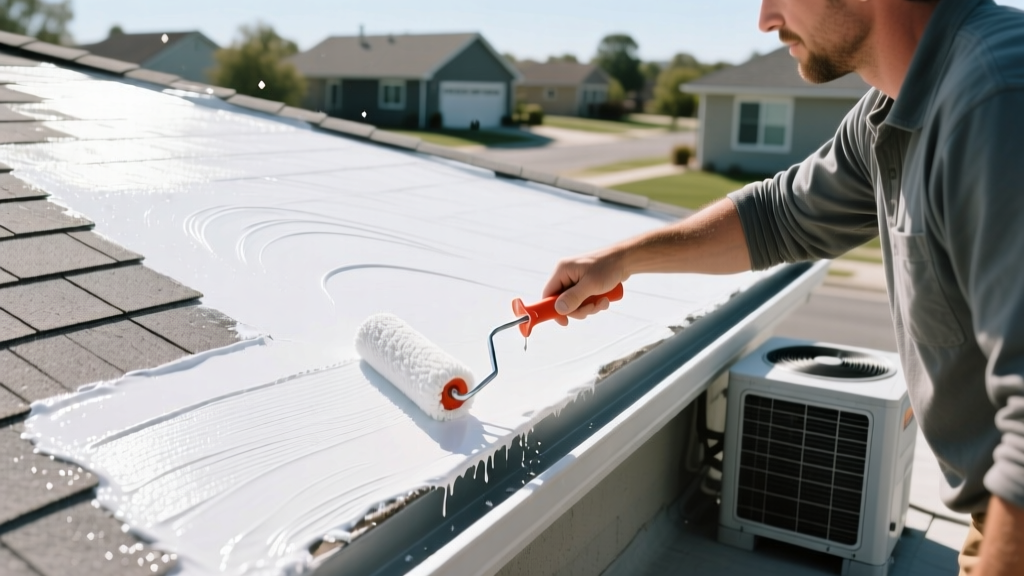
Liquid-applied membranes are the most common DIY choice for full-surface flat roof restoration because they eliminate the need for hot asphalt kettles or open-flame torches. However, the chemical composition dictates both the price and the performance envelope.
100% Silicone Coatings
Silicone is the premium standard for flat roofs that experience ponding water. Unlike water-based coatings, silicone will not re-emulsify or degrade when submerged. A standard 5-gallon pail of high-solids silicone (such as GacoRoof 100% Silicone) costs between $320 and $380 in 2026. At a required application rate of 20 to 24 wet mils, one pail covers approximately 250 square feet. This translates to a material cost of roughly $1.35 per square foot. Silicone requires only a single coat, which offsets its higher upfront pail price by reducing labor and secondary material purchases.
Acrylic Elastomeric Coatings
Acrylics (like Henry 587 White Elastomeric) are water-based, highly reflective, and significantly cheaper. A 5-gallon pail typically costs $140 to $180, covering about 250 square feet per coat. However, acrylics require a minimum of two coats to achieve the necessary dry mil thickness, pushing the effective material cost to $1.10 - $1.45 per square foot. According to the U.S. Department of Energy's Cool Roofs guide, highly reflective white acrylics can reduce peak cooling demand by 10% to 15%. The critical limitation: acrylics will break down if water ponds for more than 48 hours, making them unsuitable for perfectly flat roofs with poor drainage.
Seam and Patch Repair: Tape and Mastic Costs
If your flat roof is structurally sound but leaking at the seams or flashing, a full coating is unnecessary. Targeted patching utilizes specialized tapes and mastics.
- Butyl Rubber Tape: Products like Eternabond (4-inch by 50-foot rolls) cost approximately $55 to $65 per roll. This yields a linear foot cost of $1.10 to $1.30. Butyl tape features a pressure-sensitive adhesive that bonds to EPDM, TPO, and metal, but it requires aggressive surface cleaning and firm roller pressure to activate.
- EPDM Patch Kits: For larger tears in rubber roofs, uncured EPDM flashing tape (e.g., Carlisle Sure-Seal) costs about $3.50 per square foot. This material requires a specialized EPDM primer (roughly $45 per quart) that must flash off completely before the patch is applied.
- Polyurethane Sealants: For terminating edges and pipe penetrations, a 10.1 oz tube of high-grade polyurethane roofing sealant (like Loctite PL Roof & Flashing) costs $8 to $12. One tube covers roughly 12 linear feet of a 1/2-inch bead.
Substrate Preparation and Hidden Accessory Costs
The most frequent cause of DIY roof coating failure is inadequate substrate preparation. Liquid membranes will not adhere to chalky, oxidized, or dirty surfaces. Budgeting for preparation materials is mandatory.
| Prep Item | Estimated Cost | Purpose |
|---|---|---|
| TSP (Trisodium Phosphate) | $15 - $25 / box | Cutting grease, dirt, and oxidation |
| Power Washer Rental | $45 - $75 / day | Removing loose granules and chalk |
| 3/4-inch Nap Rollers (3-pack) | $25 - $35 | Applying thick liquid coatings evenly |
| Heavy-Duty Extension Pole | $30 - $50 | Reaching across roofs safely |
| Seam Roller (Wooden or Steel) | $15 - $25 | Pressing tape into seams to remove air |
| Acrylic/Silicone Primer | $120 - $180 / 5 gal | Sealing porous concrete or aged asphalt |
For a standard 1,000 square foot roof, expect to spend an additional $150 to $250 on preparation and application tools. Skipping the primer on porous or heavily oxidized substrates will result in the topcoat peeling within the first freeze-thaw cycle.
Calculating Your Exact Material Footprint
To prevent mid-project shortages, use this precise calculation framework for liquid coatings:
- Calculate Gross Area: Measure length and width of the roof plane. Add 5% for parapet walls and flashing turn-ups.
- Determine Mil Requirement: Check the manufacturer's Technical Data Sheet (TDS). If the product requires 20 dry mils, and the volume solids is 80%, you must apply 25 wet mils.
- Calculate Gallons Needed: 1 gallon covers 1604 square feet at 1 mil thick. Divide 1604 by your target wet mil thickness to find coverage per gallon. (e.g., 1604 / 25 = 64.1 sq ft per gallon).
- Final Pail Count: Divide your gross area by the coverage per gallon, then add 10% for waste, spillage, and uneven application. Divide by 5 to get the number of 5-gallon pails to order.
When sourcing materials, cross-reference your selected products with the EPA Energy Star certified roof products database to ensure the coating meets the solar reflectance index (SRI) requirements for your climate zone, which can qualify you for local utility rebates.
Fatal DIY Mistakes That Destroy Material ROI
Buying premium materials is pointless if the installation violates basic building science. Avoid these three high-cost errors:
1. Trapping Moisture Under the Membrane
If your existing flat roof has wet insulation or trapped moisture, applying a liquid coating or peel-and-stick membrane will seal the water inside. When the sun heats the roof, the trapped water turns to vapor, creating massive blisters that rupture the new membrane. Use a moisture meter or perform a core cut to verify the substrate is bone dry before spending a dollar on topcoat materials.
2. Ignoring Thermal Expansion Joints
Flat roofs on large buildings expand and contract significantly with temperature swings. If you bridge an expansion joint with a rigid mastic or standard seam tape, the movement will tear the repair apart within one season. You must purchase specialized expansion joint covers or high-movement polyurethane sealants, which cost roughly $25 to $40 per linear foot, to accommodate this structural reality.
3. Applying Silicone Over Chalking Acrylic
If you are repairing an older acrylic-coated roof, you cannot apply silicone directly over it if the acrylic is chalking or failing. Silicone will bond to the chalk, not the roof, and peel off in sheets. You must either power-wash and scrub the roof down to the base substrate or apply a specialized tie-coat primer (adding $0.20 per square foot to your material budget) to bridge the chemistry gap.
Written by
Marcus ChenMarcus Chen is a licensed structural engineer (PE) and building materials analyst with over 12 years of experience across residential, commercial, and industrial construction. He holds a Master of Science in Civil Engineering from UC Berkeley and spent six years at Thornton Tomasetti before transitioning to independent consulting and technical writing. Marcus specializes in material selection for seismic-prone regions, concrete reinforcement strategies, and lifecycle cost analysis. His work has been cited by the American Concrete Institute (ACI) and the Structural Engineers Association of California (SEAOC). When he is not on a job site or at his desk, you will find him hiking the Sierra Nevada or restoring a 1920s craftsman bungalow in Oakland, CA.
More from Marcus Chen
View all
Construction Cost
How Much Did the Eiffel Tower Cost to Build?
How much did the Eiffel Tower cost to build in 1889? We adjust for inflation and compare its budget to modern skyscraper construction.
Aug 4, 2026

Fire Resistance
What Is a Fire Resistant Material? Testing & Certification Guide
Discover what is a fire resistant material through ASTM and UL testing. Learn how fire ratings, certifications, and assemblies work in construction.
Aug 4, 2026

Construction Cost
How Much Did the Burj Khalifa Cost to Build?
How much did the Burj Khalifa cost to build? We break down the $1.5B project and extract 5 money-saving strategies for your next build.
Jul 30, 2026