Roofing Underlayment Materials: The Pro Selection Framework
Master roof deck protection. This selection framework compares synthetic, felt, and rubberized roofing underlayment materials by climate, slope, and cost.

The Diagnostic Triad: Pitch, Climate, and Cladding
Selecting the correct roofing underlayment materials is not a matter of picking the cheapest roll on the supplier's shelf. It requires a systematic evaluation of three variables: roof pitch, regional climate severity, and the primary roof cladding (asphalt shingles, standing seam metal, or heavy tile). The underlayment serves as the secondary water barrier and the primary defense against wind-driven rain, ice damming, and construction-phase moisture intrusion. As of 2026, building codes and insurance standards—such as the IBHS FORTIFIED Roof standard—have drastically narrowed the acceptable use cases for legacy materials, pushing the industry toward high-performance synthetics and specialized self-adhered membranes.
Before selecting a product, contractors and architects must answer three diagnostic questions:
- What is the absolute minimum pitch? Roofs below 2:12 require fully adhered systems, while 2:12 to 4:12 pitches mandate double-layer protection or specialized ice barriers.
- What is the thermal load of the cladding? Unventilated standing seam metal roofs can reach surface temperatures exceeding 200°F, which will melt and degrade standard asphalt-based underlayments.
- What is the maximum UV exposure timeline? Construction delays dictate whether a 30-day UV-rated synthetic is sufficient, or if a 6-month UV-stabilized premium membrane is required.
The Underlayment Selection Matrix
Use the following decision matrix to map your specific project parameters to the correct category of roofing underlayment materials. This framework prevents the common error of over-engineering low-risk areas while under-protecting critical vulnerability zones.
| Roof Zone / Condition | Pitch / Scenario | Recommended Material Category | Specific Product Benchmark |
|---|---|---|---|
| Eaves, Valleys, Penetrations | First 3-6 feet from edge; all valleys | Self-Adhered Rubberized (Ice & Water) | Grace Ice & Water Shield |
| Standard Field (Asphalt Shingles) | 4:12 or greater; moderate climate | Woven Synthetic (Standard Traction) | Tyvek Protec 120 |
| High-Wind / HVHZ Field | 4:12 or greater; hurricane zones | Heavyweight Synthetic + Cap Nails | GAF TigerPaw or Owens Corning ProArmor |
| Low Slope Field | 2:12 to 4:12 pitch | Double-Layer Synthetic or Fully Adhered | Double layer of synthetic with cap nails |
| Metal Roof Deck (Unventilated) | Any pitch; direct-to-deck metal panels | High-Temp Self-Adhered (Film Surface) | Grace Ice & Water Shield HT |
Tier 1: Asphalt-Saturated Felt (The Legacy Baseline)
Often referred to as "tar paper" or "felt paper," asphalt-saturated organic or fiberglass felts (typically #15 or #30) were the industry standard for decades. Today, they are relegated to budget-conscious projects or specific historic restorations. #15 felt is approximately 0.015 inches thick, while #30 is roughly double that thickness.
Felt is highly hygroscopic. When exposed to morning dew or rain during construction, it absorbs moisture, expands, and wrinkles. When the sun dries it out, it shrinks. This expansion/contraction cycle can cause "decking telegraphing," where the wrinkles push up through asphalt shingles, creating visible ridges and compromising the aesthetic and wind-resistance of the final roof.
When to use it: Only when local building codes explicitly permit it for standard 4:12+ pitches on budget projects, or when working with certain wood shake applications that require the vapor-permeable characteristics of traditional felt.
Cost: $0.15 to $0.25 per square foot (material only).
Tier 2: Woven Synthetic (The Modern Standard)
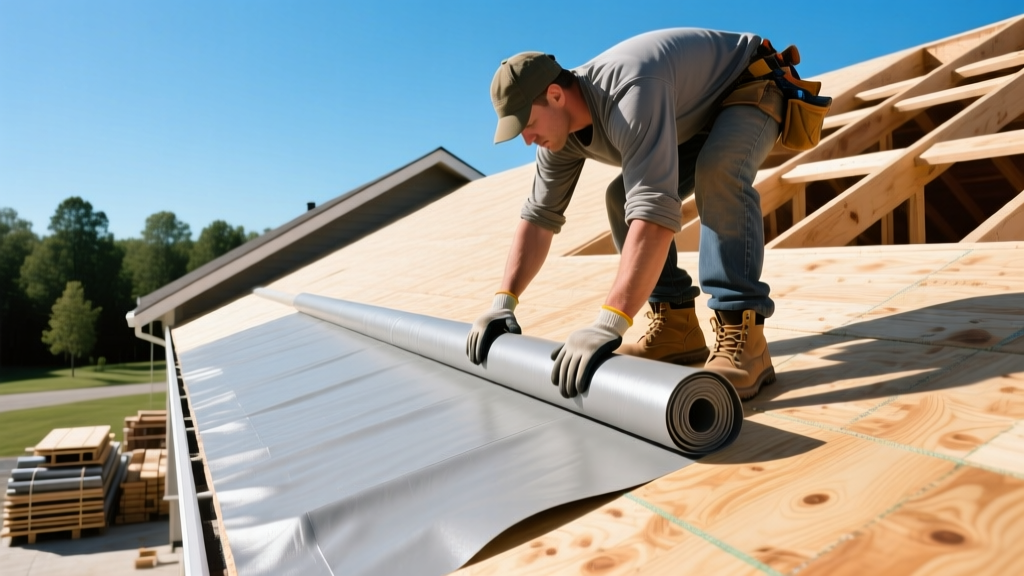
Synthetic underlayments are constructed from woven polypropylene or polyethylene fabrics, coated with slip-resistant polymers. They offer superior tear strength (often exceeding ASTM D412 standards by 400% compared to felt), zero moisture absorption, and enhanced UV stability.
The primary differentiator among synthetic roofing underlayment materials is surface traction and UV longevity. Standard synthetics (like Tyvek Protec 120) feature a textured coating that provides a slip-resistant walkable surface, crucial for steep-pitch safety. Premium variants (like GAF TigerPaw) integrate advanced grip matrices and UV stabilizers that allow the material to remain exposed to sunlight for up to six months without degrading—a critical feature for large commercial projects or custom homes prone to construction delays.
Synthetic Selection Criteria
- Tear Resistance: Look for products that boast a minimum 25 lbf tear strength in both machine and cross directions.
- Walkability: Ensure the product has a tested coefficient of friction suitable for pitches up to 10:12. Uncoated "slippery" synthetics are a severe safety hazard on steep roofs.
- UV Exposure Rating: Verify the manufacturer's stated UV exposure limit. Standard is 30-60 days; premium is 120-180 days.
Cost: $0.20 to $0.45 per square foot, depending on UV rating and traction technology.
Tier 3: Self-Adhered Rubberized Membranes (The Critical Armor)
Self-adhered membranes, commonly known as "ice and water shield," consist of a rubberized asphalt adhesive (usually SBS-modified bitumen) backed by a polyethylene film or mineral granule surface. According to the DOE Building America Solution Center, these membranes are non-negotiable in climates prone to ice damming, as they seal around fastener penetrations and prevent capillary water migration.
Granular vs. Film Surface: The Cladding Rule
The surface of the membrane must be matched to the primary roof cladding:
- Granular Surface: Designed for asphalt shingles. The granules provide traction for roofers and prevent the shingles from adhering permanently to the underlayment, allowing for future tear-offs.
- Film Surface (Smooth): Mandatory for metal roofs and slate. Granular surfaces will scratch the back of metal panels during thermal expansion/contraction and can trap moisture against the metal, accelerating corrosion.
Standard SBS-modified ice and water shields begin to soften and lose adhesion at temperatures around 140°F to 160°F. Unventilated standing seam metal roofs in southern climates routinely exceed 200°F. You must specify a High-Temp (HT) variant, such as Grace Ice & Water Shield HT, which utilizes specialized release films and modified asphalt blends rated to withstand 240°F without liquefying or bleeding out from under the metal seams.
Cost: $0.85 to $1.60 per square foot. Due to the cost, it is strategically applied only to the first 3 to 6 feet of the eaves, all valleys, dormers, and around penetrations (chimneys, skylights, vent pipes).
2026 Cost & ROI Analysis
While material costs vary, the true financial impact of roofing underlayment materials is found in the labor and risk-mitigation ROI. Upgrading from felt to synthetic adds roughly $150 to $250 to the total material cost of an average 2,500 sq. ft. residential roof, but it drastically reduces the risk of tear-outs, wrinkles, and warranty voids from the primary shingle manufacturer.
| Material Type | Material Cost (per sq ft) | Fastener Cost (per sq ft) | Total System Cost (per sq ft) | Expected Lifespan / UV Limit |
|---|---|---|---|---|
| #15 Asphalt Felt | $0.15 | $0.02 (Staples) | $0.17 | Degrades rapidly when wet; 0 days UV |
| #30 Asphalt Felt | $0.25 | $0.02 (Staples) | $0.27 | Moderate wrinkle risk; 0 days UV |
| Standard Synthetic | $0.22 | $0.05 (Cap Nails) | $0.27 | 50+ years deck protection; 60 days UV |
| Premium Synthetic | $0.40 | $0.05 (Cap Nails) | $0.45 | 50+ years deck protection; 180 days UV |
| Standard Ice & Water | $0.95 | $0.00 (Self-Adhered) | $0.95 | Seals around nails; N/A UV (Must cover) |
| High-Temp Ice & Water | $1.45 | $0.00 (Self-Adhered) | $1.45 | Withstands 240°F; N/A UV |
Fastener Protocols and Code-Mandated Edge Cases
The most advanced synthetic underlayment will fail if installed with the wrong fasteners. The transition from felt to synthetic requires a mandatory shift in fastening technology.
The Death of the Staple
Staples are acceptable for organic felt because the asphalt saturation helps seal the small puncture. However, driving a staple through woven polypropylene creates a "slice" that cannot self-seal. Under wind uplift, water will track directly through these unsealed slices into the OSB or plywood decking. Furthermore, staples provide negligible pull-through resistance on synthetic materials.
The Cap Nail Mandate
Modern best practices and high-wind building codes require the use of plastic cap nails (typically featuring a 1-inch diameter plastic cap and an 11-gauge steel shank). The wide cap compresses the synthetic material, creating a mechanical seal that prevents water intrusion and dramatically increases the wind-uplift resistance of the underlayment. In High-Velocity Hurricane Zones (HVHZ) like Miami-Dade County, cap nails are strictly mandated for all field applications of synthetic underlayment.
The "No-Compromise" Eave and Valley Strategy
As detailed in Building Science Corporation's research on ice dams, the eaves and valleys of a roof are the primary failure points for water intrusion. Heat loss from the attic melts snow on the upper roof, which refreezes at the colder eaves, creating an ice dam that forces water back up under the shingles.
To mitigate this, the selection framework dictates a hybrid approach: apply a minimum 36-inch wide strip of self-adhered rubberized membrane at the eaves, extending at least 24 inches past the interior warm wall line. In valleys, the membrane should be centered and extend 18 inches up both sides of the valley centerline. The remainder of the roof field is then covered with a high-traction synthetic underlayment, overlapping the rubberized membrane by a minimum of 6 inches. This hybrid strategy optimizes the budget by restricting the most expensive materials to the highest-risk zones while maintaining maximum tear strength and UV protection across the main roof field.
Written by
David NakamuraDavid Nakamura is a licensed architect (AIA) and construction technology writer focused on sustainable building methods, mass timber engineering, and high-performance building envelopes. He holds a Master of Architecture from the University of Washington and is a certified Passive House Consultant (CPHC). David spent eight years at the Seattle firm Mithun, where he led the design of three LEED Platinum projects, before founding his own practice specializing in net-zero residential design. He serves on the editorial advisory board of GreenBuilder Magazine and has authored peer-reviewed papers on cross-laminated timber (CLT) connections for the Journal of Structural Engineering. In his spare time, David teaches woodworking at Pratt Fine Arts Center and kayaks the Puget Sound.
More from David Nakamura
View all
Construction Cost
Labor Cost to Build a Deck Per Sq Ft: 2026 Installation Guide
Discover the exact labor cost to build a deck per sq ft in 2026. This installation guide breaks down contractor rates, complexity factors, and hidden fees.
Aug 4, 2026

Construction Cost
How Much Does It Cost to Build a 3 Bedroom House? Financing Guide
Learn exactly how much it costs to build a 3 bedroom house and explore 2026 financing options, construction loan types, and budget frameworks for your build.
Aug 4, 2026

Construction Cost
Cost to Build a Tennis Court: 2026 Guide
How much does it cost to build a tennis court in 2026? Breakdowns for asphalt, concrete, and synthetic surfaces plus fencing and lighting.
Jul 30, 2026