GAF Timberline vs Tesla Roof Solar Panels: 2026 Brand Deep Dive
Compare GAF Timberline Solar and Tesla roof solar panels. Our 2026 deep dive covers costs, wattage, installation, and durability for your home.
The Evolution of Building-Integrated Photovoltaics
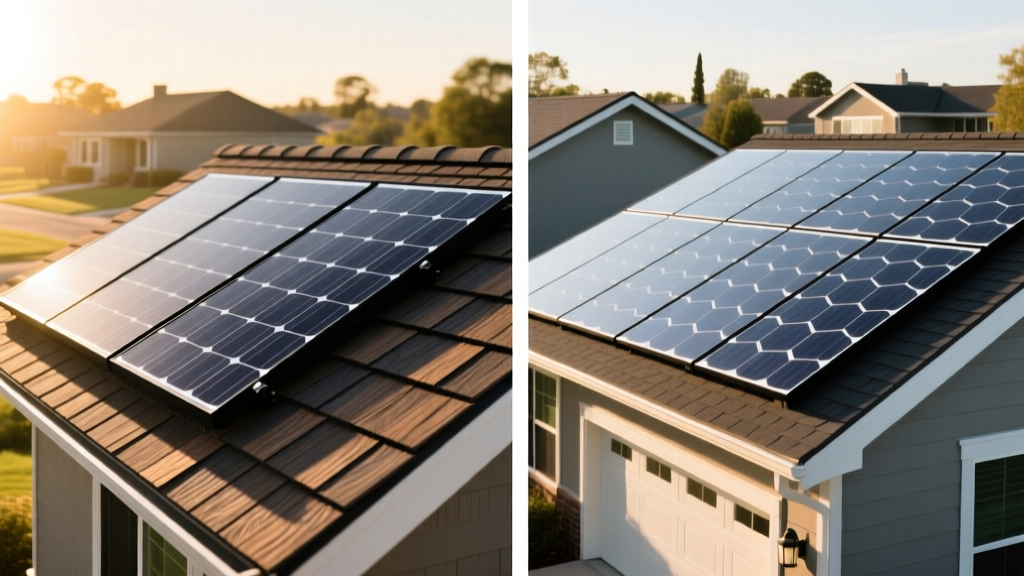
The market for roof solar panels has fundamentally shifted from bolted-on aluminum racks to seamless building-integrated photovoltaics (BIPV). According to the U.S. Department of Energy, BIPV systems now serve as both the primary weather barrier and the power generation source, eliminating the redundant material costs of a traditional roof replacement combined with a retrofitted solar array. In 2026, two distinct engineering philosophies dominate the residential integrated solar space: GAF’s hybrid asphalt approach and Tesla’s full-glass tile replacement. This deep dive dissects the technical specifications, installation realities, and financial metrics of both systems to help contractors and homeowners make an informed decision.
GAF Timberline Solar: The Roofer-Centric Hybrid
GAF approached the integrated solar market by leveraging its dominance in asphalt shingle manufacturing. The Timberline Solar system does not require a complete roof tear-off if the existing decking is sound, nor does it demand specialized solar roofers for the physical mounting. The system utilizes a nailable solar shingle that integrates directly with standard Timberline HDZ architectural shingles.
Technical Specifications & Shingle Data
| Specification | GAF Timberline Solar Shingle |
|---|---|
| Peak Wattage | 70W per shingle |
| Cell Efficiency | ~20.5% (Monocrystalline PERC) |
| Dimensions | 68.5" x 21.5" (approx. 10.2 sq ft coverage) |
| Weight | ~22 lbs per shingle |
| Wind Rating | ASTM D3161 Class F (110 mph) / Class H (150 mph) |
| Mounting Mechanism | Standard 5/16" hex-head roofing nails |
Tesla Solar Roof V4: The Full-Glass Aesthetic
Tesla’s Solar Roof represents a complete paradigm shift. Rather than integrating solar into asphalt, Tesla replaces the entire roof surface with tempered glass tiles. The V4 iteration features a textured glass surface with micro-louvers designed to hide the underlying solar cells from street-level viewing angles while maximizing photon capture. The system relies on a mix of "active" (power-generating) and "inactive" (dummy) tiles to cover complex roof geometries.
Glass Tile Engineering and Limitations
While the aesthetic appeal of the Tesla Solar Roof is unmatched, the engineering introduces unique failure modes. The interlocking glass tiles require proprietary flashing systems and specialized underlayment. Furthermore, the Lawrence Berkeley National Laboratory's Tracking the Sun report notes that fully integrated glass tile systems carry a significant premium in balance-of-system (BOS) costs due to the complexity of custom fabrication for non-standard roof pitches, valleys, and dormers.
Head-to-Head Matrix: GAF vs. Tesla Roof Solar Panels
| Feature | GAF Timberline Solar | Tesla Solar Roof V4 |
|---|---|---|
| Material Composition | Asphalt/Fiberglass mat with laminated PV | Tempered architectural glass |
| Average Installed Cost (2026) | $3.80 - $4.50 per watt | $5.50 - $7.20 per watt |
| Roof Tear-Off Required? | No (can install over existing 1-layer roof) | Yes (full tear-off to bare deck mandatory) |
| Typical Install Time (10kW) | 3 to 5 days | 10 to 21 days |
| Hail Impact Rating | UL 2218 Class 3 | UL 2218 Class 4 (ANSI FM 4473) |
| Active Coverage Area | Solar applied only to sun-facing planes | Entire roof surface (active + inactive tiles) |
Installation Realities: Decking, Flashing, and Labor
The most significant divergence between these two roof solar panels systems occurs on the job site. Understanding the labor sequence is critical for accurate project scoping.
- Deck Preparation: GAF requires standard 1/2" or 5/8" OSB/plywood decking. If installing over an existing roof, the deck must be inspected for rot, but a full tear-off is avoided. Tesla mandates a complete tear-off to the bare deck, followed by the installation of their proprietary high-temp underlayment and reinforced decking in high-load zones.
- Flashing Integration: GAF utilizes standard step-flashing and woven valley techniques familiar to any journeyman roofer. The solar shingles simply weave into the standard asphalt shingles. Tesla requires custom-machined aluminum flashing pieces that interlock with the glass tiles, demanding specialized training and proprietary sealants.
- Electrical Routing: Both systems utilize microinverters (typically Enphase IQ8 series in 2026) to convert DC to AC at the panel level. However, GAF's flexible wiring harnesses can be routed through standard attic penetrations, whereas Tesla's rigid glass tile system often requires pre-planned conduit chases drilled through the roof deck before the tiles are laid.
Inverter Architecture and Electrical Tie-Ins
Neither GAF nor Tesla utilizes central string inverters for their integrated systems. The reliance on microinverters is a deliberate choice to mitigate the shading losses inherent in complex residential rooflines. A single oak tree shading the bottom left corner of a roof will only reduce the output of the specific 70W GAF shingles or Tesla glass tiles in that zone, rather than dragging down the entire string. For a standard 10kW system, expect to install between 35 and 45 Enphase IQ8+ microinverters, paired with an Enphase Envoy-S communication gateway and an IQ System Controller to ensure rapid shutdown compliance with NEC 2023/2026 Article 690.12.
Financial Breakdown: Cost Per Watt and ROI
When evaluating roof solar panels as a dual-purpose building material, the math must account for the avoided cost of a premium roof replacement.
- GAF Timberline Solar (10kW System): Gross cost ranges from $38,000 to $45,000. After applying the 30% Federal Investment Tax Credit (ITC), the net cost drops to $26,600 - $31,500. Because it replaces the need for a $15,000 premium asphalt roof, the effective solar-only cost is highly competitive.
- Tesla Solar Roof (10kW System): Gross cost ranges from $55,000 to $72,000, heavily dependent on the ratio of active to inactive tiles and roof complexity. Post-ITC, the net cost is $38,500 - $50,400. The ROI timeline extends significantly, often pushing past 12-15 years depending on local utility rates.
Warranty Nuances: What the Fine Print Actually Says
Warranties for integrated systems are bifurcated into weatherization and power generation. GAF offers the Golden Pledge Plus warranty when installed by a Master Elite contractor, covering 100% of material and labor for 25 years, including the solar components. Crucially, GAF's warranty covers the entire roof system as a single entity. Tesla provides a 25-year warranty on the glass tiles for weatherization and a 25-year power generation guarantee (ensuring at least 80% of nameplate output). However, Tesla's warranty explicitly excludes damage from improper attic ventilation, a common issue in older homes that can cause thermal stress fractures in the glass tiles if intake/exhaust ratios are not upgraded prior to installation.
Final Verdict: Selecting the Right Integrated System
For homeowners prioritizing rapid installation, proven asphalt durability, and a faster ROI timeline, GAF Timberline Solar remains the most pragmatic choice in 2026. It leverages existing roofing expertise and minimizes supply chain friction. Conversely, for custom luxury builds, historic renovations where rack-mounted panels are prohibited by HOAs, or homeowners willing to pay a steep premium for a flawless, all-glass aesthetic, the Tesla Solar Roof V4 delivers an unmatched architectural finish. Both systems represent the pinnacle of modern BIPV technology, but they serve fundamentally different buyer profiles and structural requirements.