Metal Roofing Material Cost Per Square: 2026 Pricing Guide
Discover the exact metal roofing material cost per square in 2026. Compare prices for standing seam, corrugated, and stone-coated steel panels.

Defining the Baseline: Metal Roofing Material Cost Per Square
When estimating a roofing project, contractors and suppliers measure in 'squares'—a unit equal to 100 square feet of roof area. Understanding the exact metal roofing material cost per square is critical for accurate budgeting, as prices fluctuate based on alloy surcharges, panel profiles, and protective coatings. In 2026, supply chain stabilizations have leveled out the extreme volatility seen in previous years, but the baseline cost for raw steel and aluminum substrates remains firmly tied to global commodity indexes.
The table below breaks down the material-only costs per square for the most common residential and commercial metal roofing profiles. These figures exclude labor, underlayment, and structural decking modifications.
| Panel Profile | System Type | Typical Gauge | Material Cost Per Square (2026) |
|---|---|---|---|
| Corrugated (7.2 Panel) | Exposed Fastener | 29-Gauge | $130 - $175 |
| R-Panel / Ag Panel | Exposed Fastener | 26-Gauge | $160 - $230 |
| Snap-Lock Standing Seam | Concealed Fastener | 24-Gauge | $290 - $420 |
| Mechanical Lock Standing Seam | Concealed Fastener | 24-Gauge | $360 - $540 |
| Stone-Coated Steel | Concealed/Interlocking | 26-Gauge | $410 - $680 |
The Substrate and Coating Matrix: Where Your Money Actually Goes
The raw metal is only half the equation. The protective coatings applied to the substrate dictate the panel's lifespan, color retention, and ultimate cost. According to the U.S. Department of Energy's guidelines on cool roof coatings, highly reflective pigments not only reduce cooling loads but also require premium resin systems to resist UV degradation over decades.
Substrate Options: Galvalume vs. Aluminum
- Galvalume Steel (ASTM A792): The industry standard for residential roofing. It consists of a steel core coated with an aluminum-zinc alloy (typically AZ50 or AZ55). It offers superior cut-edge protection and costs roughly 20% less than aluminum. Expect to pay $150-$300 per square depending on the profile.
- Aluminum (ASTM B209): Mandatory for coastal properties within 1,500 feet of saltwater to prevent rapid oxidation. Aluminum roofing material costs per square run 30% to 45% higher than steel equivalents due to raw material premiums.
Paint Systems: SMP vs. PVDF (Kynar 500)
Do not compromise on the paint system to save $40 per square. The two dominant coil coating systems are:
- SMP (Silicone Modified Polyester): A budget-friendly option with a hard finish that resists scratching during installation. However, SMP fades and chalks significantly after 10-15 years in high-UV environments. Typical cost adder: $0 (Base price).
- PVDF (Polyvinylidene Fluoride / Kynar 500): A premium resin that maintains color integrity and chalk resistance for 40+ years. PVDF coatings are highly flexible, preventing micro-cracking during the panel forming process. Typical cost adder: $45 - $80 per square.
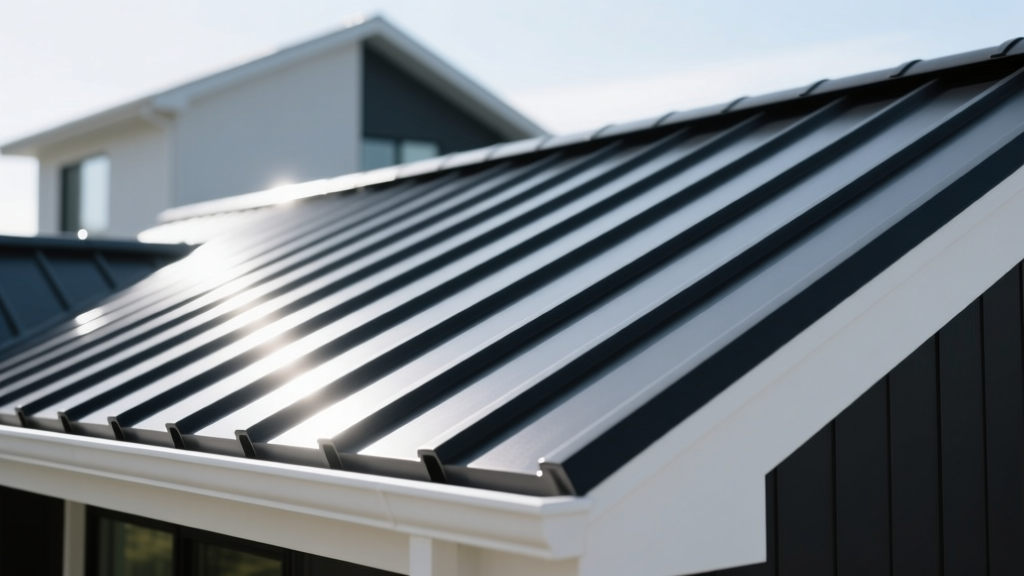
Hidden Material Costs: Trim, Closures, and Fasteners
A common mistake in estimating the metal roofing material cost per square is calculating only the flat field panel area. The accessory packages required to make the roof watertight and structurally sound will add an additional 18% to 25% to your total material invoice.
Essential Accessory Breakdown
- Z-Closures and Foam Closures: Required at the eaves and ridges of corrugated and standing seam panels to block wind-driven rain and pests. Cost: $1.50 - $3.00 per linear foot.
- Butyl Sealant Tape: A 1/8" x 1" roll is required under all end-laps and Z-trims on exposed fastener systems. Cost: $25 - $40 per 50-foot roll.
- Specialized Fasteners: For exposed fastener roofs, you must use #14 x 1" lap screws with EPDM or Teflon-coated carbon steel washers. Standard hardware store screws will rust and leak within two years. Cost: $60 - $90 per 1,000-count box (roughly $15 per square).
- Clips and Cleats: Standing seam systems require specific sliding clips to allow for thermal expansion. Fixed clips are used at the panel's center, while sliding clips are placed at the ends. Cost: $35 - $60 per square.
Gauge Thickness and Structural Integrity
In sheet metal, a lower gauge number indicates a thicker, stronger panel. Selecting the wrong gauge to save on the metal roofing material cost per square is a critical failure point, especially in high-wind regions. The Pacific Northwest National Laboratory's Building America Solution Center emphasizes that proper fastener engagement and panel thickness are non-negotiable for wind uplift resistance.
| Gauge | Decimal Thickness (Inches) | Best Application | Wind Uplift Rating |
|---|---|---|---|
| 29-Gauge | 0.0149" | Agricultural buildings, low-budget residential sheds, interior liner panels. | Low (Avoid for primary residences) |
| 26-Gauge | 0.0179" | Standard residential exposed fastener roofs (R-Panel, Corrugated). | Moderate to High |
| 24-Gauge | 0.0239" | Premium residential standing seam, commercial applications, high-wind coastal zones. | Very High (Meets strict FEMA/IBHS standards) |
Real-World Failure Modes to Avoid
Understanding why metal roofs fail helps justify the investment in higher-grade materials and proper installation techniques. Here are the most common edge cases and failure modes seen in the field:
1. Oil Canning (Stress Streaking)
Oil canning appears as wavy, distorted ripples in the flat areas of standing seam panels. It is rarely a defect in the metal itself; rather, it is caused by thermal expansion stresses combined with an uneven roof deck. The Fix: Specify panels with striations (pencil ribs or V-ribs) rolled into the flat pan. These structural ribs break up the visual plane and add rigidity, effectively hiding minor oil canning while increasing the panel's load-bearing capacity.
2. Fastener Back-Out and Washer Failure
On exposed fastener systems, the metal panels expand and contract daily with temperature shifts. Over 10-15 years, this thermal cycling can cause screws to back out, compressing and eventually cracking the EPDM rubber washers, leading to leaks. The Fix: Use 26-gauge panels (which hold threads better than 29-gauge) and ensure the installer uses a torque-controlled drill set to exactly seat the washer without over-compressing it. Budget for a maintenance walk-through every 7 years to re-tighten or replace fasteners.
3. Capillary Action at Side Laps
Water can be drawn upward against gravity between tightly pressed panel seams via capillary action, especially on low-slope roofs (under 3:12 pitch). The Fix: Never install exposed fastener panels on slopes below 3:12. For low-slope applications, you must upgrade to a mechanical lock standing seam system with factory-applied sealant in the seam, which physically blocks the capillary draw path.
Summary: Calculating Your True Material Budget
When calculating the final metal roofing material cost per square for your 2026 project, start with the base panel price, add 20% for trim and fasteners, and factor in a 10-15% waste multiplier. Investing an extra $60 per square to upgrade from an SMP-coated 29-gauge corrugated panel to a PVDF-coated 24-gauge standing seam system will double the material cost, but it will easily triple the functional lifespan of the roof, eliminating the need for fastener maintenance and preventing premature aesthetic degradation.
Written by
David NakamuraDavid Nakamura is a licensed architect (AIA) and construction technology writer focused on sustainable building methods, mass timber engineering, and high-performance building envelopes. He holds a Master of Architecture from the University of Washington and is a certified Passive House Consultant (CPHC). David spent eight years at the Seattle firm Mithun, where he led the design of three LEED Platinum projects, before founding his own practice specializing in net-zero residential design. He serves on the editorial advisory board of GreenBuilder Magazine and has authored peer-reviewed papers on cross-laminated timber (CLT) connections for the Journal of Structural Engineering. In his spare time, David teaches woodworking at Pratt Fine Arts Center and kayaks the Puget Sound.
More from David Nakamura
View all
Construction Cost
Labor Cost to Build a Deck Per Sq Ft: 2026 Installation Guide
Discover the exact labor cost to build a deck per sq ft in 2026. This installation guide breaks down contractor rates, complexity factors, and hidden fees.
Aug 4, 2026

Construction Cost
How Much Does It Cost to Build a 3 Bedroom House? Financing Guide
Learn exactly how much it costs to build a 3 bedroom house and explore 2026 financing options, construction loan types, and budget frameworks for your build.
Aug 4, 2026

Construction Cost
Cost to Build a Tennis Court: 2026 Guide
How much does it cost to build a tennis court in 2026? Breakdowns for asphalt, concrete, and synthetic surfaces plus fencing and lighting.
Jul 30, 2026