Owens Corning Duration Shingles: Performance Specs & Wind Ratings
Analyze Owens Corning Duration shingles specs, including SureNail wind ratings, impact resistance, variant comparisons, and installation requirements.
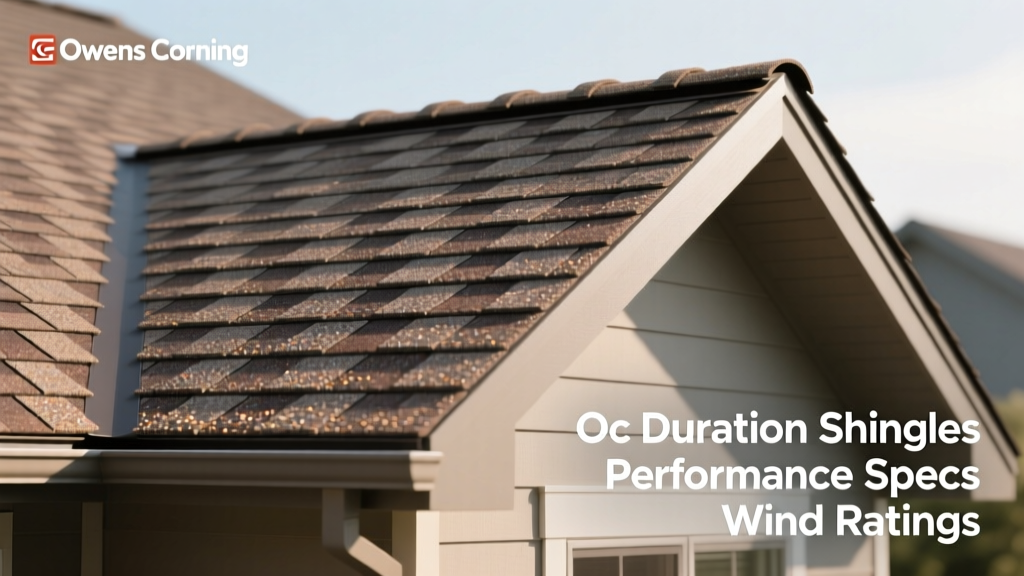
Decoding SureNail Technology and Wind Uplift Ratings
The Owens Corning Duration line occupies the premium tier of the architectural asphalt shingle market, primarily differentiated by its proprietary SureNail technology. Unlike standard laminated shingles that rely solely on the fiberglass mat and asphalt adhesion to resist nail pull-through, Duration shingles feature a distinct, woven polymer fabric strip embedded directly into the nailing zone. This structural reinforcement fundamentally alters the shingle's performance under extreme wind uplift.
According to Asphalt Roofing Manufacturers Association (ARMA) guidelines, wind resistance is dictated by both the mechanical fastening and the adhesive sealant strip. The SureNail fabric mitigates the most common point of catastrophic failure in high-wind events: the nail head tearing through the shingle mat. By distributing the shear and pull-out forces across the woven mesh, the Duration shingle achieves exceptional fastener retention.
ASTM D7158 Wind Testing Parameters
In controlled laboratory testing per ASTM D7158 (Standard Test Method for Wind Resistance of Asphalt Shingles), the standard Duration shingle qualifies for Class H classification, indicating resistance to wind speeds up to 150 mph. However, Owens Corning translates this laboratory metric into a real-world 130 mph limited wind warranty. This 20 mph delta accounts for variables such as installer error, roof deck degradation, and long-term thermal cycling that cannot be perfectly replicated in a wind tunnel.
The SureNail strip is approximately 1.5 inches wide. To maintain the structural integrity of the woven mesh and validate the wind warranty, fasteners must be driven flush—not over-driven—directly into this zone. Over-driven nails fracture the fiberglass mat surrounding the mesh, negating the pull-through resistance. Under-driven nails leave the shingle vulnerable to localized stress concentrations during thermal expansion.
Owens Corning Duration Variant Comparison Matrix
The "Duration" moniker encompasses several distinct product SKUs, each engineered for specific environmental stressors. Selecting the correct variant requires matching the shingle's material composition to the local climate's primary failure mode (e.g., hail impact vs. thermal shock).
| Variant | Core Composition | Impact Rating (UL 2218) | Wind Warranty | Weight per Square |
|---|---|---|---|---|
| Duration (Standard) | Oxidized Asphalt | Class 3 (Typical) | 130 MPH | ~235 lbs |
| Duration Storm | SBS Modified Asphalt | Class 4 | 130 MPH | ~250 lbs |
| Duration Flex | SBS Modified (High Flex) | Class 4 | 130 MPH | ~245 lbs |
| Duration Designer | Oxidized Asphalt (Tri-Laminate) | Class 3 (Typical) | 130 MPH | ~275 lbs |
For projects in regions prone to severe hail (such as the US Great Plains and Midwest), specifying the Duration Storm or Duration Flex is critical. The SBS (Styrene-Butadiene-Styrene) rubberized modifier allows the asphalt to absorb and dissipate the kinetic energy of a 2-inch steel ball dropped from 20 feet (the UL 2218 Class 4 test protocol) without fracturing the fiberglass mat. Standard oxidized asphalt shingles typically shatter or suffer micro-fractures under this specific impact, leading to delayed granule loss and premature UV degradation.
Fire, Algae, and Thermal Performance Specifications
Beyond wind and impact, the Duration line maintains rigorous baseline specifications for environmental resistance:
- Fire Resistance (ASTM E108 / UL 790): All Duration variants carry a Class A fire rating, the highest available for roofing materials. This indicates the shingle's ability to resist severe fire test exposures, effectively preventing flame spread across the roof deck.
- Algae Resistance (StreakGuard): The standard and premium variants utilize copper-infused ceramic-coated granules. This provides a 10-year limited warranty against blue-green algae (Gloeocapsa magma) discoloration. In high-humidity coastal or southeastern climates, this chemical barrier prevents the black streaking that compromises curb appeal and accelerates organic degradation.
- Thermal Cycling & Sealant Activation: The factory-applied adhesive sealant strips are engineered to activate at ambient temperatures of 50°F (10°C) and above, requiring direct solar radiation to reach the necessary thermal threshold for bonding.
If Duration shingles are installed when ambient temperatures are below 50°F (10°C), the thermal-activated sealant strips will not bond. To maintain the 130 MPH wind warranty in cold-weather applications, installers must manually apply four 1-inch diameter dabs of Owens Corning-approved asphalt roofing cement under the leading edge of every shingle tab. Failure to hand-seal in these conditions immediately voids the high-wind warranty.
Real-World Cost, Yield, and Logistics Metrics
Accurate estimating requires precise yield metrics. The standard Owens Corning Duration shingle is packaged at 3 bundles per square (100 square feet of roof area coverage). Each bundle covers approximately 33.3 square feet.
Material and Installed Pricing (2026 Benchmarks)
While regional supply chain variables and contractor overhead affect final pricing, current market benchmarks for the Duration line are as follows:
- Material Cost (Standard Duration): $42.00 to $55.00 per square.
- Material Cost (Duration Storm/Flex SBS): $65.00 to $85.00 per square.
- Total Installed Cost: $480 to $650 per square, factoring in tear-off, synthetic underlayment, ice and water shield, and labor.
Note: When calculating material requirements, always apply a minimum 10% waste factor for standard gable roofs, and a 15% waste factor for complex hip-and-valley or mansard roof geometries due to the increased cutting required to maintain the architectural shadow lines.
Edge Cases: Low-Slope and Ice Dam Vulnerabilities
While the shingles themselves boast high performance ratings, the underlying roof assembly dictates long-term survivability. The Insurance Institute for Business & Home Safety (IBHS) FORTIFIED Home standard highlights that shingle performance is compromised if the deck beneath them fails.
Low-Slope Applications (2:12 to 4:12 Pitch)
Owens Corning permits the installation of Duration shingles on roof slopes as low as 2:12. However, on these low-slope applications, water drainage velocity is significantly reduced, increasing the risk of capillary action and wind-driven rain infiltration. For slopes between 2:12 and 4:12, a double layer of asphalt-saturated felt underlayment or a full-coverage synthetic ice and water shield is mandatory to prevent lateral water migration beneath the shingle overlaps.
Ice Dam Mitigation in Northern Climates
In climates with prolonged freezing temperatures, heat loss from the attic melts snow on the upper roof planes, which refreezes at the unheated eaves, creating an ice dam. While the Duration shingle's Class A fire rating and wind resistance remain intact, hydrostatic pressure from backed-up meltwater can force water under the shingle laps. To protect the deck, a minimum 24-inch wide self-adhering polymer-modified bitumen membrane (ice and water shield) must be installed at the eaves, extending at least 24 inches past the interior warm wall line.
Frequently Asked Technical Specifications
How many nails are required per shingle to maintain the wind warranty?
To validate the 130 MPH wind warranty, Owens Corning mandates a 6-nail pattern per shingle, regardless of the roof pitch. Standard 4-nail patterns only qualify for the baseline 110 MPH wind warranty. Nails must be 11-gauge or 12-gauge hot-dipped galvanized roofing nails with a minimum 3/8-inch head diameter and a length sufficient to penetrate at least 3/4-inch into the roof decking (or fully penetrate 1/2-inch OSB/plywood).
What starter shingle is required for the Duration system?
The system requires the use of a dedicated starter strip at the eaves and rakes. Installers must use either the Owens Corning ProStart or WeatherGuard starter shingle. Using a flipped standard architectural shingle as a starter strip alters the exposure line, compromises the sealant alignment, and voids the system warranty.
Does the SureNail strip replace the need for proper nailing alignment?
No. While the SureNail fabric widens the effective nailing zone and increases pull-through resistance, it does not excuse poor fastener placement. Nails driven into the very top or bottom edge of the fabric strip, or driven at an angle (shiners), will not achieve the engineered shear strength and can lead to localized tearing during thermal expansion and contraction cycles.