Durability and Lifespan of All Roofing Materials Ranked
Compare the functional lifespan, failure modes, and durability of all roofing materials to choose the right system for your climate and budget.

Functional Lifespan vs. Warranty Coverage
When evaluating all roofing materials, the most common point of confusion is the gap between manufacturer warranties and actual functional lifespans. A 'lifetime' or 50-year limited warranty on architectural asphalt shingles does not guarantee 50 years of weather-tight performance. Warranties typically cover manufacturing defects and specific wind ratings (e.g., up to 130 mph), but they prorate heavily after the first 10 years and exclude consequential damage from poor ventilation or improper installation.
Functional lifespan refers to the period a roof system performs its primary duty—shedding water and protecting the building envelope—without requiring catastrophic repairs or full replacement. According to the National Roofing Contractors Association (NRCA), true longevity depends on the intersection of material chemistry, local climate, and the precision of the installation. Below, we rank and dissect the durability of every major roofing category based on real-world degradation metrics.
Comprehensive Durability Matrix for All Roofing Materials
| Material Category | Expected Functional Lifespan | Primary Failure Mode | Maintenance Frequency |
|---|---|---|---|
| 3-Tab Asphalt Shingles | 15 - 20 Years | Granule loss, thermal cracking, wind uplift | Annual inspections |
| Architectural Asphalt Shingles | 24 - 30 Years | Algae growth, sealant strip failure, curling | Bi-annual inspections |
| Exposed Fastener Metal | 20 - 30 Years | Neoprene washer degradation, fastener back-out | Re-tightening every 5-7 yrs |
| Standing Seam Metal | 40 - 70 Years | Oil canning, galvanic corrosion at flashings | Decadal inspections |
| Synthetic Slate/Polymer | 40 - 50 Years | UV embrittlement, color fading | Bi-annual inspections |
| Clay and Concrete Tile | 50 - 100 Years | Underlayment failure, freeze-thaw spalling | Underlayment replace at 30 yrs |
| Natural Slate | 75 - 150+ Years | Nail fatigue, delamination of soft slate | Flashings inspect every 20 yrs |
| EPDM Rubber (Low-Slope) | 20 - 30 Years | Membrane shrinkage, seam tape failure | Annual seam inspections |
| TPO / PVC (Low-Slope) | 15 - 25 Years | Plasticizer migration, heat-weld seam separation | Bi-annual inspections |
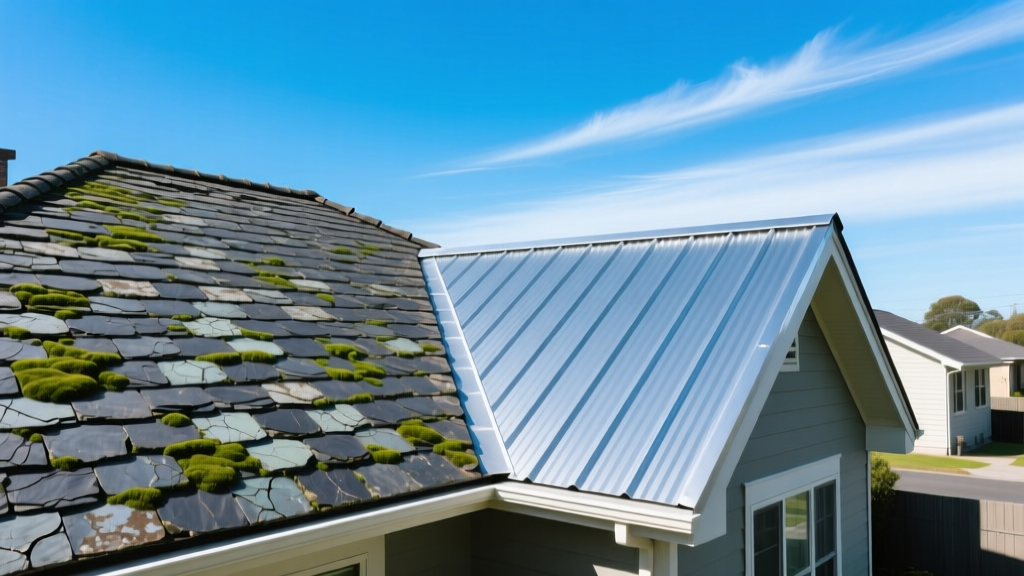
Material-Specific Degradation and Failure Modes
To make an informed decision, you must understand exactly how and why specific materials fail. Surface-level comparisons ignore the chemical and mechanical realities of roofing systems.
Asphalt Shingles: The Role of Fiberglass and Asphalt Oxidation
Modern asphalt shingles are fiberglass mats coated with asphalt and ceramic granules. The granules protect the asphalt from UV radiation. Once granules shed (due to hail, foot traffic, or manufacturing defects), the asphalt oxidizes, losing its volatile oils. This causes the shingle to become brittle and crack under thermal cycling. Architectural shingles, which feature a dual-layer laminate construction (meeting ASTM D3462 standards), offer superior wind resistance (often rated for 130 mph) and mask the visual impact of minor granule loss far better than single-layer 3-tab shingles.
Metal Roofing: Gauge Thickness and Coating Chemistry
Metal roofing durability is dictated by the substrate and the protective coating. A 24-gauge Galvalume steel panel (zinc-aluminum coating) will drastically outperform a 29-gauge G90 galvanized panel in coastal or high-humidity environments. The most critical vulnerability in exposed fastener metal roofs is the neoprene washer on the screws; these washers dry-rot and crack after 15-20 years of UV exposure, leading to leaks long before the metal itself rusts. Standing seam systems eliminate exposed fasteners by utilizing concealed clips that allow the metal to expand and contract thermally, effectively pushing the functional lifespan past the 50-year mark.
Slate and Tile: The Underlayment Bottleneck
While natural slate and fired clay tiles can easily outlast the building they cover, the secondary water barrier beneath them cannot. Traditional asphalt-saturated felt underlayment degrades in 20 to 30 years. Therefore, a '100-year' tile roof will require the tiles to be carefully removed, the underlayment replaced with a modern synthetic or self-adhering ice-and-water membrane, and the tiles reinstalled at the 30-year mark. Furthermore, slate roofs frequently fail due to 'nail fatigue'—the copper or stainless steel nails used to secure the slate corrode or snap before the stone itself degrades.
Low-Slope Membranes: Mil Thickness and UV Resistance
For flat or low-slope commercial and modern residential roofs, single-ply membranes dominate. EPDM (ethylene propylene diene terpolymer) is highly resistant to UV and ozone but relies on adhesives or tape for seams, which are notorious failure points. TPO (thermoplastic polyolefin) utilizes heat-welded seams that are stronger than the membrane itself, but early-generation TPO formulations suffered from premature cracking. When specifying TPO in 2026, insist on a minimum 60-mil thickness with a reinforced polyester scrim to resist puncture and wind uplift, as recommended by EPA guidelines on cool roof durability.
Environmental Modifiers: How Climate Alters Baseline Lifespans
The baseline lifespans listed above assume moderate conditions. Extreme environments accelerate degradation through specific mechanical and chemical pathways.
The 'Hidden' Variables That Dictate True Longevity
Material quality is only half the equation. The U.S. Department of Energy notes that building envelope dynamics play a massive role in roof survival. Three hidden variables frequently cut a roof's life in half:
- Attic Ventilation and Thermal Bypasses: An unventilated attic can reach 150°F in the summer. This 'bakes' asphalt shingles from the underside, causing premature curling and sealant failure. Proper intake (soffit) and exhaust (ridge) ventilation is non-negotiable for shingle and metal longevity.
- Flashing Details: 90% of roof leaks occur at penetrations and transitions, not in the field of the roof. Relying on roofing mastic or caulk at chimneys, skylights, and wall intersections guarantees a leak within 5 to 7 years. Proper step-flashing woven into the siding and counter-flashing mortared into the masonry is the only durable solution.
- Roof Pitch and Drainage: Low-slope applications (below 2:12 pitch) cannot use standard asphalt shingles or lapped metal panels without specialized underlayments, as capillary action will draw wind-driven rain upward under the laps. Ensuring the correct material is matched to the specific roof pitch prevents immediate water intrusion.
Ultimately, selecting from all roofing materials requires aligning the material's chemical and mechanical properties with your specific climate, roof geometry, and expected tenure in the building. Prioritize the quality of the flashings and the underlayment just as heavily as the visible exterior layer to ensure the system reaches its maximum functional lifespan.
Written by
Priya KapoorPriya Kapoor is a real estate market analyst and construction economics researcher with expertise in housing affordability, development feasibility, and infrastructure investment. She holds a Master of Regional Planning from Cornell University and previously worked as a senior analyst at CBRE's Investment Properties group, where she modeled returns for $4B in mixed-use development pipelines. Priya now runs an independent research practice advising developers, municipalities, and REITs on construction cost forecasting and market timing. She publishes the quarterly "BuildMat Market Pulse" report tracking material price indices across 12 commodity categories. Based in Austin, TX, Priya serves on the board of Habitat for Humanity Austin and is a marathon runner.
More from Priya Kapoor
View all
Construction Cost
Cost to Build a 1600 Sq Ft Home in 2026: Full Breakdown
Accurate 2026 cost to build a 1600 sq ft home—material, labor, and regional pricing breakdowns included. Plan your budget with real-time estimates.
Aug 11, 2026

Wood & Lumber
Name the Types of Wood for Pressure Treatment and Preservation
Learn how to name the types of wood best suited for pressure treatment. Compare species treatability, chemical retention levels, and 2026 preservation costs.
Aug 4, 2026

Stone & Masonry
Stone Veneer Suppliers Lindenhurst: 2026 Cost Analysis
Analyze 2026 stone veneer costs in Lindenhurst, NY. Compare local supplier pricing, delivery fees, and Suffolk County installation labor rates.
Aug 4, 2026