Decoding Roof Coating Material Safety Data Sheets for Safe Selection
Use roof coating material safety data sheets as a selection framework to compare VOC limits, PPE requirements, and chemical hazards before procurement.

The SDS Selection Matrix: Comparing Roof Coating Chemistries
Procurement teams and roofing contractors frequently evaluate elastomeric, silicone, and polyurethane roof coatings based on reflectivity, elongation, and adhesion metrics. However, treating the Safety Data Sheet (SDS) merely as a compliance afterthought leads to severe job-site bottlenecks, unexpected PPE costs, and regulatory fines. In 2026, with tightening environmental regulations and heightened OSHA enforcement on chemical exposures, the SDS must serve as a primary selection framework during the bidding and procurement phase.
By analyzing Sections 3 (Composition), 8 (Exposure Controls), and 9 (Physical Properties) of roof coating material safety data sheets, project managers can accurately map product chemistries to specific site constraints. Below is a comparative matrix of the three dominant coating chemistries based on standard SDS profiles.
| SDS Parameter | 100% Acrylic (Water-Based) | High-Solids Silicone | Solvent-Based Polyurethane |
|---|---|---|---|
| Section 3: Primary Solvents | Water, Glycol ethers | Solvent-free or minimal VM&P Naphtha | Xylene, Toluene, Acetone |
| Section 3: Typical VOC (g/L) | < 50 g/L | < 100 g/L | 250 - 420 g/L |
| Section 9: Flash Point | > 200°F (93°C) | > 200°F or N/A | 70°F - 110°F (21°C - 43°C) |
| Section 8: Required Respiratory PPE | None (unless spraying in confined space) | None (standard ventilation) | NIOSH-approved Organic Vapor Respirator |
| Section 11: Key Toxicological Hazards | Mild eye/skin irritant | Skin sensitization, eye damage | Isocyanates (HDI/MDI), CNS depression |
Decoding Section 3: VOC Content and Regulatory Triggers
The most common error contractors make when reviewing roof coating material safety data sheets is misinterpreting Section 3 (Composition/Information on Ingredients). Section 3 lists chemical components by weight percentage, but environmental regulations enforce limits in grams per liter (g/L).
The Exempt Solvent Trap
If an SDS lists a solvent like Acetone or Tertiary-Butyl Acetate (TBAc) in Section 3, procurement teams often panic, assuming the product will fail local air quality standards. However, these are classified as VOC-exempt solvents by the EPA. To determine true regulatory compliance, you must cross-reference Section 3 with Section 9 (Physical Properties) to calculate the actual VOC content:
- Identify Total Volatiles: Check Section 9 for 'VOC Content' directly. If only weight % is given in Section 3, locate the specific gravity/density in Section 9.
- Subtract Exemptions: Remove the weight of water and EPA-exempt solvents from the total volatile weight.
- Calculate g/L: Multiply the remaining VOC weight percentage by the coating density (g/L).
For commercial projects in strict air quality management districts, compliance with frameworks like SCAQMD Rule 1113 is mandatory. Rule 1113 caps roof coatings at 250 g/L, but primers and rust-preventative coatings often face stricter limits of 100 g/L to 200 g/L. Selecting a polyurethane coating with 350 g/L for a California or Northeast project will result in immediate material confiscation by local inspectors.
Section 8 & 11: Mapping Toxicity to Site Constraints
The physical environment of the roof dictates which SDS hazards are acceptable. Section 8 (Exposure Controls/Personal Protection) and Section 11 (Toxicological Information) must be audited against the building's occupancy and HVAC layout.
Many high-performance aliphatic polyurethane topcoats contain Hexamethylene Diisocyanate (HDI) or Methylene Diphenyl Diisocyanate (MDI). According to OSHA Hazard Communication guidelines, isocyanates are potent respiratory sensitizers. The Permissible Exposure Limit (PEL) for HDI is a mere 0.02 mg/m³. If the building's HVAC intake vents cannot be completely sealed, or if the roof is above an occupied hospital or school, solvent-based polyurethanes must be disqualified from the selection framework entirely, regardless of their superior abrasion resistance.
Confined Space and Low-Slope Parapets
When applying coatings in deep parapets, courtyards, or areas with low wind flow, solvent vapors (detailed in Section 9's Vapor Pressure and Vapor Density metrics) will pool. Solvents like Xylene have a vapor density greater than 3.0 (heavier than air). If the SDS indicates high vapor density and a low flash point, the selection framework must mandate either explosive-proof exhaust fans or a pivot to water-based acrylics to prevent asphyxiation and flash-fire risks.
The 4-Step SDS Procurement Framework
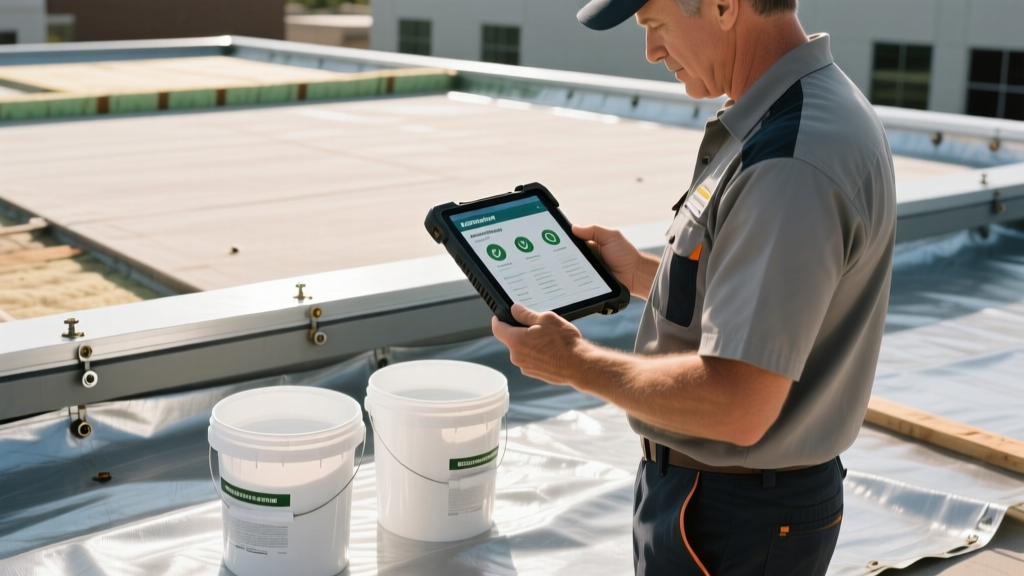
Integrate this workflow into your standard operating procedure when evaluating manufacturer submittals for flat and low-slope roof restorations.
Step 1: Site Constraint Audit
Before requesting SDS documents, define the site's non-negotiable parameters. Is the building occupied? Are there air intakes within 50 feet of the application zone? Is the ambient temperature expected to exceed 95°F, pushing solvent flash points into dangerous territory? Document these constraints.
Step 2: The Section 9 Flash-Point Filter
Pull the SDS for all proposed products. Filter out any coating with a flash point below 100°F (38°C) if the project is scheduled for summer months or if hot work (welding, torching) is occurring simultaneously on the deck. Water-based acrylics and 100% silicone coatings typically boast flash points above 200°F, eliminating fire-watch requirements and reducing insurance liabilities.
Step 3: PPE and Ventilation Costing
Use Section 8 to calculate the hidden costs of application. A solvent-based coating requiring supplied-air respirators, chemical-resistant Tyvek suits, and continuous mechanical ventilation will add thousands of dollars in labor and equipment rentals compared to a water-based alternative requiring only nitrile gloves and standard splash goggles. Factor these SDS-mandated costs into the final bid.
Step 4: Emergency Response Alignment
Review Sections 5 (Fire-Fighting Measures) and 6 (Accidental Release Measures). If a coating requires alcohol-resistant foam for firefighting or specialized hazardous materials containment for spill cleanup, ensure the local facility management team and municipal fire department are equipped to handle it. Selecting a product that requires obscure spill-response materials is a liability risk for long-term facility maintenance.
Red Flags to Reject During SDS Review
When scanning roof coating material safety data sheets, immediately flag and reject products containing the following unless absolutely engineered for a specific, highly controlled industrial application:
- Crystalline Silica (Quartz): Often found in cheap aluminum roof coatings or asphalt-based cements. When sanded or scraped during future roof removals, it poses a severe silicosis risk, triggering strict OSHA respirable dust regulations.
- Methylene Chloride: Sometimes used as a heavy solvent in mastic and flashing cements. It is a known carcinogen and heavily restricted by the EPA under TSCA regulations.
- High Naphtha Content without Exemptions: Indicates a high-VOC, high-odor product that will inevitably trigger tenant complaints in multi-family or commercial retail environments.
For a comprehensive understanding of how volatile organic compounds impact broader air quality and why regulatory bodies restrict specific solvents in architectural coatings, refer to the EPA's guidelines on VOCs and ground-level ozone pollution.
Summary: Shifting from Compliance to Strategy
Roof coating material safety data sheets are not just administrative hurdles; they are dense technical manuals that dictate the financial, legal, and operational reality of a roofing project. By systematically evaluating Sections 3, 8, 9, and 11, procurement teams can align coating chemistries with site-specific constraints, avoid catastrophic compliance failures, and protect the long-term health of their application crews. Make the SDS the foundation of your material selection framework, and the rest of the project execution will follow seamlessly.
Written by
Sarah WhitfieldSarah Whitfield is a chartered quantity surveyor (MRICS) and construction cost analyst with 15 years of experience in material pricing, procurement strategy, and project budgeting. She earned her degree in Construction Management from the University of Reading (UK) and has worked on projects ranging from $2M custom homes to $180M mixed-use developments across North America and Europe. Sarah currently leads cost estimating for BuildMat Insight, maintaining a proprietary database of 4,000+ material price points updated quarterly. She is a frequent contributor to RSMeans cost data panels and has presented at the International Cost Engineering Council (ICEC) congress. Based in Denver, CO, Sarah is an avid trail runner and volunteer mentor for Women in Construction.
More from Sarah Whitfield
View all
Wood & Lumber
What Are the Different Types of Wood? A Builder's Guide
Compare structural softwoods, finish hardwoods, and engineered lumber. Analyze Janka ratings, MOE values, and 2026 pricing for construction.
Aug 4, 2026

Walls & Panels
Steel Framing vs Wood Framing: Corrosion and Moisture Defense
Compare steel framing vs wood framing for moisture resistance. Learn about galvanized coatings, condensation risks, and corrosion protection strategies.
Jul 21, 2026

Stone & Masonry
How to Cut Stone Veneer: Wet Saw vs Grinder Comparison
Compare the best tools for cutting stone veneer. We review wet saws, angle grinders, and chop saws to help you achieve clean, chip-free cuts.
Jul 21, 2026