Single Ply Roofing Material Durability: TPO, PVC, and EPDM Lifespans
Compare TPO, PVC, and EPDM single ply roofing material durability. Discover expected lifespans, failure modes, and thickness specs for commercial roofs.

The Big Three: TPO, PVC, and EPDM Lifespan Expectations
Selecting the correct single ply roofing material requires looking past initial installation costs to evaluate long-term membrane degradation, seam integrity, and environmental resistance. The commercial low-slope market is dominated by three primary polymers: Thermoplastic Polyolefin (TPO), Polyvinyl Chloride (PVC), and Ethylene Propylene Diene Monomer (EPDM). Each exhibits distinct aging characteristics that dictate its functional lifespan.
| Membrane Type | Expected Lifespan | Standard Mil Thickness | Average Installed Cost (per sq. ft.) | Primary Degradation Factor |
|---|---|---|---|---|
| TPO | 15 – 25 Years | 60 mil | $5.50 – $8.50 | UV thermal cracking at seams |
| PVC | 20 – 30+ Years | 50 – 60 mil | $7.00 – $10.50 | Plasticizer migration / brittleness |
| EPDM | 20 – 30+ Years | 60 mil | $5.00 – $8.00 | Membrane shrinkage and tape failure |
Critical Failure Modes by Membrane Type
Understanding how and why these membranes fail allows facility managers and roofing contractors to specify the right material for specific building uses and microclimates.
TPO: Seam Degradation and UV Formulation Shifts
Early generations of TPO (manufactured prior to 2010) suffered from severe UV degradation, leading to surface cracking and premature seam failure. Modern TPO membranes, such as GAF EverGuard and Carlisle SynTec Sure-Weld, incorporate Hindered Amine Light Stabilizers (HALS) to reflect UV damage. However, TPO remains vulnerable to thermal shock. In climates with extreme diurnal temperature swings (e.g., the US Southwest), the membrane expands and contracts daily. Because TPO seams are hot-air welded, the heat-affected zone can become brittle over 15 years of continuous thermal cycling, eventually leading to micro-fissures at the weld edges.
PVC: Plasticizer Migration and Chemical Resistance
PVC is the undisputed leader in chemical resistance, making it the mandatory specification for restaurants and food processing facilities where animal fats and vegetable oils vent onto the roof. Oils rapidly dissolve TPO and EPDM but do not affect PVC. The primary failure mode for PVC is plasticizer loss. Over decades, the liquid plasticizers that keep the PVC flexible can migrate to the surface and evaporate or wash away. This leaves the membrane rigid and susceptible to shattering under impact. To counter this, high-end specifications now utilize Ketone Ethylene Ester (KEE) polymers, such as Sika Sarnafil G410, which use a solid polymer plasticizer that cannot migrate, effectively extending the membrane's flexible lifespan past 30 years.
EPDM: Shrinkage and Puncture Vulnerability
EPDM is a thermoset rubber, meaning it cannot be heat-welded; seams must be joined using primer and double-sided seam tape or liquid adhesives. While the membrane itself is highly resistant to UV and ozone, the seam tapes are the weak link, often degrading after 10 to 15 years. Additionally, unreinforced EPDM is prone to dimensional shrinkage over time. As the rubber cures and ages, it can pull away from parapet walls and HVAC curbs, placing immense stress on the termination bars and flashings. Specifying reinforced EPDM (with an internal polyester scrim) significantly mitigates this shrinkage issue.
How Mil Thickness Dictates Puncture Resistance
The 'mil' measurement (one-thousandth of an inch) directly correlates to the membrane's ability to withstand physical abuse from hail, dropped tools, and foot traffic during HVAC maintenance. According to testing standards like ASTM D4830 for puncture resistance, moving from a 45-mil to a 60-mil membrane increases puncture resistance by approximately 33%.
- 45-Mil: Acceptable only for residential applications or light commercial buildings with zero anticipated roof traffic and no overhanging trees.
- 60-Mil: The commercial industry standard. Provides the optimal balance of material cost, wind uplift resistance, and puncture protection.
- 80-Mil to 90-Mil: Specified for high-traffic roofs, buildings in severe hail zones (FM 1-90 impact ratings), or roofs with complex penetrations requiring extensive field welding.
Attachment Methods and Their Impact on Longevity
The method used to secure the single ply roofing material to the substrate dictates its wind uplift rating and long-term fatigue resistance. The US Department of Energy notes that proper attachment is critical for maintaining the thermal and reflective properties of cool roofs over time.
Fully Adhered Systems
The membrane is glued directly to the insulation board using low-rise polyurethane adhesives or water-based bonding agents. This creates a monolithic assembly that prevents wind from getting underneath the membrane, eliminating 'billowing.' Fully adhered systems routinely achieve FM Global 1-90 or 1-120 wind uplift ratings and offer the longest lifespan because the membrane is not subjected to mechanical flutter fatigue.
Mechanically Fastened Systems
The membrane is secured using plates and screws driven into the structural deck, with the seams welded over the fasteners. While 15% to 20% cheaper than fully adhered systems, mechanically fastened roofs allow wind to create negative pressure pockets, causing the membrane to billow. Over 20 years, this continuous flexing can fatigue the membrane around the fastener plates, leading to stress cracks.
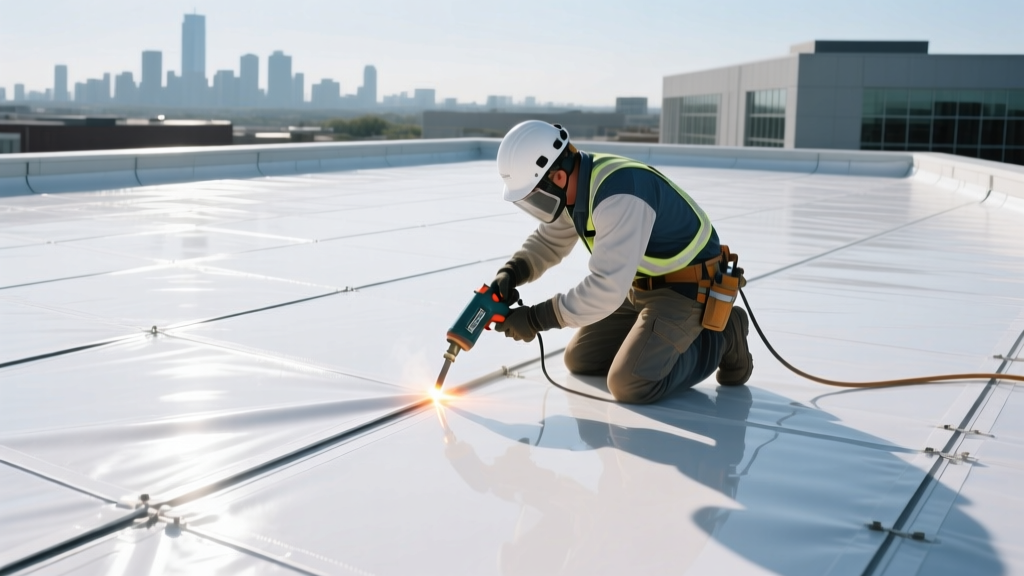
Maintenance Protocols to Extend Membrane Life
A single ply roof will not reach its maximum lifecycle without proactive maintenance. Facility managers should implement the following schedule:
- Bi-Annual Visual Inspections: Check all penetrations, pipe boots, and parapet flashings in spring and fall. 90% of leaks occur at flashings, not in the field of the membrane.
- Seam Probing (Years 10+): For TPO and PVC, use a blunt-nosed seam probe to check for voids in the heat-welded seams. For EPDM, check for tape adhesion failure and re-prime/tape as necessary.
- Infrared Moisture Surveys (Every 3-5 Years):strong> Water trapped beneath the membrane saturates the polyiso insulation, destroying its R-value and adding dead weight to the deck. Infrared scans identify wet insulation early, allowing for targeted cut-outs and patches before the deck rots.
- Chemical Wash-Downs: If the building vents grease or acidic chemicals, the roof must be washed bi-annually to prevent polymer breakdown, particularly on TPO systems.
By matching the specific polymer chemistry to the building's operational environment and enforcing strict mil-thickness and attachment standards, building owners can reliably extract 25 to 30 years of watertight performance from modern single ply systems.
Written by
Sarah WhitfieldSarah Whitfield is a chartered quantity surveyor (MRICS) and construction cost analyst with 15 years of experience in material pricing, procurement strategy, and project budgeting. She earned her degree in Construction Management from the University of Reading (UK) and has worked on projects ranging from $2M custom homes to $180M mixed-use developments across North America and Europe. Sarah currently leads cost estimating for BuildMat Insight, maintaining a proprietary database of 4,000+ material price points updated quarterly. She is a frequent contributor to RSMeans cost data panels and has presented at the International Cost Engineering Council (ICEC) congress. Based in Denver, CO, Sarah is an avid trail runner and volunteer mentor for Women in Construction.
More from Sarah Whitfield
View all
Wood & Lumber
What Are the Different Types of Wood? A Builder's Guide
Compare structural softwoods, finish hardwoods, and engineered lumber. Analyze Janka ratings, MOE values, and 2026 pricing for construction.
Aug 4, 2026

Walls & Panels
Steel Framing vs Wood Framing: Corrosion and Moisture Defense
Compare steel framing vs wood framing for moisture resistance. Learn about galvanized coatings, condensation risks, and corrosion protection strategies.
Jul 21, 2026

Stone & Masonry
How to Cut Stone Veneer: Wet Saw vs Grinder Comparison
Compare the best tools for cutting stone veneer. We review wet saws, angle grinders, and chop saws to help you achieve clean, chip-free cuts.
Jul 21, 2026