Selecting the Best Membrane Roof Material by Climate Zone
Discover how to choose the right membrane roof material for hot, cold, or high-wind climates. Compare EPDM, TPO, and PVC with current pricing.
The Core Membrane Contenders: EPDM vs. TPO vs. PVC
Selecting a membrane roof material requires more than comparing price per square foot. A thermoplastic membrane that performs flawlessly in the Arizona desert will suffer catastrophic seam failures in a Minnesota winter. Climate dictates thermal expansion, UV degradation, and wind uplift dynamics. Before mapping materials to microclimates, it is critical to understand the molecular behavior of the big three single-ply membranes.
| Material | Optimal Climate | Temp Tolerance | Seam Method | Avg. Installed Cost |
|---|---|---|---|---|
| EPDM (Ethylene Propylene Diene Monomer) | Cold / Freeze-Thaw | -40°F to 180°F | Tape / Liquid Adhesive | $4.50 - $7.00 / sq ft |
| TPO (Thermoplastic Polyolefin) | Hot / Arid / Mixed | -20°F to 160°F | Heat Weld | $5.00 - $8.50 / sq ft |
| PVC (Polyvinyl Chloride) | Coastal / Chemical | -10°F to 160°F | Heat Weld | $6.50 - $10.00 / sq ft |
Hot and Arid Climates: Beating Thermal Shock and UV
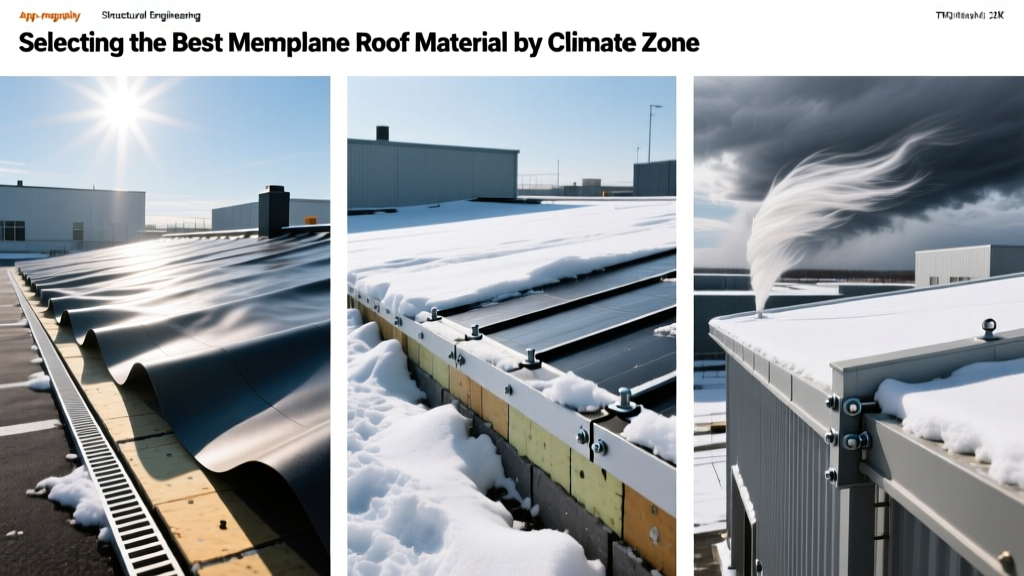
In regions like the Southwest US, the primary enemy of flat roofs is thermal shock. Daytime temperatures routinely exceed 105°F, while desert nights can drop into the 70s. A black EPDM roof in Phoenix can reach surface temperatures of 170°F. This extreme heat causes the membrane to expand significantly; when the temperature plummets at night, the rapid contraction pulls violently against fastener plates and parapet flashings, leading to tearing and seam separation.
For hot, high-UV environments, a highly reflective white TPO (Thermoplastic Polyolefin) membrane is the definitive choice. According to the U.S. Department of Energy, cool roofs like white TPO can lower roof surface temperatures by up to 50°F compared to dark surfaces, drastically reducing thermal expansion cycles and interior cooling loads.
Cold and Freeze-Thaw Zones: Prioritizing Flexibility
In the Northeast and Midwest, roofs endure hundreds of freeze-thaw cycles annually. The critical failure point for many membranes in sub-zero temperatures is the loss of flexibility. PVC membranes rely on chemical plasticizers to remain pliable. Over time, these plasticizers migrate to the surface and evaporate or wash away. In freezing temperatures, aged PVC becomes brittle and can shatter under the weight of ice or foot traffic during winter maintenance.
EPDM is the superior membrane roof material for cold climates. Because it is a vulcanized synthetic rubber (a thermoset material), its flexibility is inherent to its molecular cross-linking, not dependent on migrating plasticizers. EPDM remains pliable down to -40°F, allowing it to accommodate the structural shifting of buildings during deep freezes without cracking.
The Ice Dam and Snow Load Factor
While white roofs are mandated in some energy codes, a black EPDM roof in a snowy climate offers a distinct structural advantage. The dark surface absorbs low-angle winter solar radiation, which helps melt the bottom layer of snowpack. This facilitates drainage and reduces the formation of massive ice dams at the eaves, mitigating the risk of structural overload and water backup under the flashing.
High-Wind and Coastal Regions: Engineering for Uplift
In hurricane-prone zones like the Gulf Coast and Southeast, wind uplift is the primary design constraint. The FEMA Building Science division consistently reports that mechanically attached (screwed and plated) single-ply roofs are highly susceptible to catastrophic peeling during wind events exceeding 110 mph. Once a single seam lifts, the wind gets underneath and unzips the entire roof deck.
To survive coastal and high-wind environments, the membrane roof material must be installed using a fully adhered system or advanced induction welding, engineered to meet FM Global 1-90 or FM 1-120 uplift ratings.
- Fully Adhered TPO/PVC: The membrane is glued directly to the insulation cover board using a two-part polyurethane adhesive (e.g., OlyBond). This creates a monolithic surface where wind cannot get underneath the membrane. Ensure the adhesive is applied in continuous ribbons rather than spot dabs for maximum shear resistance.
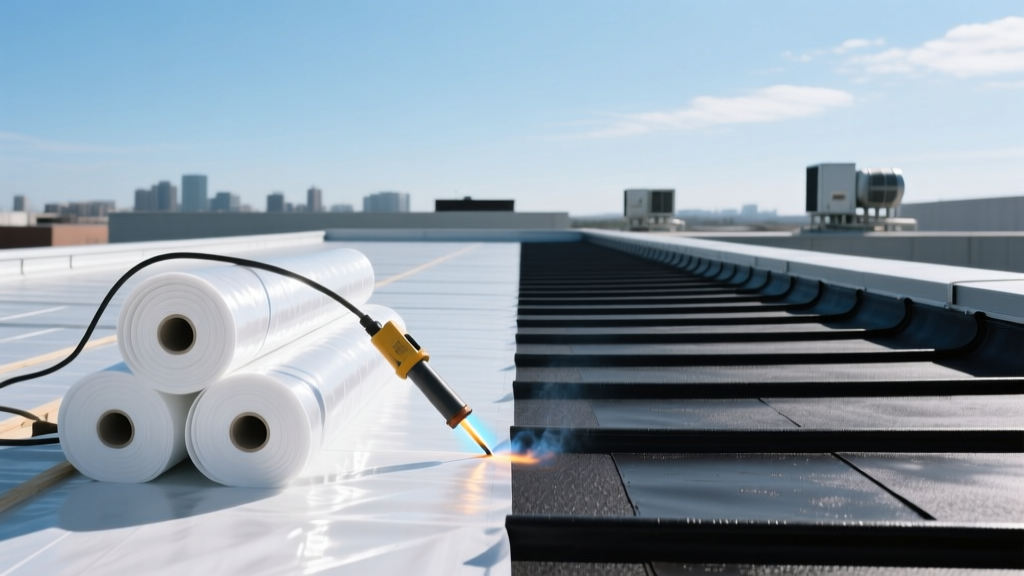
- Induction Welding (RhinoBond): Instead of penetrating the membrane with screws, specialized plates are screwed to the deck, and an electromagnetic tool welds the underside of the TPO or PVC membrane directly to the plate. This distributes wind uplift loads evenly across the deck and eliminates the weak points created by membrane penetrations.
- Seam Width Upgrades: In wind zones, upgrade standard 1.5-inch heat-welded seams to 3-inch or 6-inch seams. The additional welded surface area exponentially increases the peel strength of the thermoplastic bonds.
Climate-Specific Decision Matrix
Use this framework to finalize your membrane selection based on your building's specific environmental stressors:
If your building experiences extreme temperature swings (>50°F daily variance) and high UV index → Choose 60-mil or 80-mil White TPO with heat-welded seams.
If your building is in a deep-freeze zone with heavy snow loads and frequent winter roof access → Choose 60-mil Black EPDM with taped seams.
If your building is coastal, exposed to salt spray, or houses a restaurant with animal fat exhaust → Choose 60-mil PVC (animal fats dissolve TPO and EPDM, but PVC is chemically resistant).
Critical Installation Variables That Void Warranties
Even the most climate-appropriate membrane roof material will fail if installation parameters ignore local weather conditions. Manufacturers strictly enforce warranty exclusions based on environmental application limits.
Furthermore, the EPA Heat Island Effect guidelines note that while reflective membranes reduce ambient temperatures, they can cause condensation issues in cold climates if the roof assembly lacks a properly positioned vapor retarder. When installing a white TPO roof in a cold, humid climate (like the Great Lakes region), always include a self-adhering vapor barrier directly above the steel deck to prevent interior moisture from migrating into the insulation and freezing, which destroys the R-value and causes membrane blistering.
Ultimately, the longevity of a commercial flat roof relies on matching the chemical properties of the membrane to the physical realities of the local climate, and executing the installation within the strict environmental tolerances set by the manufacturer.
Written by
Marcus ChenMarcus Chen is a licensed structural engineer (PE) and building materials analyst with over 12 years of experience across residential, commercial, and industrial construction. He holds a Master of Science in Civil Engineering from UC Berkeley and spent six years at Thornton Tomasetti before transitioning to independent consulting and technical writing. Marcus specializes in material selection for seismic-prone regions, concrete reinforcement strategies, and lifecycle cost analysis. His work has been cited by the American Concrete Institute (ACI) and the Structural Engineers Association of California (SEAOC). When he is not on a job site or at his desk, you will find him hiking the Sierra Nevada or restoring a 1920s craftsman bungalow in Oakland, CA.
More from Marcus Chen
View all
Construction Cost
How Much Did the Eiffel Tower Cost to Build?
How much did the Eiffel Tower cost to build in 1889? We adjust for inflation and compare its budget to modern skyscraper construction.
Aug 4, 2026

Fire Resistance
What Is a Fire Resistant Material? Testing & Certification Guide
Discover what is a fire resistant material through ASTM and UL testing. Learn how fire ratings, certifications, and assemblies work in construction.
Aug 4, 2026

Construction Cost
How Much Did the Burj Khalifa Cost to Build?
How much did the Burj Khalifa cost to build? We break down the $1.5B project and extract 5 money-saving strategies for your next build.
Jul 30, 2026