Membrane Roofing Materials Compared: TPO, PVC, and EPDM
Compare top membrane roofing materials for flat roofs. We analyze TPO, PVC, and EPDM costs, lifespans, and failure modes to help you choose.

The Core Contenders: Single-Ply Membrane Roofing Materials
Flat and low-slope commercial roofs require continuous, seamless waterproofing that can withstand extreme thermal cycling, UV degradation, and chemical exposure. Single-ply membrane roofing materials dominate this sector, categorized primarily by their chemical composition and seaming methods. Selecting the wrong membrane for a specific building environment leads to premature failure, often within the first five to seven years.
TPO (Thermoplastic Polyolefin)
TPO is a single-ply reflective membrane synthesized from polypropylene and ethylene-propylene rubber. It is currently the most widely installed commercial membrane in North America due to its balance of cost and energy efficiency. Premium formulations, such as GAF EverGuard Extreme or Carlisle Sure-Weld, incorporate advanced UV stabilizers and thicker scrim reinforcements. For commercial applications, a minimum 60-mil thickness is required to withstand standard hail impacts and foot traffic, though 80-mil or 90-mil is recommended for roofs with high HVAC maintenance traffic.
PVC (Polyvinyl Chloride)
PVC membranes are engineered for superior chemical resistance and long-term flexibility. The material is plasticized to remain pliable and features hot-air welded seams that are as strong as the membrane itself. High-end variants like Sika Sarnafil and Fibertite utilize Ketone Ethylene Ester (KEE) polymers, which prevent the plasticizers from leaching out over time. PVC is the mandatory choice for facilities with grease exhaust vents, such as restaurants, or chemical processing plants where hydrocarbon exposure would dissolve other membranes.
EPDM (Ethylene Propylene Diene Monomer)
EPDM is a synthetic rubber membrane known for its exceptional durability in extreme cold and high-altitude environments. Unlike TPO and PVC, EPDM seams are joined using liquid primers, contact adhesives, and butyl seam tape. While black EPDM is highly effective at absorbing heat in northern climates, white EPDM is available for energy efficiency, though it requires a titanium dioxide coating that can degrade if not properly maintained. Carlisle RubberGard remains the industry benchmark for EPDM systems.
Head-to-Head Comparison Matrix
| Feature | TPO | PVC | EPDM |
|---|---|---|---|
| Primary Seaming Method | Hot-air welding (850°F - 1000°F) | Hot-air welding (900°F - 1100°F) | Liquid adhesive & butyl tape |
| Puncture Resistance | Moderate (Highly dependent on scrim) | High (Fleece-backed options available) | Moderate to High (in 60+ mil) |
| Chemical/Grease Resistance | Poor (Degrades near animal fats/oils) | Excellent (Impervious to hydrocarbons) | Poor (Swells and degrades) |
| Thermal Shock Tolerance | Moderate (Prone to cracking if poorly formulated) | High (Retains flexibility in deep freezes) | Excellent (Standard for extreme cold) |
| Expected Lifespan | 15 - 25 years | 20 - 30+ years | 20 - 30 years |
Failure Modes and Edge Cases
Understanding how membrane roofing materials fail in the field is critical for specifying the right system. Manufacturers test in controlled environments, but real-world variables introduce distinct edge cases.
Standard PVC membranes undergo plasticizer migration when placed in direct contact with Expanded Polystyrene (EPS) or Extruded Polystyrene (XPS) rigid insulation. The styrene extracts the plasticizers from the PVC, causing the membrane to become brittle and shatter within a few years. Always specify a separation layer, such as a fiberglass mat or geotextile fabric, between PVC and polystyrene insulation.
TPO Thermal Shock and Seam Delamination
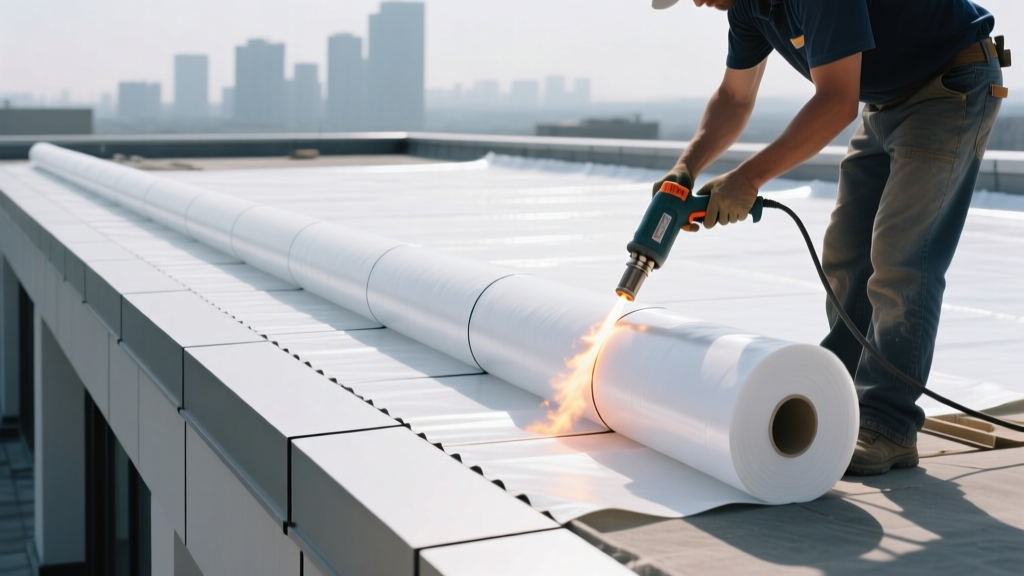
Early generations of TPO suffered from surface cracking during rapid temperature drops (thermal shock). While modern formulations have largely resolved this, TPO remains highly sensitive to installation errors. If the hot-air welder is set too low, the seam peels; if set too high, the membrane burns through. Ambient temperature and wind speed require welders to adjust their equipment continuously throughout the day.
EPDM Shrinkage and Flashing Tension
Over a 15-year period, EPDM can shrink up to 3%. If the membrane is fully adhered without adequate slack at the perimeters, this shrinkage pulls the membrane away from parapet walls and penetrations, causing the flashing to tear. Installers must detail termination bars and use reinforced flashing membranes to accommodate this long-term dimensional change.
2026 Cost Breakdown and ROI Analysis
Pricing for commercial roofing has stabilized following the supply chain disruptions of the early 2020s, but regional labor rates heavily dictate the final installed cost. The data below reflects national averages for a 10,000 sq. ft. commercial roof using 60-mil fully adhered systems.
| Membrane Type | Material Cost (per sq. ft.) | Installed Cost (per sq. ft.) | Warranty Upgrade Cost |
|---|---|---|---|
| TPO (60-mil) | $1.40 - $2.10 | $4.50 - $6.50 | $0.45 - $0.75 |
| PVC (60-mil) | $2.20 - $3.50 | $6.00 - $8.50 | $0.60 - $1.10 |
| EPDM (60-mil Black) | $1.50 - $2.30 | $5.00 - $7.00 | $0.50 - $0.85 |
Note: Upgrading to an 80-mil membrane typically adds $0.60 to $1.20 per square foot to the material cost but significantly reduces the risk of puncture-related warranty claims.
Decision Framework: Which Membrane Fits Your Building?
Use this conditional logic to specify the correct membrane for your project parameters:
- IF the building houses a restaurant, commercial kitchen, or manufacturing plant with airborne oils/grease → Specify PVC or KEE. TPO and EPDM will degrade rapidly.
- IF the project is a large-scale warehouse or distribution center with a tight budget and high HVAC cooling loads → Specify White TPO. The solar reflectance index (SRI) will lower cooling costs, and the material cost is the lowest of the three.
- IF the building is located in a climate with extreme winter freezes (e.g., Minnesota, Alberta) and experiences minimal chemical exposure → Specify EPDM. Its rubber composition remains pliable at -40°F, whereas poorly welded TPO seams can snap under severe thermal contraction.
- IF the roof has complex penetrations, numerous pipes, and irregular parapets → Specify PVC or TPO. The hot-air welding process allows for seamless, watertight integration with complex flashing details, which is difficult to achieve with EPDM tape and adhesive.
Installation Methods That Dictate Longevity
The membrane material is only half the equation; the attachment method determines wind uplift resistance and long-term adhesion. According to guidelines published by the National Roofing Contractors Association (NRCA), the three primary attachment methods carry distinct structural requirements:
Fully Adhered Systems
The membrane is glued directly to the insulation cover board using a low-VOC bonding adhesive. This method provides the highest wind uplift ratings (often exceeding FM 1-90 or UL Class 90) and prevents wind from getting underneath the membrane during storms. It is mandatory for high-velocity hurricane zones (HVHZ) and tall buildings.
Mechanically Attached Systems
The membrane is fastened to the roof deck using screws and stress plates, with the seams welded over the fasteners. This is the fastest and most cost-effective installation method for large, open roof areas. However, it is susceptible to billowing (wind flutter), which can cause fatigue at the fastener points over a 20-year lifespan.
Ballasted Systems
Loose-laid membrane is covered with smooth river stone or concrete pavers. While installation is incredibly fast, the structural deck must be engineered to support the dead load of the ballast (typically 10 to 15 lbs per square foot). The Single-Ply Roofing Industry (SPRI) provides specific wind design standards (ANSI/SPRI RP-4) that must be followed to prevent ballast blow-off during severe weather events.
Energy Efficiency and Cool Roofing Standards
When evaluating membrane roofing materials, thermal performance is a critical ROI factor. The U.S. Department of Energy notes that cool roofs can reduce peak cooling demand by 10% to 15%. White TPO and PVC membranes inherently meet ENERGY STAR and CRRC (Cool Roof Rating Council) standards for solar reflectance (initial SR ≥ 0.65). EPDM, while available in white, is traditionally black; if specifying black EPDM, building owners must rely on increased insulation R-values (minimum R-30 for commercial codes in most climate zones) to offset the heat absorption.
Written by
Sarah WhitfieldSarah Whitfield is a chartered quantity surveyor (MRICS) and construction cost analyst with 15 years of experience in material pricing, procurement strategy, and project budgeting. She earned her degree in Construction Management from the University of Reading (UK) and has worked on projects ranging from $2M custom homes to $180M mixed-use developments across North America and Europe. Sarah currently leads cost estimating for BuildMat Insight, maintaining a proprietary database of 4,000+ material price points updated quarterly. She is a frequent contributor to RSMeans cost data panels and has presented at the International Cost Engineering Council (ICEC) congress. Based in Denver, CO, Sarah is an avid trail runner and volunteer mentor for Women in Construction.
More from Sarah Whitfield
View all
Wood & Lumber
What Are the Different Types of Wood? A Builder's Guide
Compare structural softwoods, finish hardwoods, and engineered lumber. Analyze Janka ratings, MOE values, and 2026 pricing for construction.
Aug 4, 2026

Walls & Panels
Steel Framing vs Wood Framing: Corrosion and Moisture Defense
Compare steel framing vs wood framing for moisture resistance. Learn about galvanized coatings, condensation risks, and corrosion protection strategies.
Jul 21, 2026

Stone & Masonry
How to Cut Stone Veneer: Wet Saw vs Grinder Comparison
Compare the best tools for cutting stone veneer. We review wet saws, angle grinders, and chop saws to help you achieve clean, chip-free cuts.
Jul 21, 2026