Green Roof Materials: Essential Repair and Maintenance Guide
Learn how to inspect, maintain, and repair essential green roof materials, from waterproofing membranes to drainage layers and growing media.

Green roof assemblies are complex, multi-layered systems where the failure of a single component compromises the entire structure. While the vegetation is the most visible element, the underlying green roof materials—waterproofing membranes, drainage mats, root barriers, and engineered substrates—require rigorous, material-specific maintenance. According to the Environmental Protection Agency (EPA), a well-maintained green roof can last up to twice as long as a conventional roof by shielding the waterproofing layer from UV radiation and thermal shock. However, when repairs are needed, they demand precise technical interventions rather than standard roofing fixes.
Waterproofing Membrane Diagnostics and Repair
The waterproofing membrane is the most critical material in the assembly. Leaks rarely occur in the center of the membrane; they originate at seams, penetrations, and inside/outside corners. Before excavating the growing media to repair a leak, utilize electronic leak detection (ELD) or vector mapping. This low-voltage testing pinpoints breaches in the membrane without requiring destructive teardowns.
EPDM Rubber Membrane Repairs
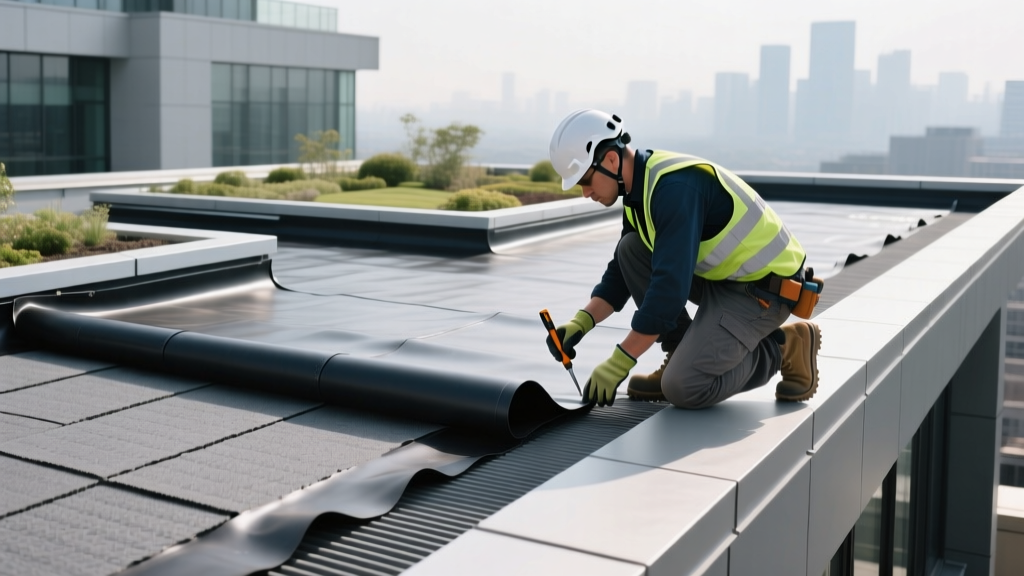
For Ethylene Propylene Diene Monomer (EPDM) systems, standard patching is insufficient for sub-grade green roof applications.
- Clean and Prime: Scour the area with a specialized EPDM splice wash and apply a uniform coat of EPDM primer. Allow it to flash off until it is tacky but does not transfer to a clean knuckle.
- Flashing Tape: Apply a minimum 6-inch overlap of uncured EPDM flashing tape over the breach. Uncured tape is mandatory because it conforms to irregular surfaces and inside corners.
- Compression: Use a hard silicone seam roller, applying approximately 100 lbs of pressure to ensure a molecular bond and eliminate air channels.
TPO and PVC Hot-Air Welding
Thermoplastic membranes (TPO and PVC) require thermal fusion for repairs. Hand-welding patches requires a hot-air gun set between 1,000°F and 1,100°F (540°C–590°C). Maintain a consistent 1.5-inch weld seam and test every weld with a cotter pin or seam probe. If the pin catches, the weld is incomplete and must be re-fused. For large-scale seam failures, an automatic hot-air welder traveling at 10 to 15 feet per minute ensures uniform heat distribution.
Drainage Mat and Geotextile Filter Maintenance
High-density polyethylene (HDPE) dimple mats and cuspated drainage boards provide the critical air gap for water flow and root aeration. Over time, these green roof materials suffer from two primary failure modes: physical crushing and geotextile clogging.
Never use high-pressure washers to clear clogged drainage mats. Pressures exceeding 500 PSI will shred the non-woven geotextile filter fabric, allowing fine soil particulates to infiltrate and permanently clog the HDPE dimples below.
To restore flow capacity, carefully pull back the filter fabric and flush the HDPE dimples with low-pressure water (under 300 PSI) combined with a biodegradable surfactant to break down biofilm and mineral scaling. If the geotextile is heavily silted, it cannot be cleaned; it must be replaced. Specify a non-woven, needle-punched polypropylene geotextile with an apparent opening size (AOS) of 70 to 100 US Sieve to balance soil retention with water permeability.
Root Barrier Integrity: Detection and Remediation
The National Park Service Technical Preservation Services emphasizes that root barrier integrity is paramount, especially in structural retrofits, to prevent biological degradation of the roof deck. Most physical root barriers are constructed from 30-mil to 40-mil HDPE or copper-foil laminates.
If an HDPE root barrier is punctured by aggressive taproots or mechanical damage during planting, the breach must be sealed immediately. Standard roofing tapes will not adhere to HDPE. You must use a compatible HDPE-backed tape with a specialized mastic sealant, overlapping the tear by at least 4 inches in all directions. For copper-infused chemical barriers, degradation is rare, but if the copper coating wears thin at high-traffic maintenance paths, apply a liquid-applied copper-rich polyurethane coating to restore the root-inhibiting zone.
Growing Media (Substrate) Depletion and Top-Dressing
Engineered green roof media is a highly specific material, typically composed of 80% to 100% inorganic Expanded Shale, Clay, and Slate (ESCS) aggregates, with 0% to 20% organic compost. Over a 5-year period, the organic fraction decomposes, and the inorganic aggregate settles, resulting in a 10% to 15% loss of total volume. This settling exposes the root barrier to UV degradation and reduces the media's water-holding capacity.
Replenishment Protocol
- Test the Media: Extract core samples and test for pH and soluble salts. Optimal pH for sedum-based extensive roofs is 6.0 to 7.5.
- Top-Dress Annually: Apply 0.5 inches of pure ESCS aggregate (particle size 1/8" to 3/8") annually to restore volume without adding excess nutrients that promote weed growth.
- Avoid Standard Topsoil: Never use native topsoil or standard potting mix for repairs. These materials are too heavy (exceeding 120 lbs/cu ft saturated), retain too much water, and will compact, suffocating the drainage layer below.
Green Roof Material Maintenance Schedule and Costs
| Material Component | Maintenance Action | Frequency | Estimated Cost (Per Sq. Ft.) |
|---|---|---|---|
| Waterproofing Membrane | Vector mapping / ELD leak detection | Every 3-5 years | $0.10 - $0.15 |
| Geotextile Filter Fabric | Visual inspection for tearing/sagging | Annually (Spring) | Included in general inspection |
| HDPE Drainage Mat | Low-pressure flushing of dimples | Every 5-7 years | $0.25 - $0.40 |
| Growing Media (ESCS) | Top-dressing to restore volume | Annually or Bi-annually | $1.50 - $2.50 |
Troubleshooting Matrix: Moisture vs. Drainage Failures
Diagnosing failures in green roof materials requires distinguishing between membrane breaches and drainage layer collapses. Use this decision framework to isolate the failing material:
| Observed Symptom | Probable Material Failure | Corrective Action |
|---|---|---|
| Water staining on interior ceiling directly below the roof deck. | Waterproofing membrane seam failure or penetration flash tear. | Perform vector mapping. Excavate media at the breach point. Apply EPDM/TPO patch per manufacturer specs. |
| Puddling on the surface of the vegetation; media remains saturated for >48 hours after rain. | Geotextile filter fabric clogged with fine particulates; HDPE mat crushed. | Remove saturated media. Replace geotextile fabric. Inspect HDPE mat for structural collapse and replace crushed sections. |
| Vegetation dying in localized patches despite adequate watering. | Media settling exposing roots; or root barrier breach causing root rot from trapped water. | Test media depth. Top-dress with ESCS. If media depth is adequate, inspect root barrier for breaches and patch with HDPE tape. |
Effective maintenance of green roof materials hinges on respecting the distinct physical properties of each layer. By utilizing precise diagnostic tools like vector mapping, adhering to strict thermal and chemical parameters for membrane repairs, and replenishing engineered substrates with the correct inorganic aggregates, facility managers can ensure the structural integrity and ecological function of the assembly for decades.
Written by
Elena RodriguezElena Rodriguez is a civil engineer and technical writer specializing in concrete technology, masonry systems, and ASTM/ACI compliance. She earned her B.S. in Civil Engineering from Texas A&M University and spent a decade at a materials testing laboratory, performing over 2,000 concrete compressive strength tests and masonry prism evaluations. Elena is an ACI-certified Field Testing Technician (Grade I) and a member of ASTM Committee C12 on Natural Building Stone. She currently consults on forensic engineering cases involving concrete failures and moisture intrusion. Based in San Antonio, TX, Elena is a proud member of the Society of Women Engineers (SWE) and coaches her daughter's FIRST Robotics team.
More from Elena Rodriguez
View all
Walls & Panels
Cost Analysis: Light Gauge Steel Framing Advantages and Disadvantages
Evaluate light gauge steel framing advantages and disadvantages through a strict cost analysis lens, comparing material, labor, and lifecycle expenses.
Aug 4, 2026

Walls & Panels
Gypsum Board Types: Exact Specifications, Thickness & Dimensions
Compare standard, Type X, and moisture-resistant gypsum board types. Get exact specifications, thicknesses, dimensions, and ASTM standards for your project.
Aug 4, 2026

Fire Resistance
Best Fire-Resistant Outdoor Decking Materials: 2026 Buyer Guide
Discover the best fire-resistant outdoor decking materials for 2026. Compare Class A PVC, aluminum, and hardwood options for WUI compliance and safety.
Aug 4, 2026