TPO Roofing Material vs EPDM & PVC: 2026 Flat Roof Comparison
Compare TPO roofing material against EPDM and PVC for commercial flat roofs. Analyze 2026 costs, seam integrity, failure modes, and top brands.

The Flat Roof Trilemma: TPO vs. EPDM vs. PVC
Specifying a single-ply membrane for a low-slope commercial roof requires balancing upfront capital expenditure, long-term weathering resistance, and chemical compatibility. The market is dominated by three primary synthetic polymers: Thermoplastic Polyolefin (TPO), Ethylene Propylene Diene Monomer (EPDM), and Polyvinyl Chloride (PVC). While all three meet baseline ASTM standards for waterproofing, their molecular structures dictate vastly different installation protocols, aging characteristics, and failure modes.
2026 Market Snapshot: Installed Costs & Lifespans
- TPO (Thermoplastic Polyolefin): $4.50 – $8.00 per sq. ft. | 20–30 Year Lifespan
- EPDM (Synthetic Rubber): $4.00 – $7.00 per sq. ft. | 25–35 Year Lifespan
- PVC (Polyvinyl Chloride): $6.50 – $11.00 per sq. ft. | 25–35+ Year Lifespan
Note: Pricing reflects fully installed, 60-mil mechanically attached or fully adhered systems on commercial decks, excluding structural tear-offs.
Deep Dive: TPO Roofing Material Performance & Specs
TPO roofing material is a blend of polypropylene and ethylene-propylene rubber, reinforced with a polyester scrim. It was introduced as a cost-effective alternative to PVC, offering heat-welded seams without the environmental concerns of chlorine-based plastics. Early-generation TPO (pre-2010) suffered from premature cracking and UV degradation. However, modern formulations utilize advanced Hindered Amine Light Stabilizers (HALS) and UV absorbers, drastically improving weatherability.
Chemical Composition & Seam Integrity
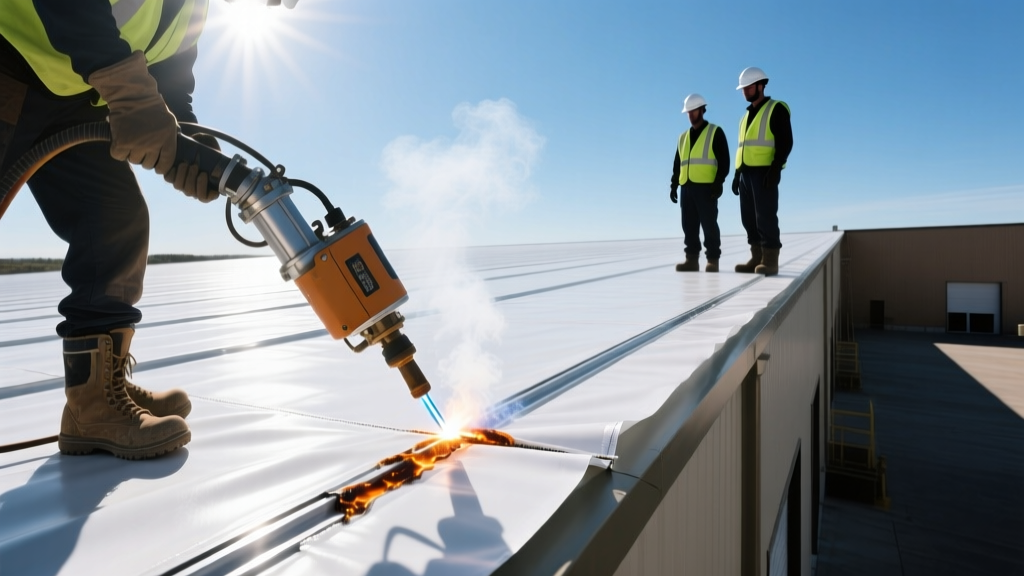
Unlike EPDM, which relies on adhesives or double-sided tape for seams, TPO is a thermoplastic. This means the seams are fused together using hot air (typically 1,000°F to 1,200°F) from an automatic robotic welder, creating a monolithic, continuous membrane that is often stronger than the sheet itself. According to the National Roofing Contractors Association (NRCA), properly heat-welded TPO seams virtually eliminate the primary failure point of traditional rubber roofs: seam shrinkage and tape delamination.
Top TPO Product Lines for 2026
- GAF EverGuard Extreme: Features a specialized top ply designed for extreme UV and heat exposure, backed by a 35-year warranty in select configurations.
- Carlisle Sure-Weld: Known for its Octaguard XT weathering package, offering superior resistance to thermal shock and high-wind uplift ratings.
- Johns Manville (JM) TPO: Offers a wide range of fleece-back options ideal for fully adhered applications over existing rough substrates like concrete or aged asphalt.
Head-to-Head Comparison Matrix
| Feature | TPO | EPDM | PVC |
|---|---|---|---|
| Material Base | Polypropylene/Ethylene-Propylene | Synthetic Rubber (Thermoset) | Polyvinyl Chloride (Thermoplastic) |
| Seam Method | Hot Air Welding | Primer & Seam Tape / Liquid Flashing | Hot Air or Solvent Welding |
| Grease/Oil Resistance | Poor (Degrades on contact) | Poor (Swells and degrades) | Excellent (Ideal for restaurants) |
| Puncture Resistance | High (Scrim reinforced) | Moderate (Relies on thickness) | High (Scrim reinforced) |
| Energy Efficiency | High (Highly reflective white) | Low (Black absorbs heat) / Mod (White) | High (Highly reflective white) |
Failure Modes and Edge Cases
Understanding how these materials fail in the real world is critical for risk mitigation. Each polymer has specific environmental or chemical triggers that lead to catastrophic system breakdowns.
TPO Vulnerabilities
The primary failure mode for TPO roofing material is improper seam welding. If the automatic welder's temperature or speed is not calibrated to the exact ambient temperature and humidity, the seam can experience a 'cold weld' (delaminating under wind uplift) or a 'burn-through' (compromising the scrim). Additionally, TPO is highly susceptible to degradation from animal fats, vegetable oils, and hydrocarbon exhaust. Specifying TPO for a building with heavy kitchen exhaust ventilation will result in the membrane dissolving into a gelatinous state within months.
EPDM Vulnerabilities
EPDM is a thermoset rubber, meaning it cannot be melted back together. It relies on seam tapes. Over a 20-year period, thermal cycling (expansion and contraction) causes the membrane to shrink. This shrinkage exerts immense tensile stress on perimeter flashings and penetrations, frequently pulling the membrane off the substrate. Furthermore, black EPDM absorbs massive amounts of solar radiation, accelerating the degradation of the underlying polyiso insulation and increasing building cooling loads, a factor heavily penalized by modern U.S. Department of Energy Cool Roof guidelines.
PVC Vulnerabilities
Standard PVC relies on liquid plasticizers to remain flexible. Over decades, these plasticizers can migrate out of the membrane, leading to brittleness and micro-cracking. To combat this, premium PVC membranes use Ketone Ethylene Ester (KEE) polymers, which are inherently flexible and do not rely on migrating plasticizers. Another critical edge case: PVC is chemically incompatible with asphalt, bitumen, and expanded polystyrene (EPS) insulation. Direct contact causes an exothermic reaction that melts the PVC.
Installation Realities: Fully Adhered vs. Mechanically Attached
The attachment method fundamentally alters the wind uplift rating and aesthetic finish of the roof system.
Warning on Mechanically Attached TPO: In high-velocity wind zones (HVHZ), mechanically attached TPO requires dense fastener patterns along the seams. If the structural purlins are not perfectly aligned, fasteners may miss the steel deck, resulting in zero pull-out resistance and immediate code violations.
- Mechanically Attached: The membrane is unrolled and fastened through the seams using barbed screws and stress plates. It is faster and cheaper but leaves the membrane susceptible to 'billowing' during high winds, which can cause fatigue at the fastener points over time.
- Fully Adhered: Utilizes a fleece-back TPO membrane bonded directly to the insulation using low-rise polyurethane adhesive or water-based bonding agents. This eliminates billowing, provides superior wind uplift resistance (often exceeding FM 1-120 ratings), and offers a smooth, aesthetically pleasing finish. However, it adds $1.50 to $2.50 per square foot in material and labor costs.
Decision Framework: Which System Should You Specify?
Use this practical framework to select the correct membrane for your specific building profile.
Choose TPO Roofing Material If:
- You are roofing a large warehouse, logistics center, or retail big-box store.
- Budget constraints demand a mid-range price point without sacrificing reflective energy efficiency.
- The building has standard HVAC units and no kitchen grease exhaust.
- You want the security of monolithic, heat-welded seams.
Choose PVC If:
- The building houses restaurants, food processing plants, or facilities with heavy animal/vegetable fat exhaust.
- The roof will be exposed to hydrocarbon chemicals, jet fuel, or harsh industrial fallout.
- You require a track record spanning 40+ years (PVC has a longer documented history in the US than TPO).
Choose EPDM If:
- You are designing a ballasted roof system (using river stone or pavers) in a cold, northern climate.
- The building has complex geometry with hundreds of small penetrations where liquid flashing is easier to apply than hot-air welding.
- You are performing a recover over an existing asphalt-based roof system (EPDM requires a simple separation slip-sheet, whereas PVC requires rigorous isolation).
Frequently Asked Questions
Does TPO qualify for ENERGY STAR and LEED credits?
Yes. White TPO membranes with a Solar Reflectance Index (SRI) of 78 or higher easily meet ENERGY STAR Certified Roof Products criteria. Specifying a highly reflective TPO system contributes directly to LEED v4.1 credits for Sustainable Sites (Heat Island Reduction) and Energy & Atmosphere performance.
What is the minimum thickness I should specify for TPO?
While 45-mil TPO is available and occasionally used for budget residential low-slope applications, commercial best practice dictates a minimum of 60-mil. For high-traffic roofs, roofs with heavy hail exposure, or fully adhered systems requiring extra rigidity, specify 72-mil or 80-mil membranes. The additional material cost is marginal compared to the exponential increase in puncture resistance and warranty coverage.
Can TPO be installed over an existing EPDM roof?
Yes, but direct contact is not recommended. TPO can be installed as a recover system over aged EPDM, provided a separation layer (such as a 1/2-inch high-density polyiso cover board or a heavy geotextile slip sheet) is placed between the two membranes. This prevents chemical incompatibility and provides a smooth, stable substrate for the new TPO fasteners or adhesives.
Written by
Priya KapoorPriya Kapoor is a real estate market analyst and construction economics researcher with expertise in housing affordability, development feasibility, and infrastructure investment. She holds a Master of Regional Planning from Cornell University and previously worked as a senior analyst at CBRE's Investment Properties group, where she modeled returns for $4B in mixed-use development pipelines. Priya now runs an independent research practice advising developers, municipalities, and REITs on construction cost forecasting and market timing. She publishes the quarterly "BuildMat Market Pulse" report tracking material price indices across 12 commodity categories. Based in Austin, TX, Priya serves on the board of Habitat for Humanity Austin and is a marathon runner.
More from Priya Kapoor
View all
Construction Cost
Cost to Build a 1600 Sq Ft Home in 2026: Full Breakdown
Accurate 2026 cost to build a 1600 sq ft home—material, labor, and regional pricing breakdowns included. Plan your budget with real-time estimates.
Aug 11, 2026

Wood & Lumber
Name the Types of Wood for Pressure Treatment and Preservation
Learn how to name the types of wood best suited for pressure treatment. Compare species treatability, chemical retention levels, and 2026 preservation costs.
Aug 4, 2026

Stone & Masonry
Stone Veneer Suppliers Lindenhurst: 2026 Cost Analysis
Analyze 2026 stone veneer costs in Lindenhurst, NY. Compare local supplier pricing, delivery fees, and Suffolk County installation labor rates.
Aug 4, 2026