Repair Guide for Common Types of Metal Roofing Materials
Learn how to diagnose and repair different types of metal roofing materials. Expert maintenance protocols, fastener upgrades, and 2026 cost data.

Diagnostic Matrix: Identifying Your Metal Roof
Metal roofing systems routinely achieve 40- to 70-year lifespans, but their longevity relies entirely on proactive maintenance at critical failure points: fasteners, panel seams, and penetrations. Before executing any repair protocol, you must accurately identify the base metal and its protective coating. Applying incompatible sealants or dissimilar metals to a roof will accelerate degradation through galvanic corrosion or chemical breakdown.
| Material Type | Visual & Physical Identifiers | Primary Degradation Vector |
|---|---|---|
| Galvalume (AZ-50/AZ-55) | Spangled silver finish; magnetic; 22-26 gauge thickness | Edge creep rust; fastener back-out; UV coating chalk |
| Aluminum (5052/3003) | Non-magnetic; dull mill finish or painted; lightweight | Galvanic corrosion at steel flashings; seam tearing |
| Copper (16oz/20oz) | Starts bright penny-orange; ages to verdigris green; non-magnetic | Solder joint fatigue; acid runoff etching |
| Zinc (Titanium Zinc) | Blue-grey matte finish; develops light carbonate patina | Condensation-induced underside corrosion; thermal buckling |
| Stone-Coated Steel | Galvanized steel core with acrylic-bonded stone granules | Granule loss; acrylic binder UV degradation; rust at cut edges |
Material-Specific Repair Protocols
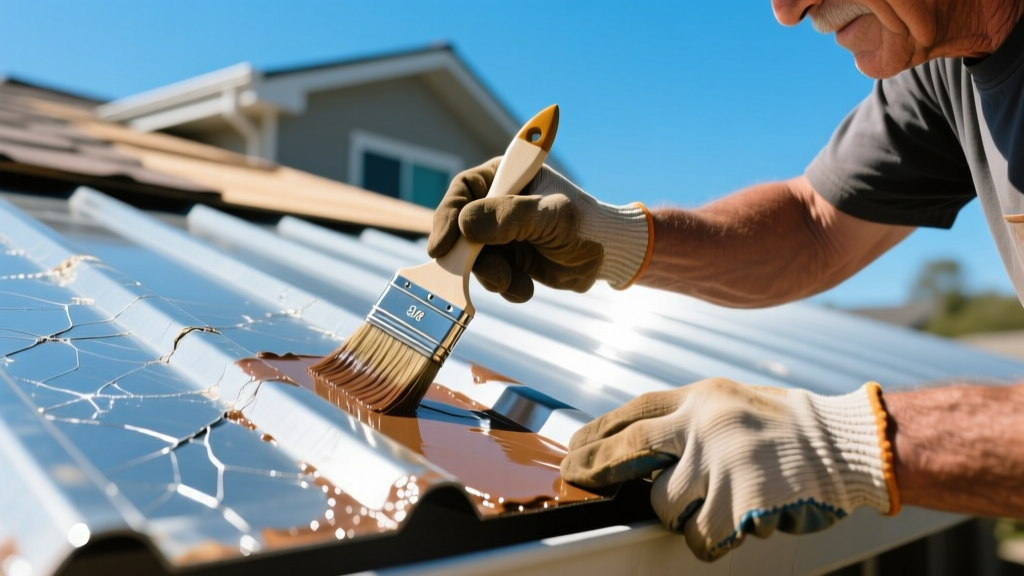
Galvalume and Galvanized Steel: Arresting Edge Creep
Galvalume panels feature an aluminum-zinc alloy coating (typically AZ-55, meaning 55% aluminum, 43.4% zinc, and 1.6% silicon). When the panel is cut or deeply scratched, the zinc sacrifices itself to protect the steel substrate. However, if the sacrificial layer is depleted, red rust forms and 'creeps' under the adjacent paint system.
Repair Procedure for Scratches and Edge Rust:
- Preparation: Remove loose oxidation using a 3M Scotch-Brite pad or a brass wire brush. Never use steel wire brushes, as embedded steel particles will immediately rust. Wipe the area clean with xylene or denatured alcohol.
- Priming: Apply a zinc-rich cold galvanizing compound (e.g., Rust-Oleum Cold Galvanizing Compound or ZRC). The dry film must contain a minimum of 90% zinc dust to provide adequate cathodic protection.
- Topcoating: Once the primer cures (typically 24 hours), apply a PVDF (Kynar 500 or Hylar 5000) matched touch-up paint. PVDF resins resist UV chalk and maintain color stability far longer than standard SMP (Silicone Modified Polyester) paints.
Aluminum Alloys: Managing Galvanic Isolation
Aluminum roofing (commonly 5052-H32 or 3003-H14 alloys) is highly resistant to atmospheric corrosion, making it the standard for coastal environments. However, aluminum is highly anodic. If it comes into direct physical contact with a more cathodic metal (like copper, untreated steel, or lead) in the presence of an electrolyte (rainwater), rapid galvanic corrosion will perforate the aluminum panel.
Seam and Puncture Repair: For tears or open seams in aluminum, avoid asphalt-based cements or polyurethane caulks, which trap moisture and degrade under UV exposure. Instead, use a high-modulus polyether sealant (such as ChemCurb or Geocel Pro Flex). Polyethers do not shrink, remain flexible across a -40°F to 200°F temperature range, and do not stain aluminum.
Copper and Zinc: Soldering vs. Caulking
Premium standing seam copper and zinc roofs rely on mechanical locks and soldered joints for waterproofing. A common maintenance error is attempting to repair a failed copper seam with polyurethane caulk or roofing tar. These materials have vastly different thermal expansion coefficients than copper and will inevitably tear away, trapping water inside the joint.
Proper Solder Repair Technique:
- Cleaning: Mechanically abrade the joint to bright, shiny metal. Apply a zinc chloride flux (muriatic acid cut with zinc) to prevent oxidation during heating.
- Solder Selection: For 16oz and 20oz cold-rolled copper, use 50/50 tin-lead solder for standard seams, or a lead-free 95/5 tin-antimony solder for potable water catchment systems. Zinc roofs require specific tin-zinc or tin-lead solders formulated for titanium zinc alloys.
- Application: Use a heavy copper soldering iron (minimum 1.5 lbs) rather than a propane torch. Torches easily overheat the thin metal, causing warping and destroying the surrounding protective patina.
The Fastener Failure Framework
According to the National Roofing Contractors Association, fastener back-out and washer degradation account for over 70% of leaks in exposed-fastener metal roofs (like R-panels and corrugated profiles). Standard EPDM (neoprene) washers typically dry-rot, crack, and lose their compression set after 15 to 20 years of UV and thermal cycling.
When conducting a maintenance audit, evaluate fasteners using this decision tree:
- Condition A (Washer intact, screw loose): Do not simply retighten. Over-torquing will strip the purlin hole. Back the screw out completely, inject a polyurethane thread-locking sealant into the hole, and reinstall. If the hole is stripped, upgrade to a #12 or #14 oversized diameter screw with a larger bearing head.
- Condition B (Washer cracked or compressed flat): Replace the fastener immediately. Upgrade from standard EPDM to TPO-encapsulated or PVDF-coated fastener heads. These advanced polymers resist UV degradation for 30+ years and match the lifespan of the metal panel itself.
- Condition C (Rust streaking from screw head): The screw's zinc plating has failed. Remove and replace with a 410 stainless steel fastener with a coated carbon steel head (to match the roof color while providing structural shear strength).
2026 Metal Roof Repair Cost Data
Budgeting for metal roof maintenance requires understanding the distinct labor and material costs associated with different repair scopes. The Metal Construction Association emphasizes that proactive maintenance is exponentially cheaper than reactive panel replacement. Below is the current 2026 national average pricing for commercial and residential metal roof repairs.
| Repair Scope | Unit of Measure | 2026 Average Cost Range | Primary Cost Drivers |
|---|---|---|---|
| Fastener Upgrade (Full Roof) | Per 100 sq. ft. (Square) | $180 - $275 | Roof pitch; screw density; TPO washer upgrades |
| Standing Seam Re-seaming | Per Linear Foot | $12 - $22 | Mechanical seamer rental; butyl tape insertion |
| Penetration Flashing Boot | Per Boot (Pipe/Vent) | $150 - $350 | Silicone vs. EPDM boot; structural curb integration |
| Galvalume Panel Replacement | Per Panel (up to 20ft) | $450 - $850 | Custom fabrication; crane access; color matching |
| Copper Solder Joint Repair | Per Hour (Specialty Labor) | $175 - $250 | Specialized sheet metal labor; flux/solder materials |
Preventative Maintenance Schedules
To maximize the lifecycle of any metal roofing system, implement a bi-annual inspection schedule (spring and autumn). Focus on clearing debris from valleys and gutters, as standing organic matter holds moisture against the metal, accelerating coating breakdown. Inspect all HVAC curbs, pipe boots, and ridge caps, as these penetrations experience the highest degree of thermal movement and are the first points of failure. By correctly identifying your specific metal type and applying material-compatible repair methodologies, you can reliably push a metal roof system well past its 50-year warranty threshold.
Written by
Marcus ChenMarcus Chen is a licensed structural engineer (PE) and building materials analyst with over 12 years of experience across residential, commercial, and industrial construction. He holds a Master of Science in Civil Engineering from UC Berkeley and spent six years at Thornton Tomasetti before transitioning to independent consulting and technical writing. Marcus specializes in material selection for seismic-prone regions, concrete reinforcement strategies, and lifecycle cost analysis. His work has been cited by the American Concrete Institute (ACI) and the Structural Engineers Association of California (SEAOC). When he is not on a job site or at his desk, you will find him hiking the Sierra Nevada or restoring a 1920s craftsman bungalow in Oakland, CA.
More from Marcus Chen
View all
Construction Cost
How Much Did the Eiffel Tower Cost to Build?
How much did the Eiffel Tower cost to build in 1889? We adjust for inflation and compare its budget to modern skyscraper construction.
Aug 4, 2026

Fire Resistance
What Is a Fire Resistant Material? Testing & Certification Guide
Discover what is a fire resistant material through ASTM and UL testing. Learn how fire ratings, certifications, and assemblies work in construction.
Aug 4, 2026

Construction Cost
How Much Did the Burj Khalifa Cost to Build?
How much did the Burj Khalifa cost to build? We break down the $1.5B project and extract 5 money-saving strategies for your next build.
Jul 30, 2026