Choosing New Roofing Materials: A 2026 Selection Framework
Evaluate new roofing materials using our 2026 selection framework. Compare solar shingles, synthetic slate, and cool membranes for cost and lifespan.
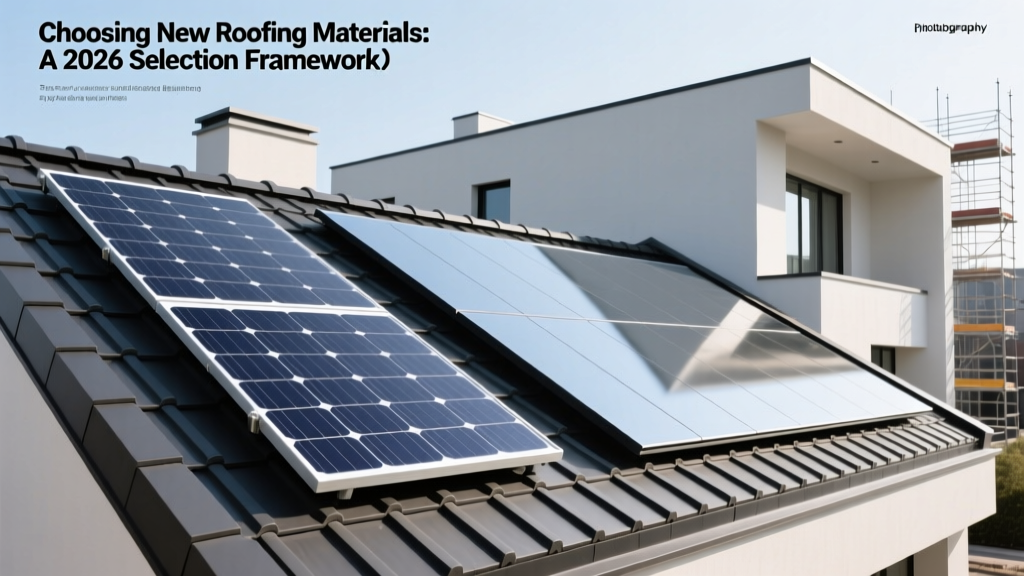
The Shift in Residential and Commercial Roofing
The roofing industry has moved beyond traditional asphalt shingles and standard EPDM membranes. Driven by stricter 2026 International Energy Conservation Code (IECC) mandates, severe weather resilience requirements, and decentralized energy goals, contractors and building owners are actively evaluating new roofing materials. However, adopting emerging technologies like Building-Integrated Photovoltaics (BIPV), synthetic composites, and bio-based cool membranes requires a rigorous vetting process. Selecting the wrong innovative material for a specific structural or climatic context leads to premature failure, voided warranties, and severe financial loss.
This selection framework provides a technical, data-driven methodology for evaluating new roofing materials, moving past marketing claims to focus on structural load, thermal dynamics, wind uplift resistance, and lifecycle economics.
The 4-Pillar Selection Framework
Before specifying any emerging roof technology, run the product through these four non-negotiable evaluation pillars:
2. Thermal & Ventilation Dynamics: How does the material handle thermal expansion and attic heat transfer? Unvented assemblies require specific insulation R-values.
3. Severe Weather Resilience: What are the verified ASTM and UL ratings for wind uplift, impact, and fire resistance?
4. Lifecycle & Maintenance Economics: What is the true cost per square over a 30-year horizon, factoring in energy savings, insurance premium reductions, and specialized repair costs?
Material Matrix: Comparing Emerging Technologies
The following matrix benchmarks three dominant categories of new roofing materials against traditional baselines, utilizing 2026 national average installed costs and manufacturer specifications.
| Material Category | Specific Product Example | Installed Cost (per sq. ft.) | Weight (lbs/sq.) | Wind Rating | Expected Lifespan |
|---|---|---|---|---|---|
| BIPV Solar Shingles | GAF Timberline Solar | $18.00 - $24.00 | ~350 lbs | ASTM D3161 Class F | 25-30 Years |
| Synthetic Composite | DaVinci Bellaforté Slate | $14.00 - $18.00 | ~300 lbs | ASTM D3161 Class F | 50+ Years |
| Bio-Based Cool Membrane | Carlisle SynTec Bio-TPO | $9.00 - $13.00 | ~120 lbs | UL 580 Class 90 | 30-35 Years |
| Architectural Asphalt (Baseline) | Standard Dimensional Shingle | $5.50 - $8.00 | ~250 lbs | ASTM D7158 Class H | 20-25 Years |
Deep Dive: Evaluating Specific Innovations
Building-Integrated Photovoltaics (BIPV)
Solar shingles have evolved from bulky, leak-prone retrofits into seamless, nailable units that integrate directly with standard asphalt courses. The GAF Timberline Solar system, for instance, utilizes a proprietary nailing flange that eliminates the need for penetrating mounting racks. However, BIPV systems introduce complex thermal dynamics. Because the solar cells generate heat, installing them over an unvented roof deck without a continuous exterior insulation layer (like polyiso) will drastically reduce cell efficiency and accelerate the degradation of the underlying underlayment.
Failure Mode Alert: Micro-cracking in BIPV shingles frequently occurs when installers fail to maintain the manufacturer-mandated 1/8-inch expansion gap between units during high-temperature installations. Always install BIPV during morning hours when ambient temperatures are below 75°F.
Advanced Synthetic Composites
Synthetic slate and shake materials, engineered from virgin polymers and recycled rubber, solve the weight and fragility issues of natural stone. Products like DaVinci Roofscapes achieve a UL 2218 Class 4 impact rating, making them ideal for hail-prone regions. The critical installation variable for synthetics is fastener placement. Unlike wood or asphalt, polymers expand and contract significantly with temperature fluctuations. Fasteners must be driven flush—never over-driven—to allow the shingle to 'float' slightly. Over-driving causes 'oil-canning' (visible warping) and stress fractures within five years.
Bio-Based and Cool Roof Membranes
For low-slope commercial applications, the shift toward cool roofs is accelerating. The U.S. Department of Energy notes that highly reflective roofs can reduce peak cooling demand by 10-15%. New bio-based TPO (Thermoplastic Polyolefin) membranes incorporate plant-derived polyols, reducing embodied carbon without sacrificing heat-weldability or UV resistance. When specifying these membranes, ensure the seam welding temperature is calibrated to the specific bio-polymer blend, as they often require a 10-15°F lower weld temperature than traditional petroleum-based TPO.
Structural Load and Decking Compatibility Check
A common oversight when adopting new roofing materials is ignoring the substrate. If you are upgrading from 3-tab asphalt shingles (approx. 200 lbs per square) to a heavy synthetic slate or a full BIPV array (350+ lbs per square), the existing roof trusses and decking must be evaluated. Furthermore, many new materials require a minimum 5/8-inch tongue-and-groove plywood or OSB deck to hold the specialized ring-shank nails required for high-wind uplift ratings. Standard 1/2-inch sheathing will strip under the pull-through force of a Class F wind event.

Step-by-Step Decision Flowchart
Use this sequential logic tree to narrow down the appropriate new roofing material for your specific project:
- Assess Roof Pitch: If the pitch is less than 2:12, eliminate all shingle-based products (BIPV, synthetic slate). Proceed directly to fluid-applied or single-ply membranes (Bio-TPO, PVC).
- Calculate Structural Capacity: Have a structural engineer verify the dead load capacity. If the trusses cannot support >350 lbs/sq., eliminate natural and heavy synthetic slates. Consider lightweight composite alternatives or solar-integrated metal panels.
- Evaluate Climate & Hazard Zones:
- Hail Zone (Hail Impact Severity Zone 3 or 4): Mandate UL 2218 Class 4 rated materials (Synthetic composites, heavy-gauge standing seam metal).
- High-Wind Coastal Zone (110+ mph): Require ASTM D3161 Class F or UL 580 Class 90 ratings. Avoid large-format synthetic tiles that act as sails if edge seals fail.
- High Solar/Heat Zone: Prioritize CRRC (Cool Roof Rating Council) certified membranes with an SRI (Solar Reflectance Index) > 50.
- Verify Local Code & HOA Restrictions: Cross-reference the selected material with the 2026 IECC energy pathways and local aesthetic covenants before finalizing the bill of materials.
Code Compliance and Insurance Incentives
The financial viability of new roofing materials is heavily influenced by regulatory compliance and insurance incentives. The Insurance Institute for Business & Home Safety (IBHS) FORTIFIED Roof standard has become the benchmark for severe weather resilience. Many synthetic composites and advanced BIPV systems automatically qualify for FORTIFIED designation when installed with the required sealed roof deck protocols (peel-and-stick underlayment over all decking seams). Achieving this designation can reduce annual property insurance premiums by 15% to 30%, significantly offsetting the higher initial capital expenditure of emerging materials.
Furthermore, the National Roofing Contractors Association (NRCA) continuously updates its technical bulletins to address the integration of solar-ready roof attachments and cool roof vapor retarder requirements. Always consult the latest NRCA guidelines to ensure your selection aligns with current best practices for vapor drive management and thermal bridging prevention.
Selecting new roofing materials requires looking past the initial aesthetic appeal. By rigorously applying this framework—prioritizing structural compatibility, verified testing standards, and long-term lifecycle economics—building professionals can confidently specify innovative systems that deliver lasting performance and verifiable ROI.
Written by
Sarah WhitfieldSarah Whitfield is a chartered quantity surveyor (MRICS) and construction cost analyst with 15 years of experience in material pricing, procurement strategy, and project budgeting. She earned her degree in Construction Management from the University of Reading (UK) and has worked on projects ranging from $2M custom homes to $180M mixed-use developments across North America and Europe. Sarah currently leads cost estimating for BuildMat Insight, maintaining a proprietary database of 4,000+ material price points updated quarterly. She is a frequent contributor to RSMeans cost data panels and has presented at the International Cost Engineering Council (ICEC) congress. Based in Denver, CO, Sarah is an avid trail runner and volunteer mentor for Women in Construction.
More from Sarah Whitfield
View all
Wood & Lumber
What Are the Different Types of Wood? A Builder's Guide
Compare structural softwoods, finish hardwoods, and engineered lumber. Analyze Janka ratings, MOE values, and 2026 pricing for construction.
Aug 4, 2026

Walls & Panels
Steel Framing vs Wood Framing: Corrosion and Moisture Defense
Compare steel framing vs wood framing for moisture resistance. Learn about galvanized coatings, condensation risks, and corrosion protection strategies.
Jul 21, 2026

Stone & Masonry
How to Cut Stone Veneer: Wet Saw vs Grinder Comparison
Compare the best tools for cutting stone veneer. We review wet saws, angle grinders, and chop saws to help you achieve clean, chip-free cuts.
Jul 21, 2026