Roof Restoration Coatings: Material Taxonomy & Selection
Compare roof restoration materials including silicone, acrylic, and polyurethane coatings. Learn selection criteria, mil thicknesses, and costs.
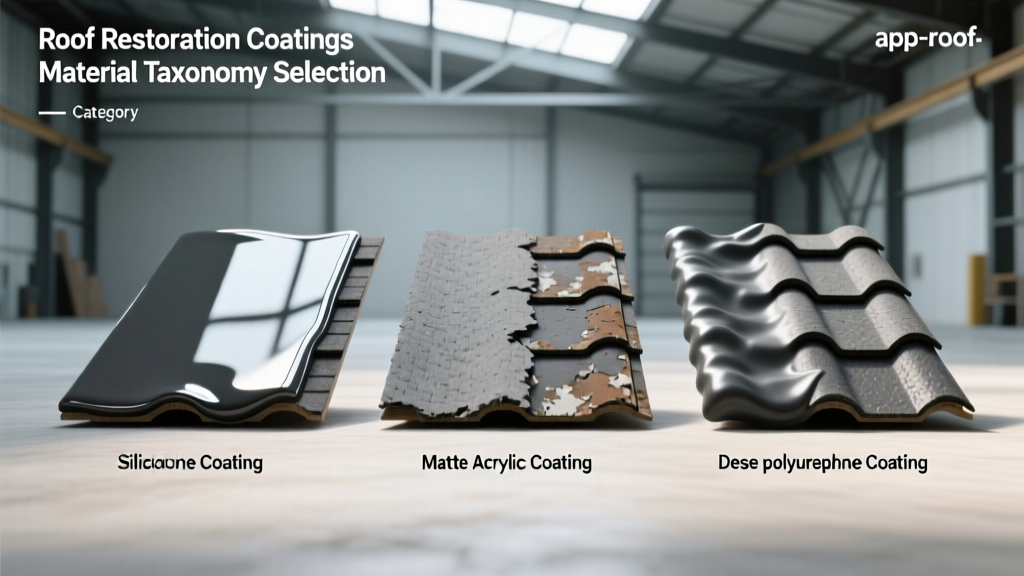
The Chemical Taxonomy of Roof Restoration Systems
Roof restoration extends the service life of an existing commercial or residential low-slope roof by 10 to 15 years at a fraction of a full tear-off. However, the success of a restoration project hinges entirely on matching the correct coating chemistry to the existing substrate and environmental stressors. Selecting the wrong material leads to re-emulsification, adhesion failure, or premature UV degradation. Below is the definitive taxonomy of the three primary elastomeric and polymeric coating families used in modern roof restoration.
1. Silicone Elastomerics (High-Solids)
Silicone coatings are the premium standard for flat roofs prone to ponding water. Modern high-solids silicone formulations (typically 95% to 98% volume solids) are moisture-cured, meaning they rely on atmospheric humidity to crosslink and form a seamless, rubber-like membrane. Because they contain almost no solvents or water, they experience minimal shrinkage during the curing process.
Best Substrates: EPDM, TPO, PVC, Modified Bitumen
Key Advantage: Impervious to constant ponding water; will not re-emulsify.
Limitation: High material cost; requires specialized spray equipment for large-scale application; dirt retention can be higher than acrylics.
Target Dry Mil Thickness: 30 to 40 mils.
2. Acrylic Elastomerics (Water-Based)
Acrylics are water-based, highly reflective, and cost-effective. They are the go-to choice for steep-slope metal roofs or flat roofs with excellent drainage and zero ponding water. According to the Department of Energy, white acrylic elastomeric coatings can reflect up to 85% of solar radiation, significantly reducing cooling loads and mitigating the urban heat island effect. However, because they are water-borne, acrylics will re-emulsify and wash away if submerged in standing water for more than 48 hours.
3. Polyurethane Systems (Aromatic vs. Aliphatic)
Polyurethane coatings are prized for their extreme tensile strength and abrasion resistance, making them ideal for roofs with heavy foot traffic or mechanical equipment maintenance. They are typically deployed in a two-coat system:
- Aromatic Polyurethane: Used as the base coat. It is highly durable and cost-effective but degrades and chalks when exposed to UV radiation.
- Aliphatic Polyurethane: Used as the top coat. It is UV-stable, retains its color, and provides a hard, dirt-resistant finish.
Substrate-to-Coating Selection Matrix
Applying a coating directly over an incompatible substrate without the proper primer is the leading cause of restoration failure. Use this decision matrix to align your existing roof membrane with the correct chemical system.
| Existing Substrate | Primary Threat | Required Primer / Prep | Recommended Coating System |
|---|---|---|---|
| EPDM (Rubber) | Membrane shrinkage, seam failure | Specialized EPDM primer or 30-day weathering period | Silicone (with polyester reinforcing fabric at seams) |
| TPO / PVC | Loss of plasticizers, UV brittleness | Chlorinated polyolefin primer | Silicone or Acrylic (if sloped) |
| Modified Bitumen | Alligatoring, granule loss, bleeding | Bleed-tracker primer (asphalt emulsion) | Acrylic topcoat over asphalt base, or Silicone |
| Standing Seam Metal | Fastener back-out, thermal expansion | Rust-inhibitive metal primer (if oxidized) | Acrylic elastomeric with high elongation |
The Mathematics of Mil Thickness and Coverage
A critical error in roof restoration is confusing wet mils with dry mils. Manufacturers specify warranty requirements in dry mil thickness (the thickness of the cured film). To achieve the required dry mils, contractors must calculate the wet mil application rate based on the product's volume solids.
The Mil Thickness Formula:
Wet Mils = Target Dry Mils ÷ Percentage of Volume Solids
Example: To achieve a 30-dry-mil warranty specification using a 95% solids silicone, you must apply 31.5 wet mils. If using a 50% solids acrylic to achieve the same 30 dry mils, you must apply 60 wet mils—requiring significantly more material and multiple passes to avoid sagging.
Always verify wet mil thickness on the job site using a mil gauge immediately after application. Relying solely on the manufacturer's stated coverage rate (e.g., 1.5 gallons per 100 sq ft) is dangerous, as substrate roughness and application waste can alter actual coverage by up to 15%.
Critical Preparation Protocols
The National Roofing Contractors Association (NRCA) emphasizes that coating adhesion is entirely dependent on substrate preparation. Skipping these steps will void manufacturer warranties.
- Infrared Moisture Scanning: Before any coating is applied, conduct an infrared thermographic survey to identify trapped moisture within the insulation. Wet insulation must be cut out and replaced; coating over trapped moisture will result in massive blistering as solar heat vaporizes the trapped water.
- High-Pressure Power Washing: Clean the roof using a pressure washer set to a minimum of 2,500 to 3,000 PSI. This removes oxidation, chalk, and biological growth. Follow up with a TSP (trisodium phosphate) or specialized roof cleaner rinse.
- Seam and Fastener Reinforcement: All membrane seams, penetrations, and metal fasteners must be detailed using a mastic flashing grade coating embedded with a 4-inch to 6-inch polyester reinforcing fabric. Never rely on liquid coating alone to bridge a moving seam.
2026 Cost Analysis: Restoration vs. Full Tear-Off
When evaluating the financial viability of roof restoration, facility managers must factor in landfill tipping fees, which have risen steadily due to stricter environmental regulations regarding asphalt and synthetic membrane disposal. The EPA's Heat Island Effect guidelines also highlight the long-term energy savings of reflective restored roofs, which can offset initial capital expenditures within 5 to 7 years.
| Cost Factor (Per Sq. Ft.) | Full Tear-Off & Replacement (TPO/EPDM) | Silicone Roof Restoration | Acrylic Roof Restoration |
|---|---|---|---|
| Material Costs | $2.50 - $4.00 | $1.80 - $2.80 | $0.90 - $1.50 |
| Labor & Equipment | $3.50 - $5.50 | $1.50 - $2.50 | $1.20 - $2.00 |
| Tear-Off & Disposal Fees | $1.50 - $3.00 | $0.00 | $0.00 |
| Total Estimated Cost | $7.50 - $12.50 | $3.30 - $5.30 | $2.10 - $3.50 |
| Expected Service Life | 20 - 30 Years | 10 - 15 Years (Renewable) | 10 - 12 Years (Renewable) |
Common Failure Modes and Edge Cases
Even with perfect material selection, specific edge cases can derail a restoration project. Be vigilant against the following failure modes:
Applying a white acrylic or silicone coating directly over aged modified bitumen or built-up roofing (BUR) will result in yellow/brown asphalt oils bleeding through the white membrane. This destroys the roof's solar reflectance index (SRI). You must first apply an asphalt bleed-blocking primer or a heavy coat of aluminum-pigmented asphalt emulsion before applying the white topcoat.
Thermal Shock on Metal Roofs: Metal roofs expand and contract drastically with temperature fluctuations. If an acrylic coating with low elongation (under 300%) is used on a standing seam metal roof, the coating will micro-fracture at the panel laps within two years. Always specify a high-elastomeric acrylic (minimum 400% elongation) for metal substrates.
By strictly adhering to this material taxonomy, verifying mil thickness mathematically, and executing rigorous substrate preparation, facility managers and contractors can ensure a roof restoration system that performs flawlessly through its entire warranty lifecycle.