Best Roofing Materials Flat Roof Options Compared
Compare the top roofing materials flat roof systems offer. We analyze EPDM, TPO, PVC, and modified bitumen costs, lifespans, and failure modes.

The Core Contenders: Single-Ply Membranes
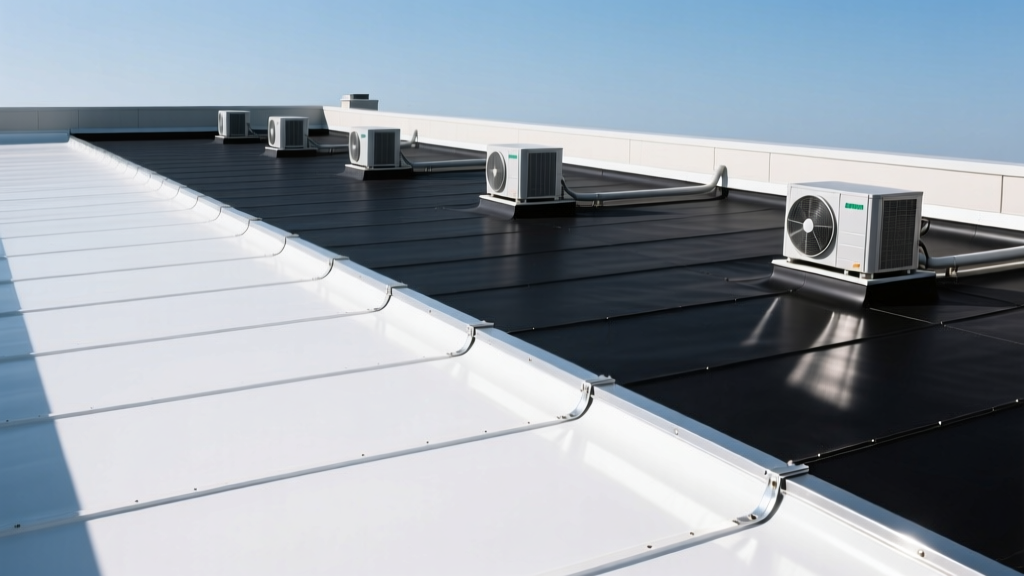
When evaluating roofing materials flat roof systems require, single-ply membranes dominate the commercial and modern residential landscape. Unlike steep-slope roofing that relies on gravity and overlapping shingles to shed water, low-slope roofs (defined as having a pitch of 3:12 or less) demand continuous, watertight barriers. The selection between Thermoplastic Polyolefin (TPO), Polyvinyl Chloride (PVC), and Ethylene Propylene Diene Monomer (EPDM) dictates not only the initial capital expenditure but the long-term thermal performance and maintenance lifecycle of the building.
TPO (Thermoplastic Polyolefin): The Reflective Standard
TPO has captured the majority of the commercial low-slope market due to its balance of cost, reflectivity, and ease of installation. Modern Gen-3 TPO formulations (such as GAF EverGuard Extreme or Carlisle Sure-Weld) have resolved the premature seam failures and plasticizer migration issues that plagued early-2010s generations. TPO membranes are typically installed in 60-mil or 80-mil thicknesses. The seams are fused using hot-air welding, creating a monolithic bond that is often stronger than the membrane itself.
PVC (Polyvinyl Chloride): The Chemical-Resistant Workhorse
PVC membranes, like Sika Sarnafil G 410 or Firestone (Elevate) UltraPly, are the premier choice for environments exposed to harsh chemicals, animal fats, or industrial exhaust. PVC is inherently resistant to the animal fats and vegetable oils expelled by restaurant rooftop exhaust fans, which can rapidly degrade TPO and EPDM. PVC utilizes hot-air welding similar to TPO, but its molecular structure includes plasticizers that keep the material flexible. A critical installation rule: PVC must never come into direct contact with expanded polystyrene (EPS) insulation or asphaltic products, as these will extract the plasticizers and cause the membrane to become brittle and shatter.
EPDM (Ethylene Propylene Diene Monomer): The Budget-Friendly Classic
EPDM is a synthetic rubber membrane renowned for its durability, UV resistance, and low initial cost. Available primarily in black (though white is manufactured at a premium), black EPDM absorbs solar radiation, which can be advantageous in northern climates to aid snowmelt but detrimental in hot climates where it increases cooling loads. Seams are joined using liquid primers and double-sided butyl seam tape, or liquid adhesives. While modern seam tapes are highly reliable, they remain the most common point of failure if the primer is applied in high humidity or if the substrate is not perfectly clean.
Material Comparison Matrix
| Material | Standard Thickness | Installed Cost (per sq. ft.) | Expected Lifespan | Primary Vulnerability |
|---|---|---|---|---|
| TPO | 60 - 80 mil | $5.50 - $8.50 | 20 - 30 years | Punctures; early-gen seam failure |
| PVC | 50 - 80 mil | $6.50 - $10.50 | 25 - 30+ years | Plasticizer loss from incompatible substrates |
| EPDM | 45 - 60 mil | $4.50 - $7.50 | 25 - 35 years | Membrane shrinkage; tape seam degradation |
| SBS Mod-Bit | 2-ply system | $5.00 - $8.50 | 20 - 25 years | Blistering; torch-application fire risk |
Note: Costs reflect 2026 national averages for fully adhered or mechanically fastened systems over existing decking, including standard polyiso insulation replacement. Regional labor variations and structural decking repairs will alter final pricing.
Modified Bitumen: The Heavy-Duty Alternative
For buildings requiring exceptional puncture resistance or for roofs with complex geometries and numerous penetrations, Modified Bitumen (Mod-Bit) remains a formidable choice. Mod-Bit is an asphalt-based system fortified with polymer modifiers. The two primary variants are APP (Atactic Polypropylene) and SBS (Styrene-Butadiene-Styrene).
- SBS (Rubberized): Offers superior elasticity and cold-weather flexibility. It can be torch-applied, mopped in hot asphalt, or installed using cold-process adhesives. SBS is the preferred choice in regions with severe freeze-thaw cycles.
- APP (Plasticized): Typically torch-applied, APP flows smoothly when heated and creates a highly UV-resistant cap sheet. However, it lacks the elastic recovery of SBS and is more prone to cracking in extreme cold.
Decision Framework: Matching Membrane to Building Use
Selecting the correct roofing materials flat roof systems require is not about finding the 'best' overall product, but the best product for the specific building environment. Use this framework to guide your specification:
- Restaurants & Food Processing Facilities: Specify PVC. The animal fats and grease expelled from rooftop ventilators will saponify and destroy TPO and EPDM. PVC's chemical resistance is non-negotiable here.
- Warehouses & Big-Box Retail (Unconditioned or Lightly Conditioned): Specify Mechanically Fastened EPDM or TPO. The goal is to minimize initial capital expenditure while providing adequate weatherproofing. Black EPDM is often the lowest cost per square foot.
- Office Buildings & Hospitals (Highly Conditioned): Specify Fully Adhered 80-mil TPO or PVC. A fully adhered system prevents wind billowing, and the high solar reflectance index (SRI) of white membranes drastically reduces HVAC cooling loads. According to the U.S. Department of Energy, cool roofs can reduce peak cooling demand by 10-15%, significantly lowering utility costs and extending roof lifespan by reducing thermal shock.
- High-Wind & Coastal Zones: Specify Fully Adhered PVC or Fleece-Backed TPO. Mechanically fastened systems are vulnerable to wind uplift. Fully adhered systems bond the membrane directly to the insulation and cover board, distributing wind loads across the entire deck.
Critical Installation Gotchas & Failure Modes
Even the most premium membrane will fail if installation protocols are ignored. As a building owner or facility manager, monitor your roofing contractor for these specific failure points:
Over a 15 to 20-year lifespan, EPDM naturally shrinks. If the membrane is tightly pulled around PVC pipe penetrations without adequate slack, the shrinkage will eventually pull the membrane away from the pipe boot, causing immediate leaks. Ensure installers use reinforced EPDM pipe boots and leave a slight 'balloon' of slack around the penetration base.
TPO hot-air welders must be calibrated daily based on ambient temperature and humidity. If the welder is too hot, the membrane scorches and weakens; if too cool, the seam creates a 'cold weld' that will peel apart under wind uplift. Demand that your contractor performs a test weld and performs a peel test every morning before production welding begins.
Insulation and Cover Boards: The Hidden Cost Drivers
When budgeting for a flat roof replacement, the membrane itself is only one component. Upgrading to current energy codes often requires adding polyisocyanurate (polyiso) insulation. Polyiso provides an R-value of approximately 5.6 per inch. Furthermore, installing a high-density fiberglass or gypsum cover board (such as Georgia-Pacific DensDeck) between the insulation and the membrane is highly recommended. Cover boards cost an additional $0.75 to $1.25 per square foot but increase puncture resistance by up to 40% and provide a stable, fire-resistant substrate for fully adhered membranes. The Cool Roof Rating Council (CRRC) also notes that proper insulation continuity is vital to prevent thermal bridging, which can lead to interior condensation and mold growth beneath the roof deck.
Final Specification Checklist
Before signing a contract for your flat roof system, ensure the proposal explicitly details the following:
- Exact membrane manufacturer and product line (e.g., Carlisle Sure-Weld TPO, not just '60-mil TPO').
- Fastener type and density (e.g., '3-inch galvanized screws with neoprene washers, placed 12 inches on center in the seam').
- Weld seam width (Minimum 1.5 inches for all hot-air welded single-ply systems).
- Warranty terms: Distinguish between a 'Material Only' warranty and a 'No Dollar Limit' (NDL) labor and material warranty backed by the manufacturer.
By matching the specific chemical, thermal, and structural demands of your building to the precise material properties of TPO, PVC, EPDM, or Modified Bitumen, you secure a low-slope roof that delivers decades of watertight performance.
Written by
Elena RodriguezElena Rodriguez is a civil engineer and technical writer specializing in concrete technology, masonry systems, and ASTM/ACI compliance. She earned her B.S. in Civil Engineering from Texas A&M University and spent a decade at a materials testing laboratory, performing over 2,000 concrete compressive strength tests and masonry prism evaluations. Elena is an ACI-certified Field Testing Technician (Grade I) and a member of ASTM Committee C12 on Natural Building Stone. She currently consults on forensic engineering cases involving concrete failures and moisture intrusion. Based in San Antonio, TX, Elena is a proud member of the Society of Women Engineers (SWE) and coaches her daughter's FIRST Robotics team.
More from Elena Rodriguez
View all
Walls & Panels
Cost Analysis: Light Gauge Steel Framing Advantages and Disadvantages
Evaluate light gauge steel framing advantages and disadvantages through a strict cost analysis lens, comparing material, labor, and lifecycle expenses.
Aug 4, 2026

Walls & Panels
Gypsum Board Types: Exact Specifications, Thickness & Dimensions
Compare standard, Type X, and moisture-resistant gypsum board types. Get exact specifications, thicknesses, dimensions, and ASTM standards for your project.
Aug 4, 2026

Fire Resistance
Best Fire-Resistant Outdoor Decking Materials: 2026 Buyer Guide
Discover the best fire-resistant outdoor decking materials for 2026. Compare Class A PVC, aluminum, and hardwood options for WUI compliance and safety.
Aug 4, 2026