How to Choose the Right Type of Roof Material by Climate
Discover which type of roof material performs best in your specific climate zone. Compare costs, lifespans, and extreme weather durability.

Choosing the right type of roof material is rarely a one-size-fits-all decision. A roofing system that thrives for 50 years in the arid Southwest will likely suffer catastrophic failure within a decade if installed in the freeze-thaw cycles of the Northeast. Environmental stressors—UV radiation, thermal shock, wind uplift, and biological growth—dictate the true lifespan of your roof far more than the manufacturer’s baseline warranty.
This guide breaks down the optimal roofing materials by specific climate zones, providing exact product specifications, installation nuances, and failure modes to ensure your investment withstands local environmental extremes.
The Climate-Material Decision Matrix
Before evaluating specific brands or profiles, use this high-level matrix to identify the primary environmental threat in your region and the corresponding material class designed to neutralize it.
| Climate Zone | Primary Environmental Threat | Optimal Material Class | Material to Avoid |
|---|---|---|---|
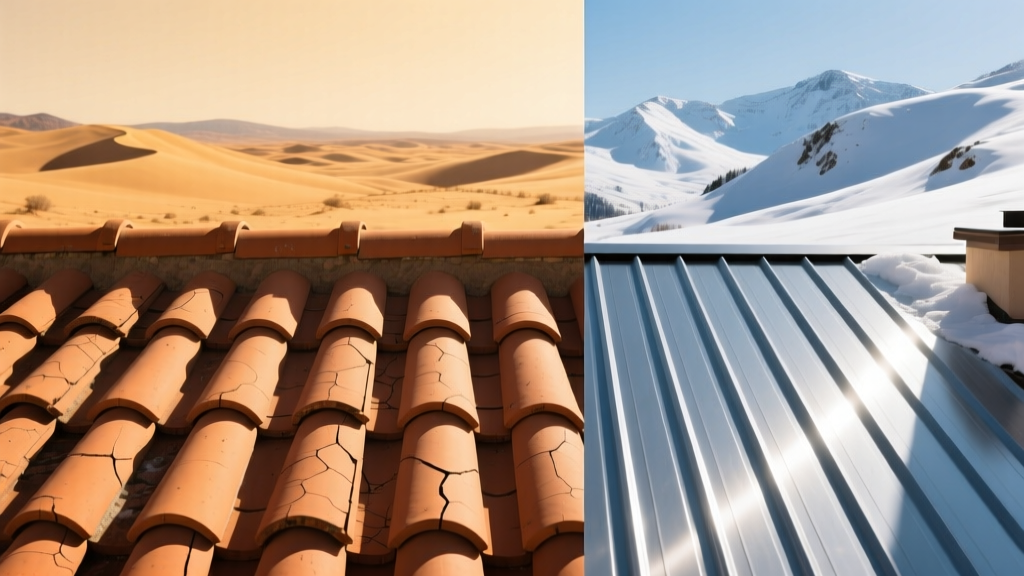
| Hot & Arid (Southwest US) | UV degradation, thermal expansion | Clay tile, Cool-roof coated metal | Standard 3-tab asphalt, untreated wood |
| Cold & Snow-Heavy (Northeast/Canada) | Ice dams, freeze-thaw spalling, snow load | Standing seam metal, synthetic slate | Porous concrete tile, low-grade wood shakes |
| Hurricane/High-Wind (Gulf/Atlantic Coast) | Wind uplift, projectile impact | Impact-rated shingles, mechanically fastened metal | Loose-laid gravel, standard clay tile |
| High-Humidity (Pacific NW, Tropics) | Algae, moss, moisture retention, rot | Algae-resistant architectural shingles, metal | Wood shakes, organic felt underlayment |
Hot and Arid Climates: Beating UV and Thermal Shock
In regions where summer roof surface temperatures routinely exceed 160°F (71°C), the primary enemies are UV-induced polymer breakdown and thermal shock (rapid temperature drops at night causing materials to crack).
Top Choice: Clay Tile and High-SRI Metal
Clay tiles, such as the Boral Terra Cotta or Ludowici Spanish S profiles, possess natural thermal mass and an air gap beneath the tiles that creates a ventilated buffer, reducing heat transfer into the attic by up to 40%. For metal roofing, specify a standing seam system finished with a Kynar 500® (PVDF) resin coating. Crucially, the coating must have a high Solar Reflectance Index (SRI). According to the Cool Roof Rating Council (CRRC), an SRI of 50 or higher is required to significantly reduce cooling loads and prevent the metal from expanding and contracting violently.
Cold and Snow-Heavy Climates: Managing Ice and Load
Roofs in snow-heavy regions face two distinct mechanical threats: the sheer dead load of accumulated snow and the hydrostatic pressure of ice dams. The ideal type of roof material here must shed snow efficiently and resist moisture intrusion when ice blocks the eaves.
Top Choice: 24-Gauge Standing Seam Metal
Metal roofs are the undisputed leaders in snow country. The hard, slick surface allows snow to slide off before it can melt and refreeze at the eaves. Specify a minimum 24-gauge steel (thicker than the standard 26-gauge) with a structural standing seam profile. The seams should be mechanically seamed on-site to a 180-degree or 360-degree fold, creating a continuous interlocking barrier that water cannot penetrate even if ice backs up under the panels.
The Underlayment Imperative
The metal panels are only half the system. In cold climates, the deck must be protected by a self-adhering polymer-modified bitumen membrane (commonly known as ice and water shield). Products like Grace Ice & Water Shield® or Carlisle WIP 300HT must be installed not just at the eaves, but extending at least 24 inches past the interior warm wall line, as well as in all valleys and around penetrations. Standard synthetic underlayment will not self-seal around fasteners if ice damming forces water uphill.
High-Wind and Hurricane Zones: Uplift and Impact Resistance
In coastal and hurricane-prone regions, wind uplift is the primary cause of catastrophic roof failure. When wind hits the windward wall of a house, it creates positive pressure, but as it flows over the roof, it creates severe negative pressure (suction) that literally attempts to peel the roof off the structure.
Top Choice: FORTIFIED Rated Systems
Look for materials tested to meet the Insurance Institute for Business & Home Safety (IBHS) FORTIFIED Home standards. For shingles, this means architectural shingles rated for 130 mph winds, such as the Owens Corning Duration® Storm, which utilizes a woven fabric backing for superior tear resistance.
Even the best shingle will fail in a hurricane if improperly fastened. In High-Velocity Hurricane Zones (HVHZ) like Miami-Dade, building codes require a 6-nail pattern per shingle (instead of the standard 4) using 11-gauge stainless steel or hot-dipped galvanized roofing nails with a minimum 3/8-inch head. Furthermore, nails must penetrate the roof deck by at least 3/4 of an inch to achieve the required pull-out resistance.
Concrete Tile in Wind Zones
If you prefer the aesthetic of tile in a high-wind zone, you must use concrete or clay tiles that possess a Miami-Dade Notice of Acceptance (NOA). These tiles require a two-part fastening system: a corrosion-resistant screw or nail at the head, combined with a specialized tile adhesive (like Dura-Foam or polyurethane adhesives) at the tail to prevent the tile from chattering and breaking under wind vibration.
High-Humidity and Heavy Rainfall Regions: Biological Warfare
In the Pacific Northwest, the Southeast, and tropical climates, the roof is in a constant battle against biological growth. Moss, algae, and lichen retain moisture against the roof surface, accelerating the degradation of almost all materials and causing unsightly black streaks (Gloeocapsa magma algae).
Top Choice: Copper-Infused Shingles and Synthetic Slate
For asphalt roofs, you must specify shingles with time-release copper or zinc-infused granules. GAF Timberline HDZ™ with StainGuard Plus™ utilizes a proprietary microsite technology that encapsulates copper, releasing it slowly over 25 years to prevent algae spores from taking root.
For a premium, maintenance-free alternative, synthetic slate and shake products (such as DaVinci Roofscapes or Enviroshake) are molded from engineered polymers that are completely impervious to moisture absorption. Unlike natural wood or porous slate, these synthetics offer zero nutritional value or surface texture for moss rhizoids to anchor into.
Flashing and Hardware Details
In high-humidity zones, standard galvanized steel flashing will rust and fail long before the roofing material does. Upgrade all step flashing, valley metal, and drip edges to 16 oz. cold-rolled copper or .032-inch aluminum. Additionally, install zinc strips (at least 3 inches wide) just below the ridge cap; as rain washes over the zinc, it deposits trace amounts of zinc carbonate down the roof slope, creating an environment hostile to moss and algae.
Cost, Lifespan, and Maintenance Breakdown
The initial cost of a roof must be weighed against its expected lifespan in your specific climate. The following data reflects average installed costs (materials and labor) for a standard 2,000 sq. ft. single-story home in 2026.
| Material Type | Average Installed Cost (per sq. ft.) | Expected Lifespan | Climate Suitability | Maintenance Level |
|---|---|---|---|---|
| Architectural Asphalt (SBS Modified) | $5.50 - $8.50 | 25 - 35 Years | All (with climate-specific coatings) | Low |
| Standing Seam Metal (24-Gauge Steel) | $14.00 - $22.00 | 40 - 60 Years | Excellent for Snow, Wind, and Heat | Very Low |
| Clay / Concrete Tile | $18.00 - $32.00 | 50 - 100 Years | Excellent for Heat and Wind (if fastened) | Medium (underlayment replacement at 30 yrs) |
| Synthetic Slate / Shake | $16.00 - $25.00 | 50+ Years | Excellent for Humidity and Impact | Very Low |
| Natural Slate | $28.00 - $45.00+ | 75 - 150 Years | Good for Cold/Humidity (Avoid in seismic/high-hail) | Low (requires specialized repairs) |
The Hidden Variable: Roof Decking and Ventilation
No type of roof material will reach its rated lifespan if the underlying deck and ventilation are compromised. In all climate zones, proper attic ventilation is non-negotiable. A balanced system—intake vents at the soffits and exhaust vents at the ridge—prevents heat buildup in the summer (which bakes shingles from underneath) and moisture condensation in the winter (which rots the OSB or plywood deck).
When replacing a roof, always have the contractor inspect the roof decking. If you are upgrading from 3-tab shingles to a heavier material like slate, tile, or even architectural shingles with a heavy snow load, the existing 7/16-inch OSB may not meet the structural deflection criteria (L/240). Upgrading to 5/8-inch CDX plywood or adding structural blocking between trusses may be required to prevent the deck from sagging, which causes the roofing material to crack, pool water, and fail prematurely.
By matching the physical properties of your roofing material to the specific meteorological stressors of your region—and refusing to cut corners on underlayment, fasteners, and ventilation—you transform your roof from a recurring maintenance expense into a permanent structural asset.
Written by
Marcus ChenMarcus Chen is a licensed structural engineer (PE) and building materials analyst with over 12 years of experience across residential, commercial, and industrial construction. He holds a Master of Science in Civil Engineering from UC Berkeley and spent six years at Thornton Tomasetti before transitioning to independent consulting and technical writing. Marcus specializes in material selection for seismic-prone regions, concrete reinforcement strategies, and lifecycle cost analysis. His work has been cited by the American Concrete Institute (ACI) and the Structural Engineers Association of California (SEAOC). When he is not on a job site or at his desk, you will find him hiking the Sierra Nevada or restoring a 1920s craftsman bungalow in Oakland, CA.
More from Marcus Chen
View all
Construction Cost
How Much Did the Eiffel Tower Cost to Build?
How much did the Eiffel Tower cost to build in 1889? We adjust for inflation and compare its budget to modern skyscraper construction.
Aug 4, 2026

Fire Resistance
What Is a Fire Resistant Material? Testing & Certification Guide
Discover what is a fire resistant material through ASTM and UL testing. Learn how fire ratings, certifications, and assemblies work in construction.
Aug 4, 2026

Construction Cost
How Much Did the Burj Khalifa Cost to Build?
How much did the Burj Khalifa cost to build? We break down the $1.5B project and extract 5 money-saving strategies for your next build.
Jul 30, 2026