Roofing Membrane Selection: Matching Materials to Low-Slope Scenarios
Match the right roofing membrane to your low-slope project. Compare EPDM, TPO, PVC, and modified bitumen costs, lifespans, and climate fit.
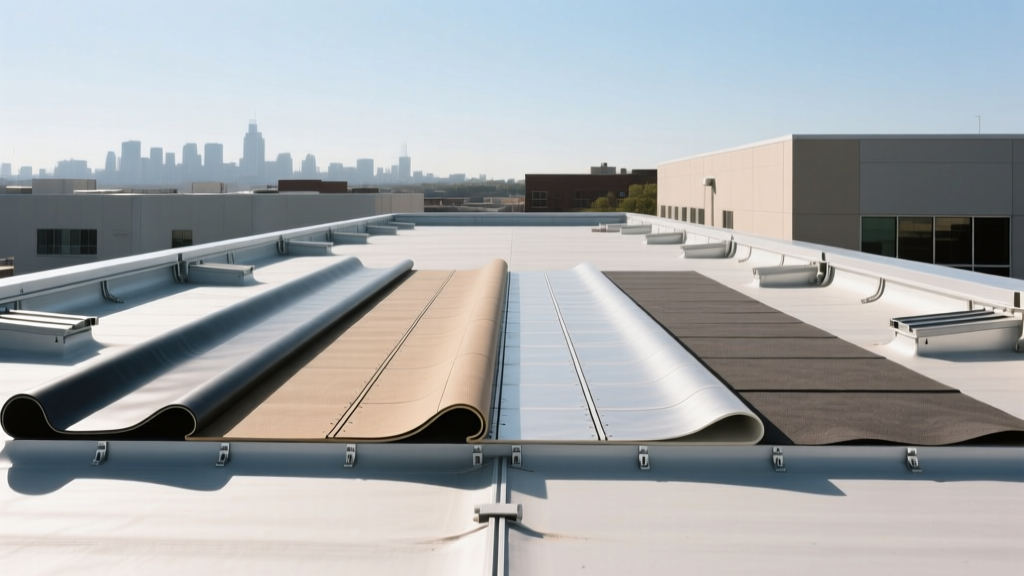
The Low-Slope Dilemma: Why One Membrane Doesn't Fit All
Flat and low-slope roofs—defined structurally as having a pitch of 3:12 or less—demand continuous, watertight barriers. Unlike steep-slope systems that rely on gravity and overlapping shingles to shed water, low-slope systems must withstand ponding water, extreme thermal shock, and structural deflection. Selecting the correct roofing membrane is not about finding a universally superior product; it requires matching specific chemical, thermal, and mechanical properties to your building's exact operational scenario, local climate, and budget.
Scenario Matching Matrix: 4 Primary Roofing Membranes
The commercial and residential low-slope market is dominated by four distinct membrane categories. Use this matrix to identify the baseline fit for your project before diving into specific manufacturer specifications.
| Membrane Type | Best Application Scenario | Installed Cost (per sq. ft.) | Expected Lifespan | Primary Vulnerability |
|---|---|---|---|---|
| TPO (Thermoplastic Polyolefin) | Budget-conscious reflective roofs; standard commercial boxes | $3.50 - $5.50 | 20 - 30 years | Degrades when exposed to grease, oils, or ketones |
| PVC (Polyvinyl Chloride) | Restaurants, chemical plants, high-pollution environments | $5.00 - $8.00 | 25 - 30+ years | Incompatible with EPS insulation and asphalt without separation |
| EPDM (Ethylene Propylene Diene Monomer) | Cold climates, complex roof geometries, heating-dominant zones | $4.00 - $6.50 | 25 - 40 years | Seam tape degradation if improperly primed or exposed to ponding |
| Modified Bitumen (SBS/APP) | High foot traffic, roof decks, puncture-prone environments | $4.50 - $7.00 | 20 - 25 years | Blistering from trapped moisture; torch application fire risks |
Deep Dive: Application-Specific Membrane Profiling
TPO: The Budget-Conscious Reflective Standard
Thermoplastic Polyolefin (TPO) dominates new commercial construction due to its balance of cost, reflectivity, and ease of installation. Industry benchmarks like Carlisle Sure-Weld and GAF EverGuard set the standard. For commercial applications, always specify a minimum 60-mil thickness. While 45-mil TPO is cheaper upfront, it is highly susceptible to puncture from hail or dropped HVAC maintenance tools. Conversely, 80-mil is generally overkill unless the building is in a severe hail zone (FM 1-90 or higher impact ratings).
TPO seams are heat-welded using hot air guns, creating a monolithic bond that is physically stronger than the membrane itself. However, TPO has a critical chemical weakness: it degrades rapidly when exposed to animal fats, vegetable oils, or ketones. Never specify TPO for buildings with restaurant kitchen exhausts or industrial chemical venting.
PVC: The Chemical and Grease Resistance Champion
Polyvinyl Chloride (PVC) is the premium single-ply choice for chemical resistance. Manufacturers like Sika Sarnafil and FiberTite utilize polyester scrim reinforcement to provide exceptional tensile strength and dimensional stability. PVC is mandatory for buildings with kitchen exhaust, chemical processing, or heavy airborne pollutants. It actively resists the animal fats and industrial oils that would dissolve a TPO membrane.
EPDM: The Cold Climate and Complex Geometry Workhorse
Ethylene Propylene Diene Monomer (EPDM) is a thermoset rubber membrane. While available in white, black EPDM accounts for roughly 90% of installations. Black EPDM is highly advantageous in heating-dominant climates (IECC Zones 5 through 8). It absorbs solar radiation, reducing winter heating loads and facilitating snowmelt to prevent ice damming at parapets. According to the EPDM Roofing Association, properly maintained and reinforced EPDM systems can routinely exceed 40 years of service life.
For complex roofs with numerous penetrations (pipes, skylights, HVAC curbs), EPDM's high elasticity allows it to stretch and conform to irregular shapes better than rigid thermoplastics. Modern installations rely on 3-inch or 6-inch double-sided butyl seam tape rather than liquid contact adhesives, drastically reducing labor time and eliminating VOC emissions during installation.
Modified Bitumen: The High-Traffic and Puncture-Resistant Standard
Modified Bitumen bridges the gap between traditional built-up roofing (BUR) and modern single-plies. It is an asphalt-based membrane fortified with polymers. SBS (Styrene-Butadiene-Styrene) adds rubberized flexibility, making it ideal for cold climates and buildings prone to structural deflection. APP (Atactic Polypropylene) adds plastic rigidity, performing better in high-heat environments. SOPREMA and GAF are leading manufacturers in this space.
Typically installed in multiple plies with a granular cap sheet, Mod-Bit offers superior puncture resistance and handles high foot traffic far better than single-ply membranes. It is the default choice for roofs that serve as pedestrian decks or require frequent maintenance access.
Climate and Environmental Decision Tree
Use this rapid diagnostic framework to narrow down your membrane selection based on environmental variables:
- If the roof is above a commercial kitchen or chemical lab: Select PVC. The chemical resistance to grease and ketones is non-negotiable.
- If the building is in a northern, heating-dominant climate (Zones 5-8): Select Black EPDM or an insulated TPO system with high R-value Polyiso to prevent thermal drift.
- If the roof experiences high foot traffic or serves as a terrace: Select Modified Bitumen with a heavy granular cap sheet, or install dedicated walkway pads over a reinforced PVC/TPO system.
- If the building is in a cooling-dominant sunbelt climate (Zones 1-3): Select White TPO or White PVC. The U.S. Department of Energy's Cool Roofs guide highlights that high-albedo white membranes can reduce peak cooling demand by 10% to 15% in these regions.
Hidden Costs: Insulation Compatibility and Fastening Methods
The membrane itself is only one component of the roofing assembly. The insulation type and fastening method drastically alter the final cost and performance profile.
Insulation Selection
Polyisocyanurate (Polyiso) is the standard for commercial low-slope roofs due to its high R-value per inch (R-5.6 to R-6.0). However, Polyiso suffers from 'thermal drift'—its R-value degrades in freezing temperatures. In cold climates, consider a hybrid approach: a base layer of Extruded Polystyrene (XPS) or Expanded Polystyrene (EPS) beneath the Polyiso to maintain thermal resistance during winter months.
Fastening Methods and Wind Uplift
- Mechanically Attached: Lowest cost. Uses plates and screws. Vulnerable to wind uplift if not properly zoned.
- Fully Adhered: Adds $1.25 to $1.75 per sq. ft. in labor and adhesive. Required for high wind zones (FM 1-90 or higher) and provides a superior aesthetic without visible fastener dimples.
- Ballasted: Uses river stone or concrete pavers. Lowest installation labor, but requires the building's structural engineer to verify the roof deck can support 10-15 lbs per sq. ft. of dead load.
Always refer to Carlisle SynTec Systems or the specific manufacturer's technical guidelines for exact fastener density patterns, particularly in the corner and perimeter zones where wind uplift forces are exponentially higher than in the field of the roof.
Real-World Failure Modes and How to Avoid Them
Understanding how membranes fail in the field allows you to specify preventative measures during the design phase.
1. Seam Shrinkage and Flashing Pull
The Issue: Early-generation, unreinforced TPO and PVC membranes were prone to thermal shrinkage over time, pulling the membrane taut and tearing it away from edge flashings and penetrations.
The Fix: Always specify scrim-reinforced membranes (polyester or fiberglass internal scrim). The scrim provides dimensional stability, virtually eliminating thermal shrinkage and ensuring flashings remain secure.
2. Ponding Water Blisters
The Issue: Modified bitumen and adhered EPDM can develop blisters if moisture is trapped within the insulation substrate or if the roof deck lacks adequate slope, leading to standing water that heats up and vaporizes.
The Fix: Mandate a minimum 1/4-inch per foot slope using tapered Polyiso insulation boards. Additionally, install a vapor retarder on the deck level if the building interior generates high humidity (e.g., swimming pools, manufacturing facilities).
3. Perimeter Wind Uplift Tear-Off
The Issue: Mechanically fastened systems failing at the roof edge during severe storms because the contractor used a uniform fastener pattern across the entire roof.
The Fix: Require the contractor to follow ANSI/SPRI FX-1 standards for wind design. The roof must be divided into three zones: Field, Perimeter, and Corner. Fastener density must double in the Perimeter zone and triple in the Corner zone to resist concentrated uplift forces.