How Long Do Different Roof Material Types Last? A Durability Guide
Compare the lifespan, failure modes, and durability of popular roof material types. Expert data on asphalt, metal, tile, and synthetic options.

Selecting a roofing system requires looking past initial installation costs to evaluate long-term degradation, structural demands, and climate-specific failure modes. The lifespan of various roof material types ranges from 15 years for basic economic options to over a century for premium masonry and stone products. Understanding the exact chemical and physical breakdown mechanisms of these materials allows property owners to calculate true lifecycle costs and schedule precise maintenance interventions.
The Hierarchy of Roofing Lifespans
Lifecycle Expectancy Summary
- Economy Asphalt (3-Tab): 15–20 years
- Premium Architectural Shingles: 30–50 years
- Exposed-Fastener Metal: 20–30 years
- Standing Seam Metal: 40–70 years
- Synthetic Polymer/Composite: 50+ years
- Concrete Tile: 50–70 years
- Clay Tile & Natural Slate: 100+ years
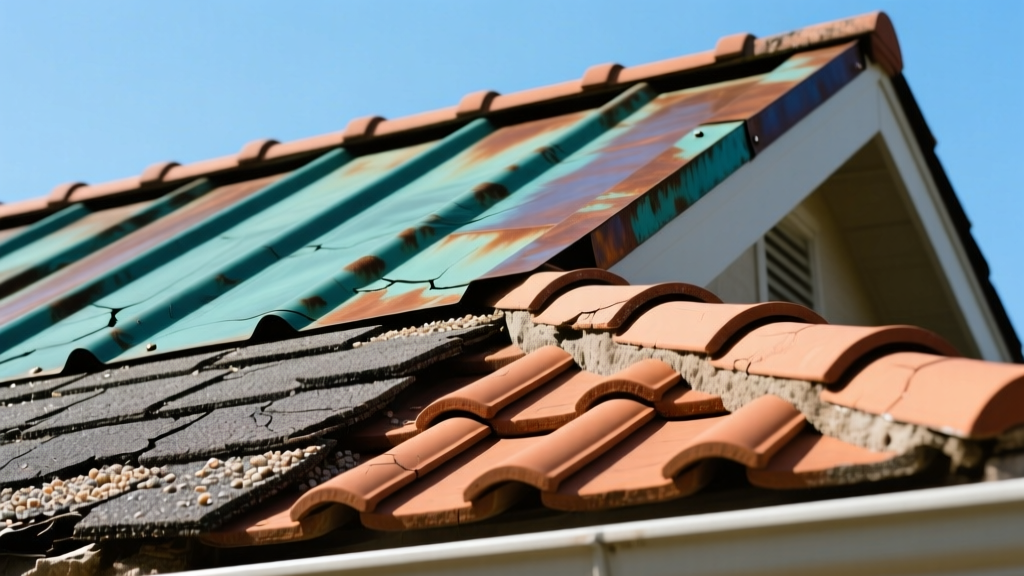
Asphalt Shingles: The Baseline for Durability
Asphalt shingles dominate the residential market, but their durability varies drastically based on manufacturing composition. All fiberglass asphalt shingles must meet ASTM D3462 standards for tear strength and fastener pull-through, but the thickness of the asphalt coating and the quality of the ceramic granules dictate real-world longevity.
3-Tab vs. Architectural Shingles
Standard 3-tab shingles feature a single, uniform layer of asphalt-coated fiberglass. They are highly susceptible to wind uplift (typically rated for only 60 mph) and thermal cracking. Architectural shingles, such as the GAF Timberline HDZ or Owens Corning Duration, utilize a laminated, multi-dimensional design that increases thickness by up to 50%. This added mass provides superior resistance to thermal shock and wind uplift (often rated up to 130 mph).
Primary Failure Modes
- Granule Loss: UV radiation degrades the asphalt binder. Once ceramic granules wash away, the exposed asphalt oxidizes, becomes brittle, and cracks.
- Thermal Blistering: Trapped moisture within the manufacturing process expands under high heat, causing surface blisters that eventually rupture and expose the mat.
- Algae Staining: In humid climates, Gloeocapsa magma bacteria consume the limestone filler in the shingles, causing black streaks that retain moisture and accelerate decay.
2026 Cost Context: Installed architectural shingles currently range from $4.50 to $7.50 per square foot, making them the most cost-effective option for a 30-year lifecycle.
Metal Roofing Systems: Fastener Exposure is the Deciding Factor
Metal roofing offers exceptional longevity, but the system's profile dictates its ultimate lifespan. The critical vulnerability in any metal roof is the penetration point where the panel meets the decking.
Standing Seam (Concealed Fastener)
Panels interlock via raised seams, and hidden clips secure the roof to the decking. This allows the metal to expand and contract freely with temperature fluctuations without stressing the fastener holes. Properly maintained Galvalume (AZ55) standing seam roofs routinely last 50 to 70 years.
Exposed Fastener (Corrugated/R-Panel)
Screws pierce directly through the metal into the framing. The neoprene or EPDM rubber washers on these screws degrade under UV exposure and thermal cycling, typically requiring replacement every 15 to 20 years to prevent leaks. Overall system lifespan is generally capped at 30 years.
According to the Insurance Institute for Business & Home Safety (IBHS), metal roofs consistently achieve Class 4 impact resistance (UL 2218), making them the premier choice for hail-prone regions. However, installers must avoid galvanic corrosion by ensuring incompatible metals (like copper flashing against steel panels) never make direct contact.
Slate, Clay, and Concrete Tile: The Century-Club Materials
Masonry and stone roofing materials offer unparalleled lifespans, frequently outlasting the structures they cover. However, their durability is inextricably linked to structural engineering and climate suitability.
Natural Slate
High-quality slate (such as unfading Vermont or Buckingham Virginia slate) contains low levels of calcium carbonate, preventing the acid rain degradation seen in cheaper imported alternatives. Slate weighs between 800 and 1,000 pounds per square (100 square feet). Homes must be engineered with reinforced roof trusses to support this dead load, adding significant upfront structural costs.
Clay and Concrete Tile
Concrete tiles are extruded and cured, lasting roughly 50 years before the color coating fades and the porous concrete requires sealing. Clay tiles are kiln-fired, rendering them virtually impervious to water and UV degradation, easily exceeding 100 years.
Warning for Cold Climates: Standard clay tiles are highly porous. In regions with frequent freeze-thaw cycles, water enters the microscopic pores, freezes, expands, and causes the tile to spall or shatter. Only ASTM C1167 Grade 1 (freeze-thaw rated) clay tiles should be installed in northern climate zones.
Synthetic and Composite Shingles: The Modern Contenders
Engineered polymers and recycled rubber composites have emerged as highly durable alternatives to natural slate and cedar shake. Brands like DaVinci Roofscapes (virgin polymer) and Euroshield (recycled rubber) manufacture products that mimic natural textures while eliminating the biological vulnerabilities of organic materials.
These synthetic roof material types do not absorb water, preventing rot, mold, and freeze-thaw damage. They consistently achieve Class A fire ratings and Class 4 impact ratings. While the material cost is high ($12.00 to $18.00 per square foot installed), the elimination of maintenance and the 50-year transferable warranties provide a strong return on investment for high-end residential and commercial applications.
Environmental Degradation Matrix
Material durability is not absolute; it is relative to the local environment. The following matrix outlines how specific climate stressors impact different roof material types.
| Climate Stressor | Most Resistant Material | Most Vulnerable Material | Degradation Mechanism |
|---|---|---|---|
| High UV / Extreme Heat | Clay Tile, Standing Seam | 3-Tab Asphalt, PVC Membrane | Asphalt bakes out, causing curling; PVC plasticizers migrate, causing brittleness. |
| Frequent Hail | Metal (24-gauge+), Class 4 Synthetic | Natural Slate, Clay Tile | Kinetic impact shatters brittle masonry and stone. |
| Coastal Salt Spray | Aluminum, Copper, Slate | Galvanized Steel (G90) | Chlorides rapidly corrode zinc coatings on standard steel panels. |
| Heavy Snow / Ice Dams | Standing Seam Metal | Wood Shakes, Asphalt | Ice damming forces meltwater under overlapping shingle layers. |
For properties in high-heat zones, the U.S. Department of Energy recommends utilizing cool-roof coatings or highly reflective metal panels to reduce thermal shock and lower cooling loads, which simultaneously extends the physical lifespan of the roofing membrane by reducing peak surface temperatures.
Maintenance Schedules to Maximize ROI
No roof material type achieves its maximum rated lifespan without proactive maintenance. Implement the following inspection and maintenance cadence to prevent minor anomalies from becoming catastrophic failures:
- Bi-Annual Debris Clearing: Remove leaves and pine needles from valleys and gutters. Trapped organic matter retains moisture, accelerating the corrosion of metal flashings and the rotting of asphalt underlayments.
- Post-Storm Flashing Inspection: Following any wind event exceeding 50 mph, inspect step flashings at wall intersections and pipe boots. These are the most common failure points for water intrusion, regardless of the primary roof material.
- Moss and Algae Treatment: If organic growth appears on asphalt or wood, apply a 50/50 mix of water and sodium hypochlorite (bleach) using a low-pressure garden sprayer. Never use a pressure washer on asphalt shingles, as the high-velocity water will strip the protective ceramic granules and void the manufacturer warranty.
- Sacrificial Anode Replacement (Metal Roofs): For coastal metal roofs, inspect zinc or magnesium sacrificial anodes every 3 years and replace them when 50% depleted to prevent galvanic corrosion of the primary panels.
By matching the specific physical properties of roof material types to the localized environmental stressors and adhering to strict maintenance protocols, property owners can ensure their roofing systems reach or exceed their maximum engineered lifespans.
Written by
David NakamuraDavid Nakamura is a licensed architect (AIA) and construction technology writer focused on sustainable building methods, mass timber engineering, and high-performance building envelopes. He holds a Master of Architecture from the University of Washington and is a certified Passive House Consultant (CPHC). David spent eight years at the Seattle firm Mithun, where he led the design of three LEED Platinum projects, before founding his own practice specializing in net-zero residential design. He serves on the editorial advisory board of GreenBuilder Magazine and has authored peer-reviewed papers on cross-laminated timber (CLT) connections for the Journal of Structural Engineering. In his spare time, David teaches woodworking at Pratt Fine Arts Center and kayaks the Puget Sound.
More from David Nakamura
View all
Construction Cost
Labor Cost to Build a Deck Per Sq Ft: 2026 Installation Guide
Discover the exact labor cost to build a deck per sq ft in 2026. This installation guide breaks down contractor rates, complexity factors, and hidden fees.
Aug 4, 2026

Construction Cost
How Much Does It Cost to Build a 3 Bedroom House? Financing Guide
Learn exactly how much it costs to build a 3 bedroom house and explore 2026 financing options, construction loan types, and budget frameworks for your build.
Aug 4, 2026

Construction Cost
Cost to Build a Tennis Court: 2026 Guide
How much does it cost to build a tennis court in 2026? Breakdowns for asphalt, concrete, and synthetic surfaces plus fencing and lighting.
Jul 30, 2026