Durability of Straw Roofing Material: Real Lifespan and Decay
Discover the true durability and lifespan of straw roofing material. Learn how to prevent decay, manage moisture, and extend your thatch roof's life.

The Reality of Straw Roofing Material Lifespan
When evaluating natural building envelopes, the durability of straw roofing material is frequently misunderstood. Unlike synthetic membranes that degrade uniformly from UV exposure, organic thatch decays through complex biological and mechanical interactions. The lifespan of a straw roof is not a fixed number; it is a direct result of botanical selection, harvesting mechanics, roof geometry, and micro-climate management. While a poorly executed wheat straw roof may rot in under a decade, a master-thatched rye or reed roof can easily protect a structure for half a century.
Material Comparison Matrix: Wheat Straw, Rye, and Water Reed
Selecting the correct agricultural byproduct or aquatic grass dictates your baseline maintenance schedule and replacement capital. Below is a comparative breakdown of the three primary organic roofing materials used in modern thatching.
| Material Type | Expected Lifespan | Minimum Pitch | Avg. Installed Cost (per sq. ft.) | Stem Structure & Decay Risk |
|---|---|---|---|---|
| Wheat Straw | 15 – 25 Years | 45° – 50° | $14 – $22 | Hollow, high capillary risk if crushed |
| Rye Straw | 20 – 30 Years | 45° – 50° | $18 – $26 | Hollow, thicker cuticle, highly flexible |
| Water Reed | 40 – 60+ Years | 40° – 45° | $28 – $45 | Solid core, low water absorption, dense |
Primary Failure Modes and Decay Mechanisms
Straw roofing material rarely fails from simple age; it fails from specific environmental triggers that accelerate lignin breakdown and fungal colonization. According to conservation guidelines outlined by Historic England, understanding these failure modes allows architects and homeowners to design preventative mitigations into the roof structure.
1. Mechanical Crushing and Capillary Wick
The most catastrophic error in modern straw roofing is the use of combine-harvested straw. Combine harvesters crush and break the cereal nodes (joints) of the straw. Because wheat straw is naturally hollow, a broken node acts as a capillary tube, wicking surface moisture deep into the core of the thatch bundle. For durable roofing, straw must be harvested using a traditional reaper-binder, which cuts the stem cleanly without crushing the vascular tissue, preserving its natural water-shedding cuticle.
2. Biological Colonization (Fungi and Algae)
Straw is composed of cellulose, hemicellulose, and lignin. When the moisture content within the thatch layer consistently exceeds 20%, wood-decay fungi (such as Phoma and Cladosporium) begin digesting the structural lignin. This is predominantly a problem on north-facing roof slopes or areas shaded by overhanging trees where UV radiation cannot dry the surface layer. Algae growth further traps moisture against the stems, creating a localized micro-climate that accelerates rot.
3. Fixing Corrosion and Wire Netting Expansion
Historically, thatchers used galvanized steel wire netting to secure the straw and deter birds. As the zinc coating degrades, the underlying steel rusts. Iron oxide expands up to seven times the volume of the original steel, physically splitting the thatch bundles from the inside and creating channels for water ingress. Modern best practice mandates the exclusive use of Grade 316 marine stainless steel wire or heavy-gauge nylon netting to eliminate expansion-based mechanical failure.
Critical Design Parameters for Maximum Durability
The physical geometry of the roof dictates how quickly water is evacuated from the straw matrix. Water must be shed before it can penetrate past the outer 2 inches of the thatch surface.
- Roof Pitch: The absolute minimum pitch for wheat straw is 45 degrees, though 50 degrees is optimal. For every 5 degrees the pitch drops below 45, the expected lifespan of the straw roofing material is reduced by up to 30% due to slowed water runoff and increased capillary creep.
- Eaves Overhang: A minimum overhang of 12 to 18 inches is required. This prevents rainwater splashback from the ground from saturating the lowest courses of the thatch and protects the underlying earth, cob, or timber walls from moisture ingress.
- Valley Avoidance: Internal valleys (where two roof slopes meet) are the enemy of straw. They concentrate water volume and accumulate organic debris (leaves, pine needles). If a valley is structurally unavoidable, it must be lined with lead or copper flashing and swept clear of debris bi-weekly during autumn.
The Ridge Vulnerability and Replacement Cycles
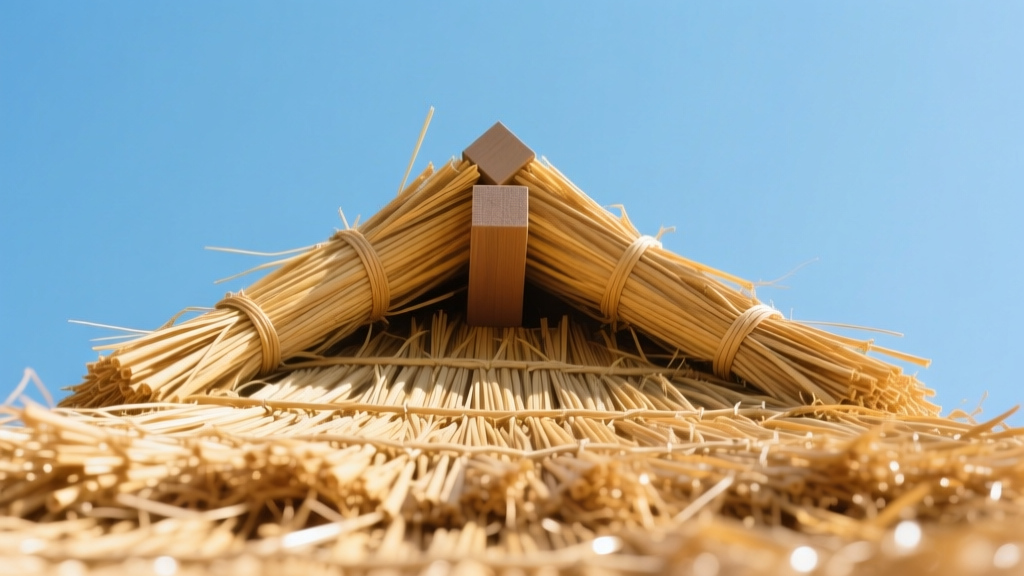
The ridge—the apex where two roof slopes intersect—is the most vulnerable point of any thatched structure. While the main coat of wheat straw may last 25 years, the ridge is exposed to extreme UV degradation, high-velocity wind shear, and direct vertical rain impact.
Chemical Treatments: What to Use and What to Avoid
The chemical treatment of straw roofing material is a subject of intense debate in the building conservation community. Misapplication of modern chemical sealants can destroy a roof faster than doing nothing at all.
'Never apply silicone-based water repellents or acrylic roof sealers to a thatched roof. Thatch relies on its ability to breathe—allowing internal condensation to evaporate outward. Sealants trap moisture inside the hollow stems, causing the roof to rot from the inside out while the surface appears perfectly dry.' — Guidance adapted from The Building Conservation Directory
Approved Treatments:
- Borate-Based Preservatives: Applied during the thatching process, borates (like disodium octaborate tetrahydrate) provide excellent resistance against wood-boring insects and offer a degree of fire retardancy without sealing the surface pores.
- Copper Naphthenate: Used selectively on the ridge and eaves to deter fungal growth and algae, though it will impart a greenish tint to the straw that eventually weathers to a muted brown.
- Intumescent Fire Retardants: Modern water-based intumescent sprays (specifically formulated for thatch) swell when exposed to extreme heat, creating a carbon char barrier. These must be reapplied every 5 to 7 years as they degrade under UV exposure.
Step-by-Step Maintenance Schedule for Longevity
To push your straw roofing material to the absolute upper limit of its lifespan, adhere to this strict chronological maintenance framework:
- Year 1 (The Settling Phase): The thatch will compress and settle. Have the original thatcher return after the first winter to 'dress' the roof—beating down raised bundles and tightening the hazel spars or stainless steel fixings that may have loosened.
- Years 2–9 (Surface Management): Annually remove leaf litter, pine needles, and moss from the surface. Trim back any overhanging tree branches to ensure a minimum 6-foot clearance, allowing wind and direct sunlight to dry the north-facing slopes.
- Years 10–15 (Ridge Replacement): Strip the degraded ridge material down to the base coat and install a new flush or block-cut ridge using fresh straw or sedge, secured with new stainless steel fixings.
- Year 20+ (Assessment for Spar Coating): If the main coat is thinning but the underlying rafters are dry, a master thatcher can perform a 'spar coat'—fixing a new 6-inch layer of straw directly over the old, weathered surface, effectively resetting the lifespan clock for another 20 years at a fraction of the cost of a full strip-and-replace.
Final Verdict: Is Straw Roofing Worth the Upkeep?
Straw roofing material offers unmatched thermal insulation (often achieving R-values of R-25 to R-30 depending on thickness) and exceptional acoustic dampening. However, its durability is entirely dependent on uncompromising execution. If you are willing to mandate reaper-binder harvested straw, enforce a 50-degree roof pitch, utilize marine-grade stainless steel fixings, and budget for a 12-year ridge replacement cycle, a straw roof will provide a highly durable, ecologically regenerative shelter that outperforms many modern synthetic alternatives in both lifespan and environmental impact.
Written by
Priya KapoorPriya Kapoor is a real estate market analyst and construction economics researcher with expertise in housing affordability, development feasibility, and infrastructure investment. She holds a Master of Regional Planning from Cornell University and previously worked as a senior analyst at CBRE's Investment Properties group, where she modeled returns for $4B in mixed-use development pipelines. Priya now runs an independent research practice advising developers, municipalities, and REITs on construction cost forecasting and market timing. She publishes the quarterly "BuildMat Market Pulse" report tracking material price indices across 12 commodity categories. Based in Austin, TX, Priya serves on the board of Habitat for Humanity Austin and is a marathon runner.
More from Priya Kapoor
View all
Construction Cost
Cost to Build a 1600 Sq Ft Home in 2026: Full Breakdown
Accurate 2026 cost to build a 1600 sq ft home—material, labor, and regional pricing breakdowns included. Plan your budget with real-time estimates.
Aug 11, 2026

Wood & Lumber
Name the Types of Wood for Pressure Treatment and Preservation
Learn how to name the types of wood best suited for pressure treatment. Compare species treatability, chemical retention levels, and 2026 preservation costs.
Aug 4, 2026

Stone & Masonry
Stone Veneer Suppliers Lindenhurst: 2026 Cost Analysis
Analyze 2026 stone veneer costs in Lindenhurst, NY. Compare local supplier pricing, delivery fees, and Suffolk County installation labor rates.
Aug 4, 2026