Corrugated Roofing Material Selection Framework Guide
Master our corrugated roofing material selection framework. Compare metal, PVC, and polycarbonate panels for gauge, coating, and pitch requirements.
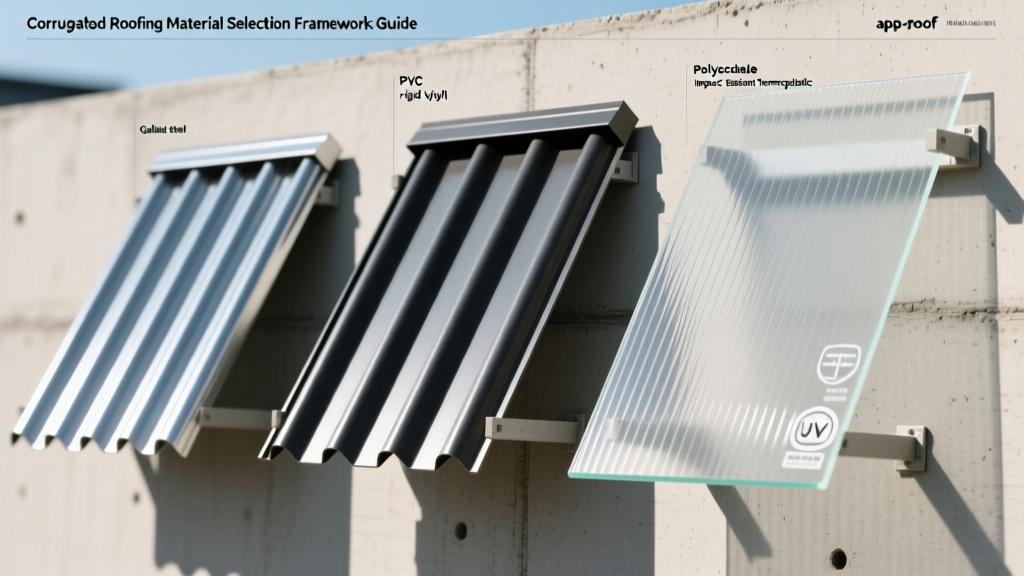
The Geometry Threshold: Pitch and Water Management
Corrugated roofing systems rely on overlapping capillary breaks rather than continuous sealed membranes. The fundamental selection constraint is roof pitch. For exposed-fastener corrugated panels, the absolute minimum pitch is 3:12 (a 3-inch vertical rise per 12 inches of horizontal run). Installing corrugated profiles below this threshold guarantees capillary draw, where wind-driven rain reverses flow up the minor ribs and infiltrates the structure.
For standard 3:12 to 4:12 pitches, end-laps (where two panel lengths meet) are the primary vulnerability. The National Roofing Contractors Association (NRCA) mandates a minimum 6-inch end-lap for slopes between 3:12 and 4:12, and a 4-inch end-lap for slopes 5:12 or greater. Always bed these end-laps in non-hardening butyl tape to accommodate thermal expansion without breaking the seal.
Substrate Metallurgy: Galvalume vs. Galvanized vs. Aluminum
The longevity of a corrugated roof is dictated by its substrate chemistry. Do not specify 'metal roofing' generically; you must define the coating weight and alloy composition.
| Substrate Material | Standard Designation | Nominal Thickness | Corrosion Mechanism | Best Application |
|---|---|---|---|---|
| Galvalume Steel | AZ50 / AZ55 | 26 ga (0.0179') / 29 ga (0.0149') | Aluminum barrier + Zinc sacrificial | Standard residential, agricultural, commercial |
| Galvanized Steel | G90 | 26 ga / 29 ga | Zinc sacrificial only | Painted panels where edge-creep is hidden |
| Aluminum Alloy | 3003-H14 / 3105-H16 | 0.032' / 0.040' | Inherent oxide layer passivation | Coastal zones (within 1,500 ft of saltwater) |
The AZ50 vs. AZ55 Galvalume Distinction
Galvalume (55% aluminum, 43.4% zinc, 1.6% silicone) is the industry standard. However, specifying AZ50 versus AZ55 is a critical decision for 2026 builds. AZ50 indicates 0.50 ounces of coating per square foot (total both sides), while AZ55 provides 0.55 ounces. According to the Metal Construction Association (MCA), AZ55 offers superior edge protection and cut-edge creep resistance. If your project is in a high-humidity zone, features numerous panel cuts (valleys, hips, dormers), or is within 1 mile of heavy industrial fallout, mandate AZ55. For simple, uncut gable roofs in arid climates, AZ50 is structurally and financially sufficient.
Paint Chemistry: SMP vs. PVDF Resin Systems
If you are specifying pre-painted corrugated panels, the resin chemistry determines whether the roof will chalk and fade in 8 years or retain its color for 35 years.
- Silicone Modified Polyester (SMP): SMP blends polyester with silicone for moderate UV resistance. It is highly scratch-resistant during installation but suffers from chalking (the breakdown of the resin matrix) after 10 to 15 years in high-UV environments. Use SMP only for agricultural buildings, concealed trim, or budget-constrained projects where a 25-year fade warranty is acceptable.
- Polyvinylidene Fluoride (PVDF): Marketed under trade names like Kynar 500 or Hylar 5000, PVDF is a fluoropolymer that is virtually inert to UV degradation. It maintains a Delta-E (color fade metric) of less than 5 Hunter units over 30 years. PVDF is softer than SMP and scratches easier during installation, requiring contractors to use specialized non-marring tools and immediately clean metal shavings. Specify PVDF for all high-end residential and architectural commercial applications.
Polycarbonate and Fiberglass Overlays for Light Transmission
Corrugated roofs often require light-transmitting panels for agricultural or workshop spaces. Never use corrugated fiberglass (FRP) for permanent structures; the resin matrix degrades under UV exposure, exposing the glass fibers and turning the panel opaque and brittle within 5 years.
Instead, specify multi-wall or corrugated solid polycarbonate (e.g., Palram Suntuf or Tuftex PolyCarb). The critical E-E-A-T detail here is the UV protection layer. You must verify that the polycarbonate features a co-extruded UV cap layer (minimum 50 microns thick) on the top surface. Surface-applied UV coatings will wash off or degrade. Install polycarbonate panels with the UV-protected side facing up; installing it upside down will result in total yellowing and structural failure within 24 months.
Fastener Metallurgy and Thermal Slotting
The most common failure point in corrugated roofing is not the panel, but the fastener. A 26-gauge Galvalume panel will outlast its fasteners if the wrong screws are used.
Washer Chemistry: EPDM vs. Neoprene
Never accept neoprene (polychloroprene) washers on exposed fasteners. Neoprene degrades rapidly under UV exposure and ozone, cracking and losing its seal within 5 to 7 years. Mandate EPDM (Ethylene Propylene Diene Monomer) rubber washers, which maintain elasticity and UV resistance for 20+ years. For extreme environments, specify fasteners with metal-backed EPDM washers (often called 'metal-seal' screws) to prevent the rubber from being over-compressed by the drill driver.
Thermal Expansion and Slotted Holes
Steel expands and contracts at a rate of approximately 1 inch per 100 feet for every 100°F temperature change. In regions with extreme seasonal swings, corrugated panels fastened tightly to purlins will experience 'oil-canning' (visible waviness) and fastener back-out. Building Science Corporation guidelines emphasize managing thermal movement in metal assemblies. For long panel runs (over 20 feet), utilize slotted fastener holes at the purlin intersections, allowing the panel to slide over the screw shank while the EPDM washer maintains the weather seal. Drive fasteners straight (perpendicular to the roof plane); a tilted screw will bind the washer unevenly, creating an immediate capillary leak path.
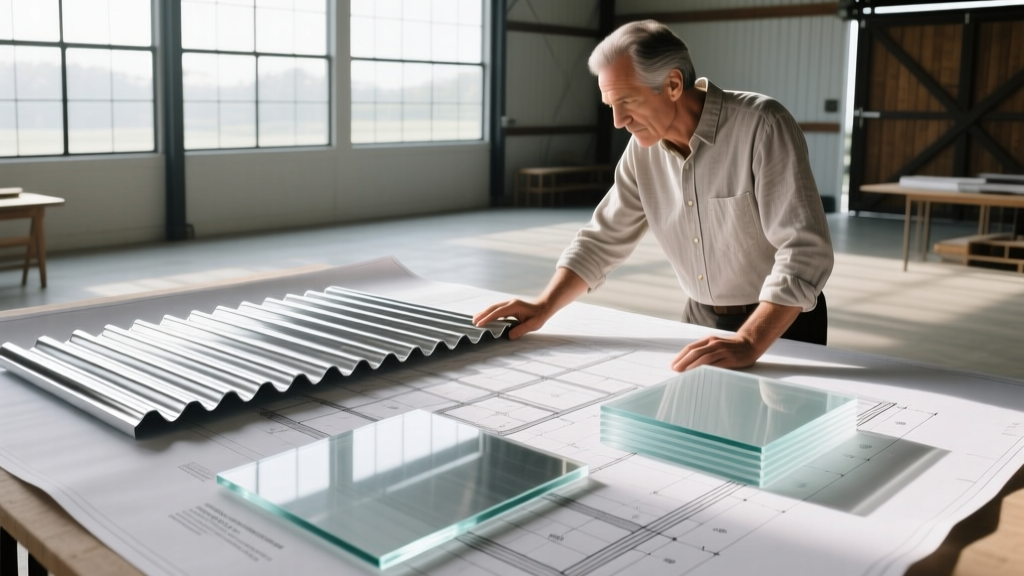
Step-by-Step Selection Workflow for Contractors
- Calculate the Geometry: Verify the roof pitch. If < 3:12, reject corrugated profiles. Calculate the ridge-to-eave length to determine if end-laps are required (max single sheet length is typically 40 feet due to transport limits).
- Define the Environment: Measure distance to saltwater. If < 1,500 feet, switch from Galvalume steel to 0.032-inch Aluminum 3003-H14. If > 1,500 feet, proceed with AZ55 Galvalume.
- Select the Gauge: Use 29-gauge for standard residential roofs with solid decking. Use 26-gauge for open-frame agricultural buildings, commercial structures, or areas with snow loads exceeding 40 PSF.
- Specify the Coating: Mandate PVDF (Kynar 500) for architectural/residential visibility; default to SMP for hidden or purely utilitarian agricultural structures.
- Audit the Fasteners: Write 'EPDM washer, #12 x 1.5-inch hex-head, carbon steel with Stalgard coating' into the submittal requirements to prevent the supplier from substituting cheap neoprene alternatives.
Written by
Marcus ChenMarcus Chen is a licensed structural engineer (PE) and building materials analyst with over 12 years of experience across residential, commercial, and industrial construction. He holds a Master of Science in Civil Engineering from UC Berkeley and spent six years at Thornton Tomasetti before transitioning to independent consulting and technical writing. Marcus specializes in material selection for seismic-prone regions, concrete reinforcement strategies, and lifecycle cost analysis. His work has been cited by the American Concrete Institute (ACI) and the Structural Engineers Association of California (SEAOC). When he is not on a job site or at his desk, you will find him hiking the Sierra Nevada or restoring a 1920s craftsman bungalow in Oakland, CA.
More from Marcus Chen
View all
Construction Cost
How Much Did the Eiffel Tower Cost to Build?
How much did the Eiffel Tower cost to build in 1889? We adjust for inflation and compare its budget to modern skyscraper construction.
Aug 4, 2026

Fire Resistance
What Is a Fire Resistant Material? Testing & Certification Guide
Discover what is a fire resistant material through ASTM and UL testing. Learn how fire ratings, certifications, and assemblies work in construction.
Aug 4, 2026

Construction Cost
How Much Did the Burj Khalifa Cost to Build?
How much did the Burj Khalifa cost to build? We break down the $1.5B project and extract 5 money-saving strategies for your next build.
Jul 30, 2026