Best Tiki Roof Material Compared: Natural vs Synthetic Thatch
Compare the best tiki roof material options. We analyze natural palm thatch vs. synthetic HDPE thatch for durability, cost, and fire safety.

The Core Debate: Authenticity vs. Longevity
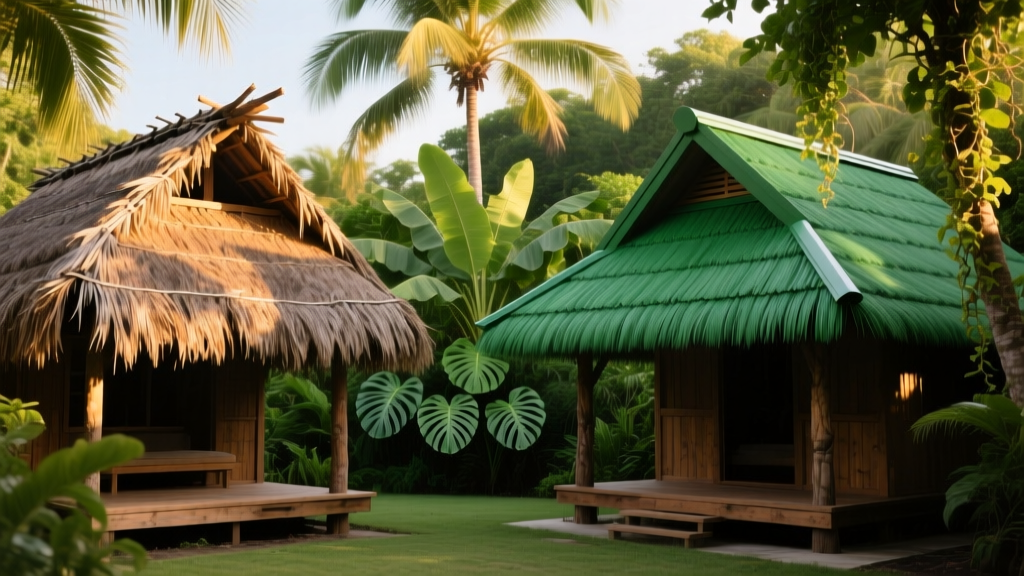
Selecting the right tiki roof material requires balancing aesthetic authenticity with structural longevity and local building codes. Whether you are constructing a commercial resort palapa, a backyard gazebo, or a commercial tiki bar, the roofing membrane dictates the structure's lifespan, maintenance schedule, and fire safety compliance. The market is currently dominated by two primary categories: harvested natural thatch (palm and reed) and engineered synthetic thatch (HDPE and PVC). This guide breaks down the material science, installation frameworks, and lifecycle costs to help you specify the correct membrane for your project.
Natural Thatch: Palm, Reed, and Bamboo
Natural thatch is harvested from sustainable plantations and provides the authentic, uneven texture that defines traditional tiki architecture. However, organic materials are inherently susceptible to biological degradation, UV breakdown, and moisture retention.
Mexican Palm (Sabal mexicana) vs. African Cape Reed
- Mexican Palm Thatch: Harvested from the fan palm, this material features a thick, shaggy profile with a rustic appearance. It is typically bundled in 36-inch lengths. In arid climates (e.g., Arizona, Southern California), a properly installed palm roof lasts 10 to 15 years. In high-humidity coastal zones, the lifespan drops to 4 to 7 years due to fungal rot.
- African Cape Reed (Thamnochortus insignis): Unlike palm, reed is tightly bound and offers a clean, uniform, and tailored look. It is significantly denser than palm, providing better wind resistance and a slightly longer lifespan (up to 20 years in dry climates). However, it lacks the "tropical shag" associated with traditional tiki huts.
Synthetic Thatch: Engineered Polymers
Synthetic thatch is manufactured to replicate the visual texture of natural palm or reed while eliminating biological vulnerabilities. These materials are extruded or injection-molded from petroleum-based polymers.
High-Density Polyethylene (HDPE)
HDPE is the premium standard for synthetic tiki roofing. Products like Viro Palm or茅草瓦 (thatch tiles) are molded from UV-stabilized HDPE. Key Specifications:
- Fire Rating: Inherently Class A fire-rated per ASTM E108 testing standards, requiring no chemical treatments.
- UV Resistance: Carbon black and UV inhibitors are mixed into the resin during extrusion, preventing the brittleness and color fading seen in cheaper plastics.
- Wind Uplift: Engineered with integrated nailing flanges and interlocking side laps, HDPE panels can withstand wind uplift pressures exceeding 110 mph when fastened to solid decking.
Polyvinyl Chloride (PVC) and Nylon
PVC thatch is a lower-cost alternative to HDPE, typically priced 30% to 40% cheaper. However, PVC degrades rapidly under direct UV exposure, often becoming brittle and cracking within 5 to 8 years. Nylon thatch is rare and generally reserved for specific indoor commercial applications where extreme flexibility is required, but it lacks the UV stability needed for exterior tiki roofs.
Head-to-Head Tiki Roof Material Comparison Matrix
| Material Type | Expected Lifespan | Fire Rating | Wind Resistance | Installed Cost (per sq. ft.) | Maintenance Level |
|---|---|---|---|---|---|
| Mexican Palm (Natural) | 4 - 15 Years | Class C (Treated) | Moderate (60 mph) | $6.00 - $9.00 | High (Annual inspections, re-treating) |
| African Cape Reed (Natural) | 10 - 20 Years | Class B (Treated) | High (90 mph) | $8.00 - $12.00 | Moderate (Ridge cap replacement) |
| HDPE Synthetic Palm | 20 - 25+ Years | Class A (Inherent) | Very High (110+ mph) | $10.00 - $16.00 | Low (Occasional rinsing) |
| PVC Synthetic Palm | 5 - 8 Years | Class A (Inherent) | Moderate (75 mph) | $7.00 - $10.00 | Moderate (UV degradation monitoring) |
Cost Breakdown and Lifecycle Value
Initial material costs often mislead buyers. A comprehensive lifecycle cost analysis must factor in substructure requirements, fire retardant re-applications, and eventual tear-off.
Furthermore, natural thatch requires a spaced batten substructure (typically 1x4 wood furring strips spaced 12 inches on center) to allow airflow and prevent rot. Synthetic HDPE thatch, when mandated by local building codes to have a secondary water barrier, requires solid 5/8-inch CDX plywood or OSB decking, which adds roughly $2.50 to $3.50 per square foot to the framing budget.
Installation Framework: Pitch, Overlap, and Fastening
Regardless of the tiki roof material selected, water management relies entirely on gravity and overlap. Thatch roofs do not use underlayment as a primary water barrier (unless specified by synthetic manufacturers for secondary protection).
Minimum Pitch Requirements
Both natural and synthetic thatch require a minimum roof pitch of 3:12 (14 degrees) to ensure adequate water runoff. However, a 4:12 or 5:12 pitch is highly recommended. Pitches below 3:12 will result in capillary action drawing water upward into the thatch bundles, causing interior leaks and rapid rot.
Fastening Specifications
- Natural Palm: Bundles are wired or stapled to the battens. Use 16-gauge galvanized or stainless-steel staples (minimum 1.5-inch crown, 2-inch legs). Do not use electro-galvanized fasteners, as they will rust and stain the thatch within one season.
- Synthetic HDPE: Panels feature a top nailing flange. Fasten using #8 x 2-inch stainless steel screws with neoprene sealing washers. Space fasteners at 12 inches on center along the flange, ensuring the screw head is flush but not over-driven, which will crack the HDPE flange.
The Ridge Cap: The Primary Failure Point
The ridge (the peak where two roof slopes meet) is the most vulnerable point on any tiki roof. For natural thatch, the ridge must be capped with a custom-bent 24-gauge aluminum or copper ridge flashing, hidden beneath a final, tightly bound layer of thatch. For synthetic roofs, manufacturers provide proprietary molded HDPE ridge rolls that interlock with the field panels, sealed with a bead of polyurethane roofing sealant (e.g., Sikaflex-1a) along the top lap.
Decision Flowchart: Which Material Fits Your Project?
Use this framework to finalize your tiki roof material specification:
- Scenario A: Commercial Hospitality (Resorts, Restaurants, Tiki Bars)
Verdict: Specify HDPE Synthetic Thatch. Commercial properties face strict fire marshaling and insurance requirements. The inherent Class A fire rating of HDPE eliminates the need for sprinkler integration at the roof peak, and the 20-year lifespan reduces long-term operational maintenance. - Scenario B: Residential Backyard in an Arid Climate (Southwest US)
Verdict: Specify Natural African Cape Reed or Mexican Palm. If local HOA and municipal codes permit natural thatch, the dry climate will naturally preserve the organic material, allowing you to achieve the authentic aesthetic at a lower initial upfront cost. - Scenario C: Coastal High-Wind Zone (Florida, Gulf Coast, Caribbean)
Verdict: Specify HDPE Synthetic Thatch over Solid Decking. The Florida Building Code and similar coastal regulations require strict wind-uplift mitigation. Synthetic panels screwed into solid plywood decking, combined with hurricane clips on the underlying trusses, will survive Category 2 hurricane wind loads, whereas natural thatch will inevitably experience bundle tear-off.
Written by
Marcus ChenMarcus Chen is a licensed structural engineer (PE) and building materials analyst with over 12 years of experience across residential, commercial, and industrial construction. He holds a Master of Science in Civil Engineering from UC Berkeley and spent six years at Thornton Tomasetti before transitioning to independent consulting and technical writing. Marcus specializes in material selection for seismic-prone regions, concrete reinforcement strategies, and lifecycle cost analysis. His work has been cited by the American Concrete Institute (ACI) and the Structural Engineers Association of California (SEAOC). When he is not on a job site or at his desk, you will find him hiking the Sierra Nevada or restoring a 1920s craftsman bungalow in Oakland, CA.
More from Marcus Chen
View all
Construction Cost
How Much Did the Eiffel Tower Cost to Build?
How much did the Eiffel Tower cost to build in 1889? We adjust for inflation and compare its budget to modern skyscraper construction.
Aug 4, 2026

Fire Resistance
What Is a Fire Resistant Material? Testing & Certification Guide
Discover what is a fire resistant material through ASTM and UL testing. Learn how fire ratings, certifications, and assemblies work in construction.
Aug 4, 2026

Construction Cost
How Much Did the Burj Khalifa Cost to Build?
How much did the Burj Khalifa cost to build? We break down the $1.5B project and extract 5 money-saving strategies for your next build.
Jul 30, 2026