Torch Down Roof Material Lifespan: Durability and Failure Guide
Discover the true lifespan of torch down roof material. Learn about SBS vs APP durability, common failure modes, and maintenance tips to maximize longevity.

The Baseline Lifespan of Torch Down Roof Material
Modified bitumen (mod-bit) roofing, commonly installed via torch application, remains a dominant choice for low-slope commercial and residential roofs. When evaluating torch down roof material, durability is heavily dictated by the polymer modification, the reinforcement mat, and the precision of the installation. Under optimal conditions, a professionally installed two-ply torch down system delivers a functional lifespan of 15 to 25 years. However, this range is not guaranteed; it is highly contingent on environmental stressors and proactive maintenance.
Lifespan Data Highlights
- Standard 2-Ply System: 15–20 years (Uncoated, standard granular cap sheet)
- Premium 3-Ply System: 20–25 years (Includes heavy-duty polyester base and reinforced cap)
- Coated/Maintained System: 25–30+ years (With reflective elastomeric coatings applied at year 10)
The Asphalt Roofing Manufacturers Association (ARMA) notes that the longevity of modified bitumen relies heavily on the integrity of the asphalt-polymer matrix. Once the UV-blocking granular surface is compromised, the underlying asphalt binder oxidizes rapidly, accelerating the end of the membrane's life cycle.
SBS vs. APP Modified Bitumen: A Durability Comparison
Not all torch down roof material is engineered equally. The two primary polymer modifiers—Styrene-Butadiene-Styrene (SBS) and Atactic Polypropylene (APP)—react differently to thermal cycling and physical stress. Understanding this distinction is critical for matching the material to your specific climate and building movement profile.
| Feature | SBS (Styrene-Butadiene-Styrene) | APP (Atactic Polypropylene) |
|---|---|---|
| Polymer Type | Rubberized (Elastomeric) | Plasticized (Plastomeric) |
| Flexibility & Elongation | Superior; stretches with structural settling | Rigid; higher tensile strength but lower stretch |
| UV & Heat Resistance | Moderate; requires granular surface or coating | Excellent; inherently resistant to high heat flow |
| Installation Temp | Lower melting point; easier to torch in cold weather | Higher melting point; requires intense, consistent heat |
| Best Climate Application | Northern climates with high thermal shock | Southern climates with high sustained UV/heat |
| ASTM Standard | ASTM D6164 | ASTM D6222 |
For buildings experiencing significant structural deflection or located in regions with extreme winter-to-summer temperature swings, SBS is the superior choice for long-term durability. Its rubberized nature allows it to absorb thermal shock without cracking. Conversely, APP excels in high-heat environments where the roof surface routinely exceeds 160°F (71°C), as its plasticized matrix resists softening and slumping.
Primary Failure Modes and Edge Cases
When a torch down roof fails prematurely (before the 15-year mark), it is rarely due to the material itself degrading uniformly. Premature failure is almost always localized to specific installation errors or unmitigated environmental damage.
1. Seam Degradation: Cold Seams vs. Burnt Seams
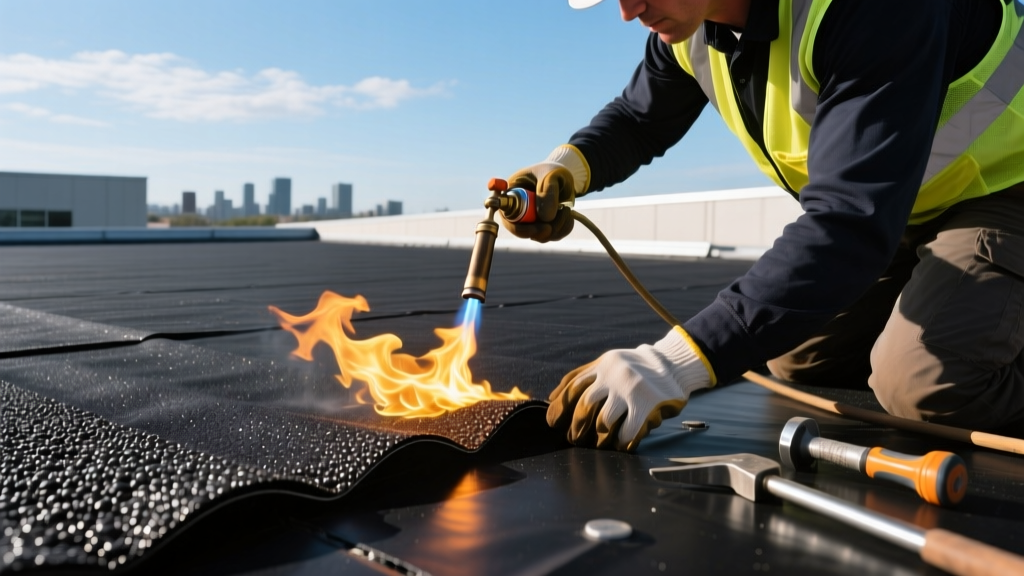
The torch application requires heating the underside of the cap sheet until the asphalt reaches a liquid state, then pressing it into the base ply. The industry standard requires a "bleed-out"—a continuous bead of melted bitumen squeezing out from the seam edge measuring exactly 1/4-inch to 1/2-inch.
- Cold Seams (Under-torched): If the bleed-out is absent, the asphalt did not reach the necessary viscosity to fuse the plies. These seams will delaminate within 3 to 5 years, allowing wind uplift to tear the membrane and water to infiltrate the insulation.
- Burnt Seams (Over-torched): If the bleed-out exceeds 1 inch or the asphalt appears bubbly and charred, the polymer modifiers have been incinerated. The seam becomes brittle and will fracture under the first major thermal contraction event.
2. Blistering and Vapor Pressure
Blisters occur when moisture is trapped between the membrane plies or within the underlying insulation during installation. As the roof heats up in the sun, this trapped moisture vaporizes and expands, pushing the membrane upward. While small, localized blisters may not immediately cause leaks, they stretch the reinforcement mat. Over time, the repeated expansion and contraction fatigue the mat, leading to radial splitting at the blister's apex.
3. Alligatoring and Binder Oxidation
If the mineral granules on the cap sheet are lost due to foot traffic or severe weather, the exposed asphalt binder is subjected to direct UV radiation. This causes the volatile oils in the asphalt to evaporate, resulting in a network of interconnected cracks resembling alligator skin. Once alligatoring begins, the membrane loses its waterproofing continuity and must be coated or replaced.
Environmental Stressors: Thermal Shock and Ponding
The National Roofing Contractors Association (NRCA) identifies thermal shock and ponding water as the two most aggressive environmental adversaries to low-slope modified bitumen systems.
The Impact of Thermal Shock
Thermal shock occurs when a hot roof surface is rapidly cooled, such as during a sudden summer thunderstorm. The surface temperature of a dark mod-bit roof can drop by 50°F to 70°F in a matter of minutes. This rapid contraction places immense tensile stress on the membrane, particularly at penetrations, parapet walls, and field seams. Using a heavy-weight polyester reinforcement mat (minimum 250 g/m²) significantly increases the membrane's resistance to thermal tearing.
The 48-Hour Ponding Water Rule
While modified bitumen is inherently water-resistant, it is not designed for continuous submersion. Industry standards dictate that a roof should drain completely within 48 hours after precipitation. Chronic ponding water accelerates the breakdown of the asphalt binder, promotes biological growth (algae and mold) that can degrade the mat, and drastically increases the structural dead load on the roof deck. If your roof exhibits chronic ponding, installing tapered polyisocyanurate insulation crickets to redirect water to drains is a mandatory intervention to preserve the roof's lifespan.
Proactive Maintenance to Maximize Longevity
Extending the life of torch down roof material past the 20-year mark requires a shift from reactive leak-patching to proactive system management. Implement the following maintenance framework:
- Bi-Annual Seam Probing: Every spring and fall, a technician should use a blunt-tipped roofing probe to test the adhesion of all field seams, flashings, and penetrations. Any seam that yields to moderate pressure must be cleaned, primed, and resealed with a compatible mastic or heat-welded patch.
- Infrared Moisture Surveys: Every 3 to 5 years, commission an infrared thermography scan at dusk. This non-destructive testing identifies wet insulation trapped beneath the membrane before it causes structural deck rot or widespread blistering. Wet sections can be surgically removed and replaced without tearing off the entire roof.
- Reflective Coating Application: At the 10-to-12-year mark, apply a high-solids silicone or elastomeric acrylic roof coating. This seals minor granule loss, restores UV protection, and reduces the roof surface temperature by up to 50°F, drastically slowing the asphalt oxidation process. Manufacturers listed on GAF's commercial roofing systems portal frequently offer extended warranty options when approved liquid-applied coatings are utilized over their mod-bit systems.
2026 Cost-to-Lifespan Analysis: Is It Worth the Investment?
When evaluating the financial viability of torch down roofing, it is essential to look beyond the initial installation cost and calculate the life-cycle cost. As of 2026, the installed cost for a premium two-ply modified bitumen system ranges from $5.50 to $9.50 per square foot, depending on regional labor rates, roof complexity, and insulation requirements.
"A $7.00 per square foot torch down roof that lasts 20 years yields an annualized cost of $0.35 per square foot. Compare this to a single-ply TPO system installed at $4.50 per square foot that may require replacement at year 14 due to seam failure, yielding an annualized cost of $0.32. The marginal savings of single-ply often do not justify the loss of puncture resistance and multi-ply redundancy that modified bitumen provides."
Ultimately, the durability of torch down roof material is a direct reflection of material selection and installation rigor. By specifying the correct polymer modifier (SBS or APP) for your climate, demanding strict adherence to bleed-out tolerances during installation, and executing a disciplined coating and maintenance schedule, a modified bitumen roof will reliably protect your asset for a quarter-century or more.
Written by
Priya KapoorPriya Kapoor is a real estate market analyst and construction economics researcher with expertise in housing affordability, development feasibility, and infrastructure investment. She holds a Master of Regional Planning from Cornell University and previously worked as a senior analyst at CBRE's Investment Properties group, where she modeled returns for $4B in mixed-use development pipelines. Priya now runs an independent research practice advising developers, municipalities, and REITs on construction cost forecasting and market timing. She publishes the quarterly "BuildMat Market Pulse" report tracking material price indices across 12 commodity categories. Based in Austin, TX, Priya serves on the board of Habitat for Humanity Austin and is a marathon runner.
More from Priya Kapoor
View all
Construction Cost
Cost to Build a 1600 Sq Ft Home in 2026: Full Breakdown
Accurate 2026 cost to build a 1600 sq ft home—material, labor, and regional pricing breakdowns included. Plan your budget with real-time estimates.
Aug 11, 2026

Wood & Lumber
Name the Types of Wood for Pressure Treatment and Preservation
Learn how to name the types of wood best suited for pressure treatment. Compare species treatability, chemical retention levels, and 2026 preservation costs.
Aug 4, 2026

Stone & Masonry
Stone Veneer Suppliers Lindenhurst: 2026 Cost Analysis
Analyze 2026 stone veneer costs in Lindenhurst, NY. Compare local supplier pricing, delivery fees, and Suffolk County installation labor rates.
Aug 4, 2026