Duro-Last Roofing Material Lifespan: Durability & Failure Modes
Analyze the Duro-Last roofing material lifespan, PVC durability science, product line comparisons, and real-world failure modes for commercial roofs.

When evaluating commercial low-slope roofing systems, the Duro-Last roofing material stands out due to its unique manufacturing process and thermoplastic chemistry. Unlike generic TPO or EPDM membranes, Duro-Last utilizes a proprietary PVC (polyvinyl chloride) formulation combined with custom prefabrication. This combination fundamentally alters the expected lifespan and failure profile of the roof. Understanding the material science, specific product lines, and real-world edge cases is critical for facility managers and commercial roof specifiers aiming for a 25- to 30-year service life.
The Core Chemistry: PVC Formulation and UV Resistance
The longevity of any PVC membrane is dictated by its plasticizer package and reinforcement scrim. Over time, liquid plasticizers can migrate to the surface and leach out, leading to membrane embrittlement and shrinkage. Duro-Last addresses this by utilizing a high-molecular-weight PVC resin paired with solid, non-migratory plasticizers and UV stabilizers. This formulation ensures the membrane retains its flexibility and heat-weldability decades after installation.
Furthermore, the membrane is reinforced with a weft-inserted polyester scrim. According to Duro-Last Technical Resources, this scrim provides exceptional dimensional stability and puncture resistance, allowing the material to meet and exceed the physical properties required by ASTM D4434 (Standard Specification for Poly(Vinyl Chloride) Sheet Roofing). The white reflective surface also rejects up to 85% of solar radiation, significantly reducing the thermal cycling that causes expansion and contraction fatigue in darker membranes.
Expected Lifespan by Product Line
The Duro-Last product ecosystem is not monolithic. Selecting the correct membrane thickness and backing is the primary determinant of your roof's ultimate lifespan and installed cost.
| Product Line | Thickness | Expected Lifespan | Installed Cost (per sq. ft.) | Best Application |
|---|---|---|---|---|
| Duro-Last Standard | 40 / 50 mil | 20 - 25 Years | $4.50 - $6.50 | Standard commercial roofs, low foot traffic |
| Duro-Last 60 mil | 60 mil | 25 - 30+ Years | $5.50 - $7.50 | High HVAC traffic, severe weather zones |
| Duro-Last EV | 50 / 60 mil | 20 - 25 Years | $6.00 - $8.50 | Retrofit over existing asphalt or EPDM |
| Duro-Fleece | 50 / 60 mil + Fleece | 25 - 30 Years | $7.00 - $9.50 | Direct-to-deck adhered systems, complex geometries |
The Prefabrication Advantage: Eliminating the Primary Failure Point
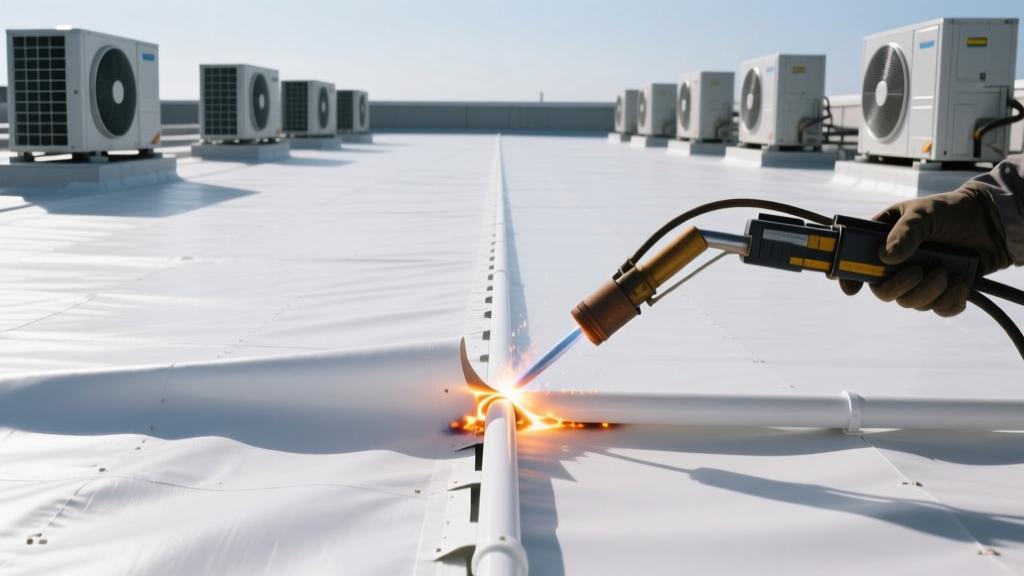
Industry data consistently shows that up to 90% of single-ply roof leaks occur at field seams. Traditional TPO and EPDM roofs require hundreds of linear feet of seams to be welded or taped in unpredictable field conditions (wind, moisture, temperature fluctuations).
By shifting the majority of the seam welding to a factory floor, the risk of human error, cold-welds, and moisture-trapped seams is virtually eliminated. This structural integrity is the primary reason Duro-Last can offer warranties that cover consequential damages (the Platinum Warranty), a rarity in the commercial roofing sector.
Real-World Failure Modes & Edge Cases
Despite its durability, the Duro-Last roofing material is not invincible. Specifiers must design around specific vulnerabilities to ensure the membrane reaches its maximum lifespan.
1. Plasticizer Extraction (Chemical Incompatibility)
Standard PVC membranes will suffer catastrophic plasticizer extraction if placed in direct contact with asphalt, bitumen, or EPDM rubber. The oils in these materials draw the plasticizers out of the PVC, causing it to shrink, crack, and fail within months. Solution: If recovering an existing modified bitumen or EPDM roof, you must specify Duro-Last EV, which features an EVA (ethylene vinyl acetate) top layer that acts as a chemical barrier, or install a physical separation layer like a 43lb fiberglass mat or geotextile fabric.
2. Perimeter Wind Uplift Failure
The membrane itself can withstand immense tensile force, but the perimeter securement is often the weak link. In high-wind events, failure typically occurs at the edge metal or parapet transitions. Installers must strictly adhere to Single-Ply Roofing Industry (SPRI) guidelines, specifically ANSI/SPRI FX-1 for perimeter securement and ES-1 for edge metal design, utilizing the correct fastener density in the corner and perimeter zones.
3. Puncture from Maintenance Traffic
A 40-mil PVC membrane can be punctured by a heavy tool dropped from a technician's belt or sharp debris blown across the roof. If the roof houses multiple HVAC units requiring quarterly servicing, a 40-mil membrane is insufficient. Specify a 60-mil membrane and install designated walkway pads (like Duro-Walk) along all primary service routes to distribute point-loads and protect the scrim.
Maintenance Protocol to Reach the 30-Year Mark
Reaching the upper end of the Duro-Last lifespan requires a proactive, documented maintenance regimen. The National Roofing Contractors Association (NRCA) recommends bi-annual inspections, but high-value commercial assets require a more targeted approach.
- Spring/Fall Drainage Clearance: Remove all debris from scuppers, drains, and gutters. Ponding water does not chemically degrade PVC, but the added weight stresses the deck, and standing water accelerates the accumulation of biological growth (algae/mold) which can stain and degrade reflective properties.
- Penetration Flashing Inspection: 70% of leaks occur at penetrations. Inspect all pitch pans, pipe boots, and HVAC curbs. Ensure the heat-welded patches at the base of pipe boots show no signs of peeling or 'fish-mouthing'.
- Post-Storm Seam Verification: After any wind event exceeding 50 mph, inspect the perimeter flashings and termination bars. Look for stretched membrane or pulled fasteners in the edge zones.
- Biocide Treatment: In humid climates, apply an EPA-approved, roof-safe biocide annually to prevent black streaking and biological degradation of the top ply.
Cost vs. Lifespan ROI Matrix
When calculating the true cost of ownership, the Duro-Last roofing material often outperforms cheaper initial alternatives. While a standard 45-mil TPO roof might cost $3.50 to $5.00 per square foot installed, its lifespan is frequently capped at 15 to 20 years due to field seam degradation and UV embrittlement.
A 60-mil Duro-Last system installed at $6.50 per square foot, backed by a 20-year Platinum Warranty (which includes labor and consequential interior damage), shifts the financial risk from the building owner to the manufacturer. When amortized over a 30-year lifecycle, the annualized cost of a properly specified and prefabricated PVC system is significantly lower than replacing a failed TPO system at year 18, which incurs massive tear-off and disposal costs.
Frequently Asked Questions
Can Duro-Last be installed in cold weather?
Yes. Because the majority of seams are factory-welded, field installation is less dependent on ambient temperature than fully adhered EPDM or cold-applied systems. However, field hot-air welding requires careful adjustment of welder speed and temperature when ambient temperatures drop below 40°F to ensure proper fusion.
Is Duro-Last resistant to grease and fats?
Standard PVC is highly susceptible to degradation from animal fats and vegetable oils (grease). If the roof is over a restaurant kitchen, you must install specialized grease guards or specify a different membrane chemistry (like Hypalon/CSPE or specialized TPO) over the exhaust fan areas, as standard Duro-Last will soften and dissolve upon prolonged contact with cooking oils.
Written by
Sarah WhitfieldSarah Whitfield is a chartered quantity surveyor (MRICS) and construction cost analyst with 15 years of experience in material pricing, procurement strategy, and project budgeting. She earned her degree in Construction Management from the University of Reading (UK) and has worked on projects ranging from $2M custom homes to $180M mixed-use developments across North America and Europe. Sarah currently leads cost estimating for BuildMat Insight, maintaining a proprietary database of 4,000+ material price points updated quarterly. She is a frequent contributor to RSMeans cost data panels and has presented at the International Cost Engineering Council (ICEC) congress. Based in Denver, CO, Sarah is an avid trail runner and volunteer mentor for Women in Construction.
More from Sarah Whitfield
View all
Wood & Lumber
What Are the Different Types of Wood? A Builder's Guide
Compare structural softwoods, finish hardwoods, and engineered lumber. Analyze Janka ratings, MOE values, and 2026 pricing for construction.
Aug 4, 2026

Walls & Panels
Steel Framing vs Wood Framing: Corrosion and Moisture Defense
Compare steel framing vs wood framing for moisture resistance. Learn about galvanized coatings, condensation risks, and corrosion protection strategies.
Jul 21, 2026

Stone & Masonry
How to Cut Stone Veneer: Wet Saw vs Grinder Comparison
Compare the best tools for cutting stone veneer. We review wet saws, angle grinders, and chop saws to help you achieve clean, chip-free cuts.
Jul 21, 2026