Best Fire-Resistant Roofing Material: Class A Ratings Explained
Discover the best fire-resistant roofing material for your home. We break down Class A ratings, UL 790 tests, and real-world costs for wildfire zones.

The Reality of Wildfire Roofing: Why 'Fireproof' is a Myth
When building or retrofitting in the Wildland-Urban Interface (WUI), searching for the best fire-resistant roofing material is the single most critical decision you will make for your structure's survivability. However, the term 'fireproof' is a dangerous misnomer. No roofing material is entirely impervious to the 2,000°F heat of a crown fire. Instead, building codes and insurance mandates rely on fire-resistance ratings—specifically the Class A standard—to measure how well a roof assembly prevents flame penetration and ember ignition.
As of 2026, with WUI building codes (like California's Chapter 7A and the ICC's International Wildland-Urban Interface Code) becoming strictly enforced, selecting a roof requires looking beyond the surface shingle or tile. A true fire-resistant roof is a complete assembly, and understanding the testing methodology behind the ratings is the only way to avoid catastrophic installation errors.
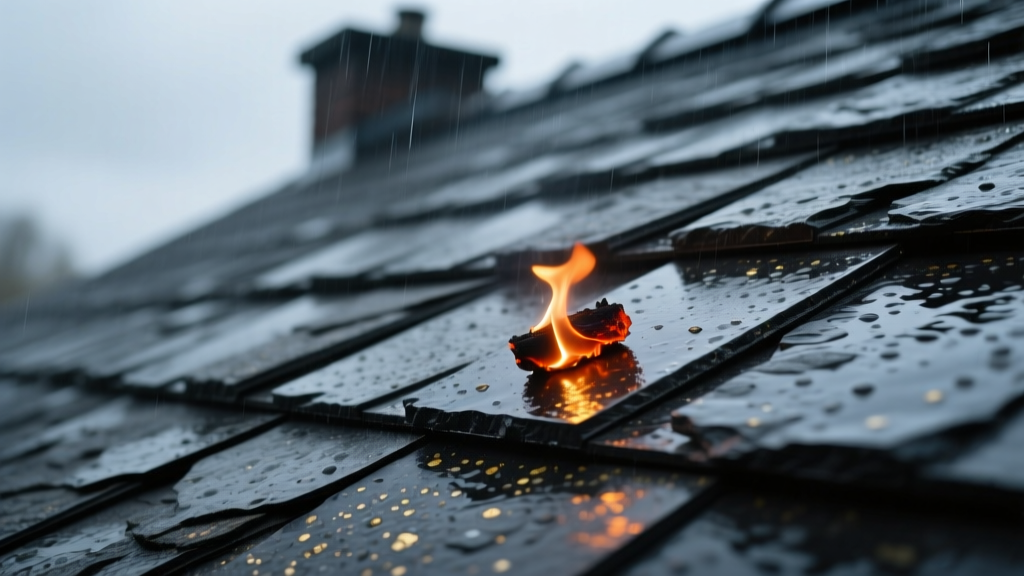
Decoding the UL 790 and ASTM E108 Fire Rating System
The UL Solutions fire testing protocols (UL 790) and the identical ASTM E108 standard evaluate roof coverings across three distinct criteria. To achieve a Class A rating—the highest available and the only one recommended for high-risk fire zones—the material must pass all three:
- Intermittent Flame Exposure: Simulates flames licking the edge of the roof from an adjacent burning structure.
- Spread of Flame: Measures how far and how fast fire travels across the roof surface under wind-driven conditions.
- Burning Brand Test: The most grueling test for Class A. A 12x12 inch, 2,000-gram lattice of dry wood (the 'Class A brand') is ignited and placed on the roof assembly while a 12 mph wind blows across it for 90 minutes. The assembly must not allow flames to penetrate the underlying deck.
Material Comparison: The Best Class A Roofing Options for 2026
Based on current market availability, installed costs, and structural requirements, here is how the top fire-resistant materials compare.
| Material Type | Avg. Installed Cost (per sq. ft.) | Weight (lbs/sq) | Primary Vulnerability |
|---|---|---|---|
| Stone-Coated Steel | $9.50 - $14.00 | 150 - 250 | Scratching during installation exposes base metal |
| Slate (Natural) | $18.00 - $35.00 | 800 - 1,200 | Extreme weight requires reinforced truss engineering |
| Concrete / Clay Tile | $12.00 - $22.00 | 900 - 1,100 | Ember intrusion through curved profile gaps |
| Class A Asphalt Shingles | $4.50 - $7.50 | 230 - 350 | Highly dependent on fire-rated underlayment |
1. Stone-Coated Steel (The WUI Champion)
Products like DECRA and Gerard stone-coated steel roofs offer the optimal balance of weight, fire resistance, and wind uplift ratings. The galvalume steel core is entirely non-combustible, while the stone granules provide a Class A surface that dissipates heat. Because they interlock tightly, they leave virtually no gaps for wind-blown embers to penetrate. According to USDA Forest Service Wildfire Risk data, metal roofing systems consistently show the lowest ignition rates in post-fire structural assessments.
2. Natural Slate
Slate is a metamorphic rock and is inherently non-combustible. It will not ignite, melt, or off-gas toxic fumes. However, the cost of structural reinforcement to hold 1,000+ lbs per square often pushes the total project cost beyond standard residential budgets. Furthermore, slate is brittle; heavy hail or falling branches during a windstorm can crack the tiles, creating crevices where embers can lodge and smolder against the underlayment.
3. Concrete and Clay Tile
While the tiles themselves are completely fireproof, their profile is their Achilles heel. Barrel and S-tiles create open channels at the eaves and ridges. In a wildfire, convective winds can suck glowing embers directly into these channels, bypassing the tile and igniting the combustible underlayment or wood deck below.
4. Class A Fiberglass Asphalt Shingles
Modern architectural shingles (e.g., Owens Corning Duration or CertainTeed Landmark) achieve Class A ratings through the use of heavy fiberglass mats and ceramic-coated granules. They are the most budget-friendly option, but they represent a 'sacrificial' layer. In a direct flame impingement scenario, the asphalt will eventually burn away, making the quality of the underlying fire-resistant underlayment the true last line of defense.
Critical Edge Cases: Where Class A Roofs Fail in the Field
Understanding material ratings is useless if the installation ignores real-world physics. The NFPA wildfire safety guidelines emphasize that most homes in WUI zones are not ignited by the main fire front, but by wind-blown embers (firebrands) that can travel up to a mile ahead of the fire. Here is how roof assemblies fail:
The Underlayment Trap
If you choose concrete tile or Class A asphalt, you must upgrade the underlayment. Standard #15 or #30 asphalt-saturated felt is highly combustible. If an ember enters a tile gap or melts through a shingle, the felt will ignite.
The Fix: Specify a non-combustible or fire-rated synthetic underlayment. Products like FireShield or Deck-Armor feature a fiberglass core or specialized fire-retardant coatings that maintain the integrity of the Class A assembly even if the outer layer is breached.
Tile Gaps and Ember Intrusion
For clay and concrete tile roofs, the eaves are the primary failure point. Embers are drawn into the open butts of the tiles via the Bernoulli effect as wind rushes over the roof.
The Fix: Install code-mandated bird stops and eave closures (often made of fire-resistant foam or metal mesh) at the first course of tiles. Additionally, all ridge caps must be mortared or sealed with fire-rated, high-temperature silicone to prevent ember entry at the peak.
Step-by-Step Selection Framework for Wildfire Zones
Use this decision matrix to select the right material based on your specific structural and budget constraints:
- Assess Structural Load Capacity: Have a structural engineer evaluate your trusses. If they cannot support 900+ lbs per square without a $10,000+ reinforcement, immediately eliminate Slate and Concrete Tile.
- Determine Roof Pitch: If your roof pitch is below 3:12, avoid tile and slate entirely due to water pooling risks. Stone-coated steel or specialized low-slope Class A membrane systems are required.
- Specify the Assembly, Not Just the Shingle: When requesting contractor bids, explicitly write 'Fire-rated synthetic underlayment (e.g., FireShield) required over solid OSB/Plywood deck' into the contract. Do not allow spaced sheathing (skip sheathing) in WUI zones.
- Verify the UL Directory: Before signing off on materials, look up the specific product in the UL Product iQ database to verify its Class A listing matches the exact underlayment and deck type your contractor plans to use.
Frequently Asked Questions
Do bare metal roofs (like standing seam) have a Class A rating?
Yes, bare metals like galvalume standing seam are non-combustible and inherently achieve a Class A by special exception in most building codes, provided they are installed over a solid, non-combustible deck or appropriate fire-rated underlayment. However, they can be prone to thermal expansion noises and require specialized snow guards in alpine environments.
Can I install a new Class A roof over my existing shingles?
In most WUI jurisdictions, overlaying a new roof over an existing layer is strictly prohibited. The old layer acts as a hidden fuel source. If embers penetrate the new Class A layer, the old combustible shingles will ignite, and firefighters will be unable to access the fire without tearing off both roofs. A complete tear-off to the deck is required for code compliance and true fire safety.
Are solar panels a fire risk on a Class A roof?
Solar panels themselves do not negate the roof's Class A rating, but the gap between the panel and the roof is a major ember trap. Embers can accumulate in this gap and ignite debris. To mitigate this, install critical fire safety mesh (like Solar Critter Guard or specialized metal screening) around the perimeter of the solar array to block embers and debris from entering the space beneath the panels.
Written by
James ThorntonJames Thornton is a construction industry veteran with 25 years of hands-on experience in wood framing, lumber grading, and residential building codes. He started as a framing carpenter in rural Oregon, earned his ICC Residential Building Inspector certification, and eventually became a senior plan reviewer for the City of Portland Bureau of Development Services. James holds a B.S. in Wood Science & Technology from Oregon State University and is a certified lumber grader through the West Coast Lumber Inspection Bureau (WCLIB). He has inspected over 3,000 residential construction sites and authored the city's internal guide on advanced framing techniques (2x6 at 24" O.C.). James lives in Bend, OR, where he builds custom timber-frame cabins and competes in lumberjack sports.
More from James Thornton
View all
Insulation
Best Home Insulation Materials: Complete 2026 Guide
Compare top home insulation materials for 2026. Find R-values, installed costs per square foot, and best uses for fiberglass, spray foam, and mineral wool.
Aug 4, 2026

Sustainable Building
Certify Your Green Building Material for LEED and WELL
Step-by-step guide to certifying a green building material for LEED v5 and WELL v2. Master EPDs, HPDs, and VOC limits for 2026 project specifications.
Aug 4, 2026

Stone & Masonry
Veneer Stacked Stone Panels: Interior Design & Style Showcase
Discover how veneer stacked stone panels transform interiors. Explore modern design profiles, material pairings, and technical installation specs.
Aug 4, 2026