Fire Resistant Insulation Material Ratings Explained for Builders
Understand fire resistant insulation material ratings, ASTM E84, NFPA 285, and how to select mineral wool or cellular glass for code compliance.

The Anatomy of Fire Ratings for Insulation
When specifying a fire resistant insulation material, builders and architects often conflate thermal resistance (R-value) with fire resistance. These are distinct properties governed by entirely separate testing protocols. In modern commercial, multi-family residential, and high-performance construction, selecting the correct insulation requires navigating a complex matrix of material-level and assembly-level fire tests. A material that performs exceptionally well in a laboratory flame test might fail catastrophically in a real-world wall assembly if the surrounding components are not properly rated.
Decoding the Core Test Standards
To choose the right product, you must understand the specific language of fire testing. The industry relies on three primary standards to evaluate how insulation behaves under thermal stress.
ASTM E84 / UL 723: Surface Burning Characteristics
Often referred to as the Steiner Tunnel test, ASTM E84 measures the relative burning behavior of materials by observing the flame spread along the specimen's surface. It generates two critical metrics:
- Flame Spread Index (FSI): Measures how far and how fast flames travel across the surface. For a Class A (or Class 1) rating, the FSI must be 25 or less.
- Smoke Developed Index (SDI): Measures the optical density of smoke generated during combustion. A Class A rating requires an SDI of 50 or less.
Most high-quality mineral wool and cellular glass products achieve an FSI of 0 and an SDI of 0, making them ideal for plenums and egress corridors where smoke toxicity is a primary life-safety concern.
ASTM E119: Standard Fire Tests of Building Construction
While E84 tests the material itself, ASTM E119 tests the entire wall or floor assembly. Insulation is subjected to a standard time-temperature curve that reaches 1,000°F at 5 minutes and 1,700°F at 1 hour. The assembly must prevent the passage of flames, maintain structural integrity, and restrict heat transfer to the unexposed side (the temperature rise on the unexposed side cannot exceed an average of 250°F above ambient). Mineral wool is frequently the mandatory core component in 1-hour, 2-hour, and 3-hour UL-rated shaft and partition assemblies.
NFPA 285: Exterior Wall Assembly Fire Propagation
For exterior walls in Types I, II, III, and IV construction, the IBC mandates NFPA 285 testing if combustible components (like foam plastic insulation or water-resistive barriers) are used. This is a massive two-story burn test. Even if you use a non-combustible fire resistant insulation material like mineral wool in the stud cavity, the presence of a combustible exterior weather barrier can trigger the NFPA 285 requirement. According to NAIMA, utilizing continuous mineral wool insulation on the exterior sheathing is one of the most reliable methods to pass NFPA 285 without relying on complex, proprietary assembly exceptions.
Top Fire Resistant Insulation Material Categories
Not all insulation is created equal. The chemical composition and melting point of the base material dictate its performance in a structural fire.
Mineral Wool (Stone Wool and Slag Wool)
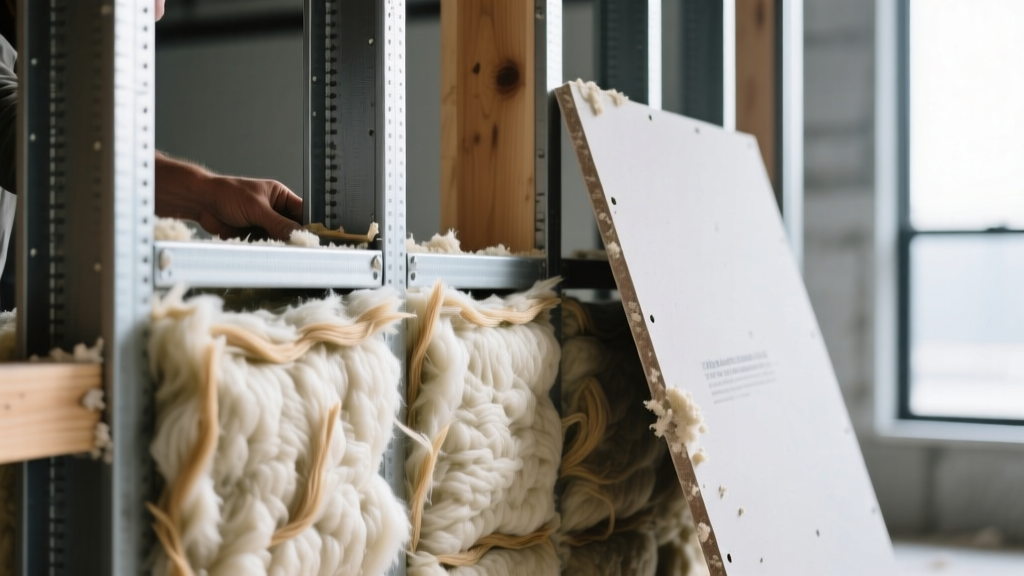
Mineral wool is the undisputed leader in cavity and continuous fire-resistant applications. Manufactured from basalt rock and recycled slag spun at extreme temperatures, it is inherently non-combustible. Products like ROCKWOOL Comfortbatt 80 and Thermafiber FireBarrier maintain their structural integrity at temperatures exceeding 2,150°F (1,176°C). Because the fibers themselves do not melt until extreme heat is reached, mineral wool acts as a physical firebreak within wall cavities, delaying the transfer of heat to adjacent studs and slowing structural degradation.
2026 Market Pricing: Expect to pay between $1.80 and $2.60 per square foot for standard 3-inch thick mineral wool batts, with specialized high-density firestop products reaching $4.50 per square foot.
Cellular Glass
Cellular glass insulation, such as FOAMGLAS F, is composed of millions of completely sealed glass cells. It is 100% glass, meaning it is entirely non-combustible (ASTM E136 compliant) and will not burn, melt, or off-gas toxic fumes. While its R-value (R-4.5 per inch) is lower than closed-cell spray foams, its absolute impermeability to water and vapor makes it the premium choice for below-grade applications, roofing assemblies, and industrial pipe insulation where fire resistance and moisture resistance must coexist.
2026 Market Pricing: Cellular glass is a premium product, typically costing between $9.50 and $14.00 per square foot for standard 2-inch thicknesses.
Fiberglass (With Critical Caveats)
Fiberglass insulation (like Owens Corning EcoTouch) is made of glass fibers, which have a melting point of roughly 1,500°F. However, the critical vulnerability lies in the binder. Traditional fiberglass batts use acrylic or phenol-formaldehyde binders to hold the fibers together. These organic binders combust at relatively low temperatures (between 300°F and 400°F). Once the binder burns away, the fiberglass loses its shape, slumps to the bottom of the stud cavity, and exposes the upper portions of the wall to direct flame and radiant heat. For this reason, fiberglass is rarely permitted as the sole firestop material in high-hour fire-rated shaft enclosures.
Material Comparison Matrix
| Material Type | Max Service Temp | Flame Spread (FSI) | Smoke Developed (SDI) | Avg. Cost / Sq Ft (2026) |
|---|---|---|---|---|
| Mineral Wool (Stone) | 2,150°F (1,176°C) | 0 | 0 | $1.80 - $2.60 |
| Cellular Glass | 900°F (482°C)* | 0 | 0 | $9.50 - $14.00 |
| Fiberglass (Standard) | 250°F (Binder Limit) | 0 - 25 | 0 - 50 | $0.80 - $1.30 |
| Spray Polyurethane Foam | 250°F (Charring limit) | 25 - 75** | 150 - 450** | $3.00 - $5.50 |
* Cellular glass does not burn or off-gas at higher temperatures, but structural compressive strength may degrade above 900°F.
** Spray foam requires an intumescent coating or thermal barrier (like 1/2" gypsum) to meet interior fire codes; raw FSI/SDI numbers are significantly higher.
Step-by-Step Selection Framework for Code Compliance
Navigating the 2024 and upcoming 2026 IBC adoption cycles requires a methodical approach to insulation specification. Follow this framework to ensure compliance:
- Identify the Construction Type: Determine if the project is Type I-V. Types I and II strictly limit combustible materials. If you are building a Type III exterior wall, you must immediately evaluate NFPA 285 requirements for the exterior envelope.
- Determine the Required Assembly Rating: Consult IBC Table 601 to find the required fire-resistance rating for your structural frame, bearing walls, and shaft enclosures (e.g., 2-hour for high-rise shaft walls).
- Select the UL Design: Do not pick insulation first. Pick the tested UL Design (e.g., UL V496 for a 2-hour area separation wall). The design will explicitly list the approved insulation types, thicknesses, and densities.
- Verify Continuous Insulation (ci) Requirements: If energy codes require exterior continuous insulation, check if the assembly allows for EPS/XPS (combustible) or mandates mineral wool (non-combustible) to bypass NFPA 285 testing under IBC Section 2603.4.1.4 exceptions.
- Specify Firestopping for Penetrations: Where HVAC, plumbing, or electrical systems penetrate your fire-rated insulated assemblies, specify tested firestop systems (like intumescent caulking or mineral wool packing with UL-classified sealants) to maintain the hourly rating.
Common Installation Failures That Void Fire Ratings
Even the highest-rated fire resistant insulation material will fail if installed incorrectly. Fire investigators and third-party inspectors frequently cite the following field errors:
- Compression of Mineral Wool: Stuffing a 6-inch batt into a 4-inch cavity increases the R-value slightly but ruins the acoustic and fire-resistive density profile. The compressed material may pull away from the edges of the studs, creating a chimney effect that channels flames and superheated gases directly up the wall cavity.
- Improper Fastening of Gypsum Board: The fire rating of an insulated wall relies heavily on the gypsum board staying attached to the studs during a fire. If the drywall screws are over-driven (breaking the paper face) or spaced wider than the UL design dictates (usually 8 inches on center for ceilings, 12 inches for walls), the board will collapse prematurely, exposing the insulation to direct flame.
- Uninsulated Header Cavities: In exterior wood-framed walls, builders often insulate the main stud cavities but leave the horizontal header spaces above windows and doors empty. In a fire, these uninsulated voids become thermal weak points, allowing heat to rapidly transfer to the exterior cladding or interior finishes.
- Mixing Untested Materials: Swapping a specified Thermafiber mineral wool product for a generic, unbranded mineral wool without verifying its specific UL inclusion is a major liability. Fire ratings are proprietary to the exact density and binder formulation tested in the laboratory.
By prioritizing assembly-level testing data over individual material marketing claims, builders can ensure that their chosen fire resistant insulation material delivers genuine, code-compliant life safety when it matters most.
Written by
James ThorntonJames Thornton is a construction industry veteran with 25 years of hands-on experience in wood framing, lumber grading, and residential building codes. He started as a framing carpenter in rural Oregon, earned his ICC Residential Building Inspector certification, and eventually became a senior plan reviewer for the City of Portland Bureau of Development Services. James holds a B.S. in Wood Science & Technology from Oregon State University and is a certified lumber grader through the West Coast Lumber Inspection Bureau (WCLIB). He has inspected over 3,000 residential construction sites and authored the city's internal guide on advanced framing techniques (2x6 at 24" O.C.). James lives in Bend, OR, where he builds custom timber-frame cabins and competes in lumberjack sports.
More from James Thornton
View all
Insulation
Best Home Insulation Materials: Complete 2026 Guide
Compare top home insulation materials for 2026. Find R-values, installed costs per square foot, and best uses for fiberglass, spray foam, and mineral wool.
Aug 4, 2026

Sustainable Building
Certify Your Green Building Material for LEED and WELL
Step-by-step guide to certifying a green building material for LEED v5 and WELL v2. Master EPDs, HPDs, and VOC limits for 2026 project specifications.
Aug 4, 2026

Stone & Masonry
Veneer Stacked Stone Panels: Interior Design & Style Showcase
Discover how veneer stacked stone panels transform interiors. Explore modern design profiles, material pairings, and technical installation specs.
Aug 4, 2026