Decoding ASTM E119 Fire Tests of Building Construction and Materials
Master ASTM E119 fire tests of building construction and materials. Explore time-temperature curves, assembly ratings, and IBC code compliance.

The Core Purpose of ASTM E119 in Modern Construction
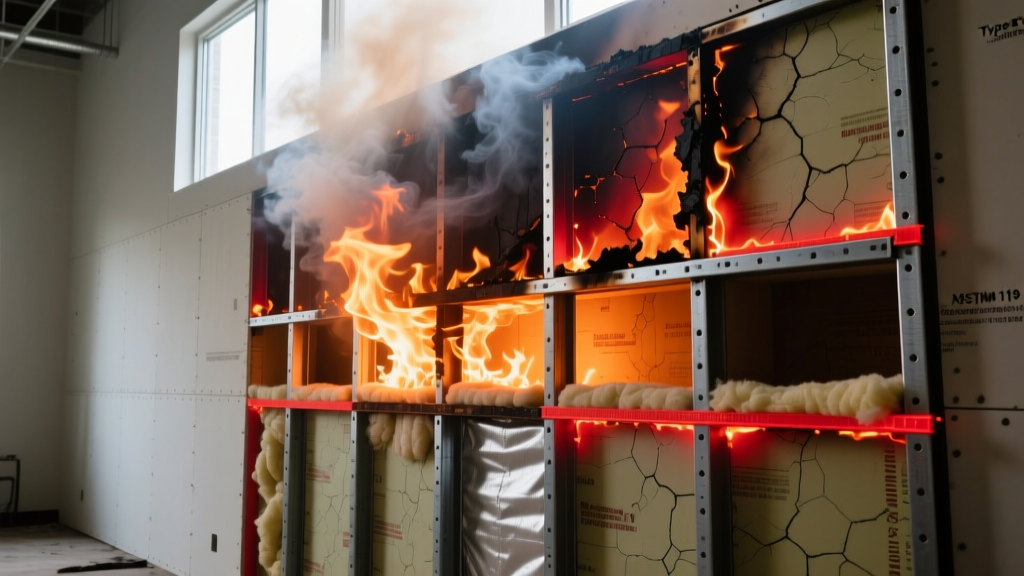
When architects and engineers specify fire-rated assemblies, they are ultimately relying on the ASTM E119 fire tests of building construction and materials. Unlike surface burning characteristic tests (such as ASTM E84) that measure flame spread and smoke development, ASTM E119 evaluates the structural integrity, thermal transmission, and flame penetration resistance of entire wall, floor, roof, and column assemblies under extreme heat exposure.
A critical misconception in the construction industry is that ASTM E119 rates individual materials. It does not. It rates assemblies. A 5/8-inch Type X gypsum board does not have an inherent 'one-hour rating' on its own; rather, a specific configuration of steel studs, fastener spacing, joint treatment, and gypsum layers achieves that rating. Understanding this distinction is the foundation of code-compliant fire-safe design.
Deconstructing the Standard Time-Temperature Curve
The furnace environment in an ASTM E119 test is strictly controlled to follow a standard time-temperature curve. This curve was established in 1918 and remains the benchmark for comparative fire endurance testing today. It simulates a severe, fully developed compartment fire.
| Time Elapsed | Furnace Temperature (°F) | Furnace Temperature (°C) | Typical Assembly Rating Target |
|---|---|---|---|
| 5 Minutes | 1,000°F | 538°C | N/A (Initial thermal shock) |
| 10 Minutes | 1,300°F | 704°C | N/A |
| 30 Minutes | 1,550°F | 843°C | 30-Minute Corridor Walls |
| 60 Minutes | 1,700°F | 927°C | 1-Hour Exit Enclosures |
| 120 Minutes | 1,850°F | 1,010°C | 2-Hour Structural Frames |
| 240 Minutes | 2,000°F | 1,093°C | 4-Hour High-Hazard Separations |
The primary acceptance criteria for the thermal transmission endpoint is that the average temperature on the unexposed (cold) side of the assembly must not rise more than 250°F (139°C) above its initial ambient temperature. Additionally, no single point on the unexposed side can exceed a 325°F (181°C) rise.
Even if the thermal transmission limits are not breached, the assembly fails immediately if flames or hot gases penetrate through cracks and ignite a cotton waste pad placed on the unexposed side. This simulates the ignition of adjacent combustible contents via localized breaches.
The Hose Stream Test: Simulating Structural Collapse and Thermal Shock
Perhaps the most misunderstood phase of the ASTM E119 protocol is the hose stream test. Following the furnace exposure, the test specimen is immediately subjected to a high-pressure water stream from a 2.5-inch fire hose equipped with a standard playpipe nozzle.
Pressure and Distance Specifications
- Walls and Partitions: 30 psi (207 kPa) nozzle pressure, applied from a distance of 10 feet (3.05 m).
- Floors, Roofs, and Ceilings: 15 psi (103 kPa) nozzle pressure, applied from a distance of 20 feet (6.1 m).
The purpose is not merely to test water resistance. The kinetic impact of the water simulates the mechanical shock of structural collapse, falling debris, and the violent thermal contraction that occurs when firefighting efforts cool superheated building elements. Assemblies that rely on brittle fireproofing, such as certain rigid cementitious boards without proper mechanical fastening, frequently spall and fail during this phase.
Material Specifics: How Assemblies Achieve 1-Hour and 2-Hour Ratings
Achieving specific fire endurance ratings requires precise material selection and installation tolerances. Below is a breakdown of how common materials perform under ASTM E119 conditions.
Gypsum Board Assemblies
Standard gypsum board contains approximately 21% chemically bound water by weight. When exposed to fire, this water calcines (boils off) at 212°F, absorbing massive amounts of thermal energy and keeping the unexposed side relatively cool. However, once the water is driven off, the core shrinks and cracks.
Type X Gypsum: Formulated with glass fibers (typically 1% to 2% by weight) that hold the calcined core together, delaying shrinkage and cracking. A standard 1-hour non-load-bearing wall requires one layer of 5/8-inch Type X board on each side of 3-5/8-inch steel studs (20-gauge minimum).
Type C Gypsum: Contains enhanced glass fibers and vermiculite additives to resist core shrinkage at higher temperatures. It is frequently used in multi-layer 2-hour and 3-hour shaft wall assemblies where extreme core stability is required.
Structural Steel Protection
Unprotected structural steel loses 50% of its yield strength at approximately 1,100°F, which occurs in less than 10 minutes under the ASTM E119 curve. To achieve a 2-hour rating, steel beams and columns must be protected based on their W/D ratio (Weight-to-Heated-Perimeter ratio).
- Spray-Applied Fire-Resistive Materials (SFRM): A medium-density cementitious spray (e.g., Cafco 300) typically requires 1.5 to 2.0 inches of thickness to protect a standard W-shape beam for 2 hours.
- Intumescent Coatings: Thin-film intumescent paints (e.g., Nullifire SC902) swell up to 50 times their original thickness when heated, forming an insulating char. Achieving a 2-hour rating often requires 30 to 45 mils of Dry Film Thickness (DFT), heavily dependent on the specific steel section's massivity.
Common Failure Modes in ASTM E119 Testing
When assemblies fail in real-world fires or during laboratory re-creations, it is rarely due to the primary field material failing. Failures almost always occur at the transitions, joints, and penetrations.
- Thermal Bridging at Framing: In steel-stud walls, the steel conducts heat rapidly to the unexposed side. If the gypsum joints align directly over the studs without staggered layering, the localized temperature spike will breach the 325°F single-point limit.
- Unprotected Electrical Cutouts: Cutting an outlet box into a 1-hour rated wall compromises the membrane. Unless the box is equipped with an intumescent fire putty pad (e.g., STI SpecSeal) or enclosed in a listed fire-rated box wrapper, the assembly is voided.
- Head-of-Wall Deflection: Walls must accommodate floor slab deflection during a fire. If the head-of-wall joint is packed with standard mineral wool without a tested, listed firestop elastomeric sealant, the joint will open under thermal expansion, allowing flame passage.
Translating ASTM E119 Results to IBC Code Compliance
The International Building Code (IBC) relies heavily on ASTM E119 (and its counterpart UL 263) to enforce fire safety. According to IBC Chapter 7 (Fire and Smoke Protection Features), fire-resistance-rated construction must be tested in accordance with ASTM E119.
However, the IBC also permits the use of 'analytical methods' and 'prescriptive assemblies' detailed in the Gypsum Association Fire Resistance Design Manual or the UL Fire Resistance Directory. This means contractors do not always need to commission a custom $25,000 furnace test for every project; they can build exact replicas of previously tested and listed assemblies.
'The most critical error in fire-rated construction is treating a listed assembly as a suggestion rather than a strict recipe. Deviating from the tested fastener spacing by even half an inch can alter the thermal dynamics enough to compromise the rating during an actual fire event.'
— Senior Fire Protection Engineer, NFPA Technical Committee
FAQ: Nuances of Fire Endurance Testing
Does a 2-hour rated wall require double the materials of a 1-hour wall?
Not necessarily. While a 1-hour steel stud wall uses one layer of 5/8-inch Type X per side, a 2-hour wall typically uses two layers per side (a 1/2-inch base layer and a 5/8-inch Type X face layer). The increase in fire resistance is non-linear due to the compounding insulating effect of the trapped air spaces and the delayed calcination of the deeper layers.
Can I mix and match fire-rated components from different manufacturers?
No. ASTM E119 listings are proprietary to the specific assembly tested. If a UL design specifies Georgia-Pacific gypsum, USG steel studs, and Hilti firestop sealant, substituting an equivalent-looking product from a different manufacturer voids the listing unless an Engineering Judgment (EJ) is formally issued by a recognized testing laboratory.
What is the difference between ASTM E119 and UL 263?
Technically, they are identical. UL 263 is Underwriters Laboratories' proprietary standard, but its text and testing parameters are harmonized word-for-word with ASTM E119. Both are accepted universally by building officials across North America.
Written by
Priya KapoorPriya Kapoor is a real estate market analyst and construction economics researcher with expertise in housing affordability, development feasibility, and infrastructure investment. She holds a Master of Regional Planning from Cornell University and previously worked as a senior analyst at CBRE's Investment Properties group, where she modeled returns for $4B in mixed-use development pipelines. Priya now runs an independent research practice advising developers, municipalities, and REITs on construction cost forecasting and market timing. She publishes the quarterly "BuildMat Market Pulse" report tracking material price indices across 12 commodity categories. Based in Austin, TX, Priya serves on the board of Habitat for Humanity Austin and is a marathon runner.
More from Priya Kapoor
View all
Construction Cost
Cost to Build a 1600 Sq Ft Home in 2026: Full Breakdown
Accurate 2026 cost to build a 1600 sq ft home—material, labor, and regional pricing breakdowns included. Plan your budget with real-time estimates.
Aug 11, 2026

Wood & Lumber
Name the Types of Wood for Pressure Treatment and Preservation
Learn how to name the types of wood best suited for pressure treatment. Compare species treatability, chemical retention levels, and 2026 preservation costs.
Aug 4, 2026

Stone & Masonry
Stone Veneer Suppliers Lindenhurst: 2026 Cost Analysis
Analyze 2026 stone veneer costs in Lindenhurst, NY. Compare local supplier pricing, delivery fees, and Suffolk County installation labor rates.
Aug 4, 2026