Fire Resistant Roofing Materials: UL 790 Testing & Certification
Understand how fire resistant roofing materials are tested. Learn about UL 790, ASTM E108, Class A/B/C ratings, and certification requirements.

The Anatomy of Roof Fire Testing: UL 790 and ASTM E108
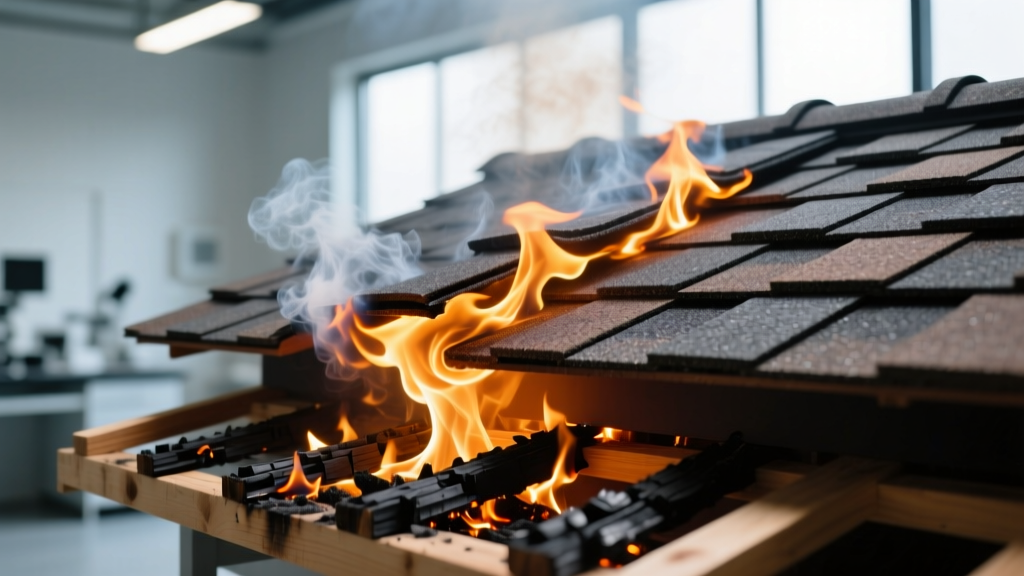
When evaluating fire resistant roofing materials, the term 'fireproof' is a dangerous misnomer. No roofing material is entirely immune to combustion under extreme thermal loads. Instead, the industry relies on rigorous fire-resistance testing to measure how long a roof assembly can withstand direct flame impingement, radiant heat, and airborne embers before structural failure occurs. In North America, this evaluation is governed by two virtually identical standards: ASTM E108 and UL 790. Both standards subject roof coverings to a triad of severe thermal tests to assign a Class A, B, or C rating.
Certification Snapshot
UL 790 and ASTM E108 test the entire roof assembly, not just the outer shingle or tile. A material that achieves a Class A rating over a non-combustible concrete deck may drop to Class C or fail entirely when installed over a standard wood deck with traditional felt underlayment. Always verify the 'assembly' rating, not just the 'stand-alone' material rating.
Decoding Class A, B, and C Fire Ratings
The classification system dictates the severity of the fire exposure the roof can survive. Class A is the highest rating, mandatory in most Wildland-Urban Interface (WUI) zones, while Class C offers only basic protection against light exterior fire exposure.
| Rating | Burning Brand Size & Weight | Max Flame Spread | Intermittent Flame Cycles | Common Materials |
|---|---|---|---|---|
| Class A | 12" x 12" x 2" (approx. 2000g) | 6 feet (max) | 15 cycles | Clay/Concrete Tile, Metal, Slate, Fiberglass Asphalt |
| Class B | 6" x 6" x 2" (approx. 500g) | 8 feet (max) | 8 cycles | Fire-retardant treated wood shakes |
| Class C | 1.5" x 1.5" x 0.5" (approx. 12g) | 13 feet (max) | 3 cycles | Standard organic asphalt shingles, uninsulated metal |
The Three Pillars of Roof Fire Certification Tests
To achieve any classification, the roof assembly must pass three distinct laboratory evaluations without exhibiting structural failure, deck ignition, or excessive flame spread.
1. Intermittent Flame Test
This test simulates a fire exposing the roof to cyclic thermal shock. A gas burner producing a flame temperature of approximately 1,500°F is directed at the roof surface. For a Class A rating, the burner is cycled on for two minutes and off for two minutes, repeated for 15 cycles (60 minutes total). The assembly fails if the flame penetrates the deck, if the deck glows red, or if structural integrity is compromised.
2. Spread of Flame Test
Wind-driven fire spread is a primary cause of structural loss in urban conflagrations. In this test, a continuous gas flame is applied to the roof surface while a wind tunnel generates a 12 mph airflow across the assembly. Sensors track the leading edge of the flame. To pass Class A, the flame must not travel more than 6 feet from the ignition source within 10 minutes. Materials like untreated wood shakes typically fail this test catastrophically, with flames racing to the eaves in under 3 minutes.
3. Burning Brand Test (The Crucible of Class A)
Airborne embers (firebrands) are the leading cause of home ignitions in wildfires. The Insurance Institute for Business & Home Safety (IBHS) emphasizes that ember intrusion is the most critical vulnerability for modern roofs. The burning brand test addresses this by placing a pre-weighed, ignited wooden lattice directly onto the roof surface.
- Class A Brand: A 12-inch by 12-inch lattice weighing 2,000 grams. It burns for up to 90 minutes, generating intense, localized thermal transfer.
- Class B Brand: A 6-inch by 6-inch lattice weighing 500 grams.
- Class C Brand: A tiny 1.5-inch lattice weighing just 12 grams, simulating a small, wind-blown twig.
Assembly vs. Stand-Alone: The 'By Design' Loophole
A critical nuance in fire resistant roofing materials is the distinction between 'stand-alone' and 'by design' (assembly) ratings.
'A concrete roof tile is inherently non-combustible, but it is not inherently Class A. The wind tunnels created by the curved profiles of barrel tiles can channel embers directly to the combustible wood deck below. Without a specific fire-rated underlayment and proper bird-stopping at the eaves, a concrete tile roof can fail a Class A assembly test.'
When reviewing product data sheets, look for the specific assembly requirements. If a product is listed as requiring 'Type 72' or 'SU' (Special Underlayment) to achieve a Class A rating over a wood deck, installing it over standard synthetic underlayment voids the fire rating and violates WUI building codes.
Verifying Certifications: How to Spot Fake or Outdated Labels
With the increasing stringency of WUI codes in states like California, Colorado, and Oregon, the market has seen an influx of misleading marketing claims. Contractors and homeowners must independently verify fire ratings using authoritative databases.
- Check the CalFire WUI List: The California Office of the State Fire Marshal maintains the most rigorous public database of approved WUI products. If a roofing material is not listed here, it is highly unlikely to be accepted by inspectors in any strict WUI jurisdiction.
- Search UL Product iQ: Access the UL Product iQ database and search for the manufacturer's exact product model number. Look for the 'Fire Resistance' category and verify the specific design number (e.g., Design No. U305). This document will list the exact deck type, fastener spacing, and underlayment required to maintain the rating.
- Inspect the Packaging: Legitimate Class A asphalt shingles will feature a physical UL classification mark printed directly on the bundle wrapper, alongside the ASTM D7158 (wind) and ASTM D3462 (tear) standards. Absence of this mark indicates a non-certified or contractor-grade product.
Frequently Asked Questions on Roof Fire Testing
Does a metal roof automatically qualify as Class A?
No. While steel and aluminum are non-combustible, a metal roof assembly can fail the Class A intermittent flame test if the thermal transfer through the metal panels ignites the underlying wood deck or combustible insulation. The metal must be installed over a tested, fire-rated underlayment assembly to achieve the Class A certification.
How do solar panel mounts affect the roof's fire rating?
Penetrations for solar racking systems compromise the continuous fire barrier. If the flashing and sealants used around the lag bolts are not specifically tested and listed for use with the certified roof assembly, the penetration becomes a direct conduit for embers. Always use solar mounting systems that possess their own UL 2703 fire classification, which tests the integrated roof-mount assembly.
Can I apply a fire-retardant spray to an existing wood shake roof to get a Class A rating?
No. Topical fire-retardant sprays and coatings degrade rapidly under UV exposure and rain. While they may temporarily pass a Class B or C surface burn test, they cannot achieve a Class A rating, and no building code in a designated WUI zone accepts topical treatments as a substitute for inherently fire-rated materials or certified assembly replacements.
Written by
Priya KapoorPriya Kapoor is a real estate market analyst and construction economics researcher with expertise in housing affordability, development feasibility, and infrastructure investment. She holds a Master of Regional Planning from Cornell University and previously worked as a senior analyst at CBRE's Investment Properties group, where she modeled returns for $4B in mixed-use development pipelines. Priya now runs an independent research practice advising developers, municipalities, and REITs on construction cost forecasting and market timing. She publishes the quarterly "BuildMat Market Pulse" report tracking material price indices across 12 commodity categories. Based in Austin, TX, Priya serves on the board of Habitat for Humanity Austin and is a marathon runner.
More from Priya Kapoor
View all
Construction Cost
Cost to Build a 1600 Sq Ft Home in 2026: Full Breakdown
Accurate 2026 cost to build a 1600 sq ft home—material, labor, and regional pricing breakdowns included. Plan your budget with real-time estimates.
Aug 11, 2026

Wood & Lumber
Name the Types of Wood for Pressure Treatment and Preservation
Learn how to name the types of wood best suited for pressure treatment. Compare species treatability, chemical retention levels, and 2026 preservation costs.
Aug 4, 2026

Stone & Masonry
Stone Veneer Suppliers Lindenhurst: 2026 Cost Analysis
Analyze 2026 stone veneer costs in Lindenhurst, NY. Compare local supplier pricing, delivery fees, and Suffolk County installation labor rates.
Aug 4, 2026