Decoding Fire Ratings for Fireproof Building Materials
Understand hourly fire ratings, ASTM E119 standards, and Class A/B/C classifications to select the right fireproof building materials for your project.

This guide is written for commercial architects, structural engineers, and facility managers. Bare metal buildings possess a zero-hour fire resistance rating because unprotected steel yields and loses structural integrity at 1,000 degrees Fahrenheit (538 degrees Celsius). To achieve metal building fire resistance ratings of 1, 2, or 3 hours, builders must apply approved fireproofing assemblies like intumescent paint or cementitious sprays that insulate the steel from critical failure temperatures.
- Unprotected steel fails structurally at 1,000°F (538°C), yielding a 0-hour rating.
- Applied assemblies achieve 1-hour to 4-hour metal building fire resistance ratings.
- The 2026 International Building Code mandates specific hourly ratings based on building height and occupancy type.
Understanding Hourly Fire Resistance Ratings
A fire resistance rating is a standardized engineering metric indicating the exact duration, measured in minutes or hours, that a specific building assembly can contain a severe fire while maintaining its structural load-bearing capacity under standardized laboratory test conditions established by national safety organizations.
The American Society for Testing and Materials (ASTM) E119 standard dictates how these assemblies are tested. During the test, a furnace exposes the building material to a controlled time-temperature curve. The assembly passes if it prevents heat transfer and maintains its structural load for the designated timeframe. You can review the specific testing parameters via the National Fire Protection Association (NFPA) 251 standard.
Fireproofing Methods for Steel Structures
When researching how to fireproof a metal building, professionals choose between reactive and non-reactive insulation systems. The selection depends on architectural aesthetics, budget, and required hourly protection.
Intumescent Coatings
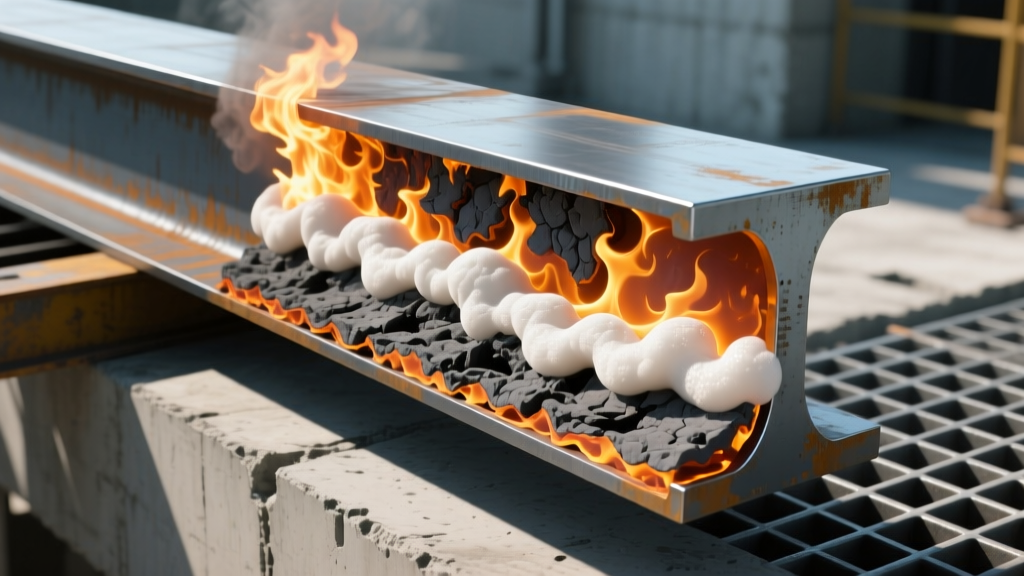
Intumescent paint remains invisible under normal conditions but swells up to 50 times its original thickness when exposed to high heat. This expansion creates a carbonaceous char that insulates the steel substrate. Applying 150 mils of wet film thickness typically yields a verified 2-hour fire rating for standard wide-flange beams.
Cementitious Spray Fireproofing
Spray-applied fire-resistive materials (SAFRM) consist of Portland cement, aggregate, and chemical binders. This non-reactive method provides robust protection for concealed structural members. The applied density ranges from 15 to 40 pounds per cubic foot, offering up to a 4-hour rating depending on the thickness applied to the steel web and flanges.
Gypsum Board Enclosures
For interior columns and aesthetic shear walls, builders use Type X gypsum board enclosures. A standard 5/8-inch thickness of fire-rated gypsum board contains glass fibers that prevent the core from cracking under thermal stress. Multiple layers are applied to achieve 1-hour or 2-hour ratings.
Fireproofing Material Comparison Matrix
Use this decision framework to evaluate fireproofing options for your structural steel members based on performance and 2026 market costs.
| Material Type | Max Hourly Rating | Applied Thickness (inches) | Estimated Cost (per sq. ft.) |
|---|---|---|---|
| Intumescent Coating | 3 Hours | 0.15 - 0.50 | $4.50 - $8.00 |
| Cementitious Spray (SAFRM) | 4 Hours | 0.75 - 2.50 | $1.50 - $3.00 |
| Type X Gypsum Board | 2 Hours | 1.25 - 2.50 | $2.00 - $4.00 |
2026 Building Code Requirements
Steel structure fire rating requirements are strictly governed by local jurisdictions adopting the latest International Building Code (IBC). The International Code Council (ICC) 2024/2026 IBC classifies buildings by construction type, which directly dictates the required hourly ratings.
Type IA construction mandates a 3-hour fire resistance rating for the primary structural frame, requiring heavy cementitious or multi-layer intumescent protection. Conversely, Type IIB construction permits a 0-hour rating, allowing completely unprotected steel. However, most commercial warehouses and multi-story metal buildings fall under Type IIA, requiring a 1-hour rating for all load-bearing columns and beams.
Verification of these assemblies is managed by independent testing laboratories. The Underwriters Laboratories (UL) Fire Resistance Testing directory provides the certified design numbers that inspectors require during final building sign-offs.
Frequently Asked Questions
Does steel burn in a fire?
Steel does not combust or burn in standard structural fires. However, it is highly conductive and rapidly loses its yield strength at elevated temperatures. Without fireproofing, a loaded steel beam will buckle and collapse when its internal temperature reaches 1,000 degrees Fahrenheit.
What is the fire rating of a metal roof?
The exterior fire rating of a metal roof is typically Class A, meaning it resists severe external fire exposure. However, the internal structural fire rating of the roof deck and supporting bar joists depends entirely on the applied fireproofing assembly and the building's designated occupancy type.
How is the fire rating of steel beams calculated?
The fire rating of steel beams is not calculated mathematically on-site; it is determined through standardized laboratory testing. Engineers use the beam's area-to-perimeter (A/P) ratio or width-to-depth (W/D) ratio to select a pre-tested UL design that guarantees the required hourly protection.
Conclusion and Next Steps
Metal buildings achieve hourly fire resistance ratings exclusively through applied fireproofing assemblies, as bare structural steel inevitably yields at extreme temperatures. Selecting the right intumescent or cementitious system ensures compliance with modern safety codes while protecting human life and physical assets.
Your next step is to consult a licensed fire protection engineer. Have them calculate the exact area-to-perimeter (A/P) ratio for your specific steel members to specify the optimal coating thickness and material type for your project.
Written by
James ThorntonJames Thornton is a construction industry veteran with 25 years of hands-on experience in wood framing, lumber grading, and residential building codes. He started as a framing carpenter in rural Oregon, earned his ICC Residential Building Inspector certification, and eventually became a senior plan reviewer for the City of Portland Bureau of Development Services. James holds a B.S. in Wood Science & Technology from Oregon State University and is a certified lumber grader through the West Coast Lumber Inspection Bureau (WCLIB). He has inspected over 3,000 residential construction sites and authored the city's internal guide on advanced framing techniques (2x6 at 24" O.C.). James lives in Bend, OR, where he builds custom timber-frame cabins and competes in lumberjack sports.
More from James Thornton
View all
Insulation
Best Home Insulation Materials: Complete 2026 Guide
Compare top home insulation materials for 2026. Find R-values, installed costs per square foot, and best uses for fiberglass, spray foam, and mineral wool.
Aug 4, 2026

Sustainable Building
Certify Your Green Building Material for LEED and WELL
Step-by-step guide to certifying a green building material for LEED v5 and WELL v2. Master EPDs, HPDs, and VOC limits for 2026 project specifications.
Aug 4, 2026

Stone & Masonry
Veneer Stacked Stone Panels: Interior Design & Style Showcase
Discover how veneer stacked stone panels transform interiors. Explore modern design profiles, material pairings, and technical installation specs.
Aug 4, 2026