Fire Proof Building Materials Cost Analysis: 2026 Budget Guide
Discover the true cost of fire proof building materials in 2026. Compare pricing for gypsum, concrete, intumescent coatings, and fiber cement per square foot.

The Real Premium: Understanding Fire-Resistant Construction Costs
Specifying fire proof building materials is no longer just a commercial building requirement; it is a critical investment for residential structures in high-risk zones. When evaluating the financial impact of fire-resistant construction, contractors and developers must look beyond the initial material invoice. The true cost analysis involves weighing the upfront material premium against labor adjustments, long-term maintenance, and substantial insurance premium reductions.
Upgrading a standard structural envelope to meet stringent Wildland-Urban Interface (WUI) codes or commercial ASTM E119 fire-resistance ratings typically adds a 2% to 5% premium to total framing and cladding budgets. However, this initial capital expenditure is frequently offset by reduced lifecycle costs and mitigated catastrophic risk.
Material-by-Material Cost Breakdown
The market for fire-resistant products has expanded significantly, offering varied price points depending on the required fire-resistance rating (e.g., 1-hour vs. 2-hour assemblies). Below is a comparative cost matrix for the most widely specified materials in 2026.
| Material Category | Standard Alternative | Fire-Resistant Option | Material Cost (per sq. ft.) | Installed Cost (per sq. ft.) |
|---|---|---|---|---|
| Interior Wallboard | 1/2" Standard Gypsum | 5/8" Type X Gypsum | $0.45 - $0.65 | $1.80 - $2.40 |
| Exterior Siding | Vinyl Siding | Fiber Cement Siding | $3.50 - $5.50 | $8.50 - $13.00 |
| Cavity Insulation | Fiberglass Batts | Stone Mineral Wool | $1.10 - $1.60 | $2.50 - $3.50 |
| Structural Steel | None / Standard Paint | Intumescent Coating | $4.00 - $9.00 | $12.00 - $22.00 |
| Roofing Underlayment | Standard Felt | Fire-Block Membrane | $0.85 - $1.25 | $1.50 - $2.20 |
Type X Gypsum Board vs. Standard Gypsum
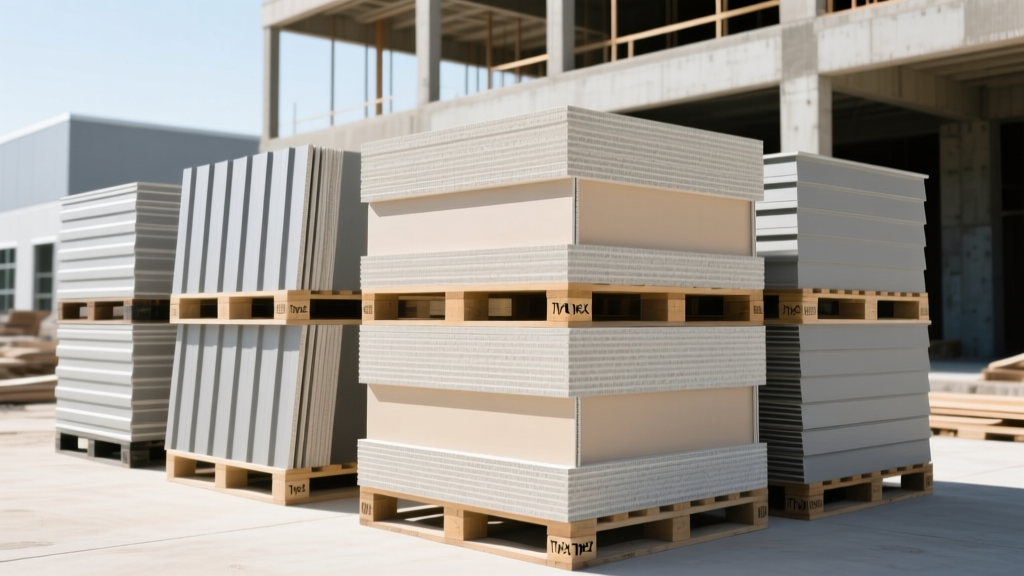
For interior fire-rated assemblies, 5/8-inch Type X gypsum board (such as USG Sheetrock Brand Firecode X) remains the most cost-effective fire proof building material available. Type X contains glass fibers and other non-combustible additives that delay structural failure during a fire. While the material cost is roughly 40% higher than standard 1/2-inch gypsum, the labor cost to install it is nearly identical. The primary cost driver is the increased weight of the panels, which can slightly slow down hanging times on multi-story commercial projects, adding roughly $0.15 per square foot in labor overhead.
Fiber Cement Siding vs. Vinyl and Wood
Exterior cladding is the first line of defense against radiant heat and wind-blown embers. Fiber cement products, like James Hardie HardiePlank, achieve a Class A fire rating (ASTM E84) and are non-combustible. At $8.50 to $13.00 per square foot installed, it carries a significant premium over vinyl siding ($4.00 to $6.00 installed). However, fiber cement does not melt or ignite when exposed to direct flame impingement, making it a mandatory specification in many California and Colorado WUI zones. Wood siding, even when treated with fire-retardant chemicals, requires ongoing maintenance and re-treatment, increasing its 10-year lifecycle cost above that of fiber cement.
Intumescent Coatings for Structural Steel
Protecting exposed structural steel in commercial builds requires intumescent paints (e.g., Sherwin-Williams FIRETEX or Nullifire SC902). These coatings swell to form an insulating char when exposed to extreme heat, delaying steel yielding. The cost of intumescent coatings is highly dependent on the required mil thickness to achieve a specific UL 263 rating. A 1-hour rating may require 20 mils and cost around $4.00 per square foot for materials, while a 2-hour rating can demand 50+ mils, pushing material costs past $9.00 per square foot. Application requires specialized airless sprayers and certified applicators, heavily inflating the installed price.
Hidden Costs and Application Edge Cases
Budgeting for fire proof building materials requires accounting for secondary costs that are frequently omitted from initial estimates. Failing to plan for these edge cases can result in severe budget overruns and failed municipal inspections.
- Substrate Preparation for Coatings: Intumescent paints cannot be applied over standard primers or rusted steel. The steel must undergo SSPC-SP6 commercial blast cleaning. This preparation adds $1.50 to $2.50 per square foot to the project cost before the first drop of fireproofing paint is applied.
- Specialized Fasteners and Joint Compound: A fire-rated wall assembly is only as strong as its weakest component. Using standard drywall screws instead of coarse-thread, fire-rated screws, or failing to use setting-type joint compound (like USG Durabond) will void the UL assembly rating. Fire-rated sealants and firestop putty for electrical penetrations add $400 to $800 to a standard residential electrical rough-in.
- Third-Party Inspection Fees: Commercial projects utilizing sprayed fire-resistive materials (SFRM) or complex intumescent coatings require special inspections by certified third-party agencies. Expect to budget $1,200 to $2,500 per inspection phase to verify mil thickness and adhesion.
- Mineral Wool Density Constraints: Stone mineral wool insulation (e.g., ROCKWOOL Safe'n'Sound) is inherently non-combustible and withstands temperatures up to 2,150°F. However, its high density makes it difficult to cut and compress into standard stud cavities, increasing insulation labor time by approximately 15% compared to fiberglass batts.
ROI and Insurance Premium Reductions
The financial justification for fire proof building materials extends far beyond the construction phase. According to data analyzed by the Insurance Institute for Business & Home Safety (IBHS), structures built to fortified wildfire standards experience significantly lower loss ratios. Insurance carriers are increasingly utilizing satellite imagery and material databases to underwrite properties in high-risk zones.
Insurance Premium Impact
Homes and commercial structures built with certified Class A fire proof building materials in high-risk WUI zones see an average 12% to 18% reduction in annual property insurance premiums. In regions facing insurer pullouts, utilizing these materials is often the only way to secure coverage at all.
Furthermore, the National Fire Protection Association (NFPA) notes that ember intrusion is responsible for up to 90% of home ignitions during wildfires. Investing in fire-rated underlayments, ember-resistant vents (which cost $40 to $85 each compared to $10 for standard vents), and non-combustible siding directly targets the primary vector of structural loss, yielding the highest return on investment for the material dollar spent.
Decision Framework: Matching Materials to Fire Zones
To optimize your budget, avoid over-specifying materials in low-risk areas and under-specifying in critical zones. The FEMA Ready.gov guidelines and modern WUI codes divide the area around a structure into three distinct defensible space zones. Material selection should be tiered accordingly.
Zone 0: The Immediate Perimeter (0 to 5 feet)
This zone is subjected to direct flame contact and intense radiant heat. Combustible materials are strictly prohibited.
Required Materials: Poured concrete, masonry, stone veneer with mortar, or stucco.
Cost Strategy: Use a concrete stem wall or masonry wainscoting for the bottom 5 feet of the exterior, transitioning to a less expensive fire-resistant material higher up to save costs.
Zone 1: The Intermediate Buffer (5 to 30 feet)
This zone faces heavy ember showers and moderate radiant heat.
Required Materials: Fiber cement siding, fire-retardant treated wood (FRTW), metal roofing, and mineral wool insulation.
Cost Strategy: FRTW is cheaper than fiber cement upfront but requires chemical re-treatment every 5 to 10 years. For long-term lifecycle cost optimization, fiber cement or metal cladding is vastly superior.
Zone 2: The Extended Perimeter (30 to 100 feet)
This zone is primarily managed through landscaping and vegetation clearance rather than structural materials.
Required Materials: Standard building materials are generally permissible, provided they meet baseline local building codes.
Cost Strategy: Allocate the budget saved in Zone 2 toward upgrading the roof assembly and installing 1/8-inch metal mesh over all attic and crawlspace vents to prevent ember intrusion.
Strategic allocation of fire proof building materials based on zone-specific vulnerability ensures code compliance and maximum structural resilience without unnecessarily inflating the overall construction budget.
Written by
Marcus ChenMarcus Chen is a licensed structural engineer (PE) and building materials analyst with over 12 years of experience across residential, commercial, and industrial construction. He holds a Master of Science in Civil Engineering from UC Berkeley and spent six years at Thornton Tomasetti before transitioning to independent consulting and technical writing. Marcus specializes in material selection for seismic-prone regions, concrete reinforcement strategies, and lifecycle cost analysis. His work has been cited by the American Concrete Institute (ACI) and the Structural Engineers Association of California (SEAOC). When he is not on a job site or at his desk, you will find him hiking the Sierra Nevada or restoring a 1920s craftsman bungalow in Oakland, CA.
More from Marcus Chen
View all
Construction Cost
How Much Did the Eiffel Tower Cost to Build?
How much did the Eiffel Tower cost to build in 1889? We adjust for inflation and compare its budget to modern skyscraper construction.
Aug 4, 2026

Fire Resistance
What Is a Fire Resistant Material? Testing & Certification Guide
Discover what is a fire resistant material through ASTM and UL testing. Learn how fire ratings, certifications, and assemblies work in construction.
Aug 4, 2026

Construction Cost
How Much Did the Burj Khalifa Cost to Build?
How much did the Burj Khalifa cost to build? We break down the $1.5B project and extract 5 money-saving strategies for your next build.
Jul 30, 2026