How Much Does It Cost to Build a Firepit? 2026 Material Review
Discover how much it costs to build a firepit in 2026. Compare prices for Corten steel, masonry, and concrete, plus labor and fire-safety requirements.

The True Cost of Building a Firepit: Beyond the Basic Kit
When homeowners ask how much it costs to build a firepit, the answer depends entirely on the intersection of material durability, heat tolerance, and installation labor. In 2026, a basic DIY steel ring kit costs between $150 and $300, while a custom masonry installation with a gas line and professional landscaping ranges from $3,500 to $7,500. The wide variance is driven by fire-resistant material requirements; standard building materials often fail under the extreme thermal cycling of a contained wood fire, necessitating specialized, code-compliant components.
This comparison review breaks down the exact material costs, lifespan expectations, and structural requirements for the three most common firepit builds: Corten steel, masonry (brick and stone), and pre-cast concrete.
Material Comparison Matrix: Price, Durability, and Heat Tolerance
| Material Type | Avg. Material Cost (DIY) | Professional Install Cost | Expected Lifespan | Thermal Shock Resistance |
|---|---|---|---|---|
| 1/4-inch Corten Steel Ring | $350 - $650 | $1,200 - $2,500 | 20 - 30+ years | Excellent |
| 10-Gauge Steel Ring | $120 - $250 | $800 - $1,500 | 3 - 5 years | Good (but warps) |
| Clay Brick (with Firebrick liner) | $450 - $800 | $2,500 - $4,500 | 40+ years | Excellent (if lined) |
| Natural Stone / Retaining Blocks | $300 - $700 | $3,000 - $6,000 | 25 - 50 years | Poor (requires steel insert) |
| Pre-Cast Concrete Pavers | $150 - $300 | $1,000 - $2,000 | 5 - 10 years | Poor (prone to spalling) |
Deep Dive: Fire-Resistant Material Options
Corten Steel: The Modern Standard for Contained Fires
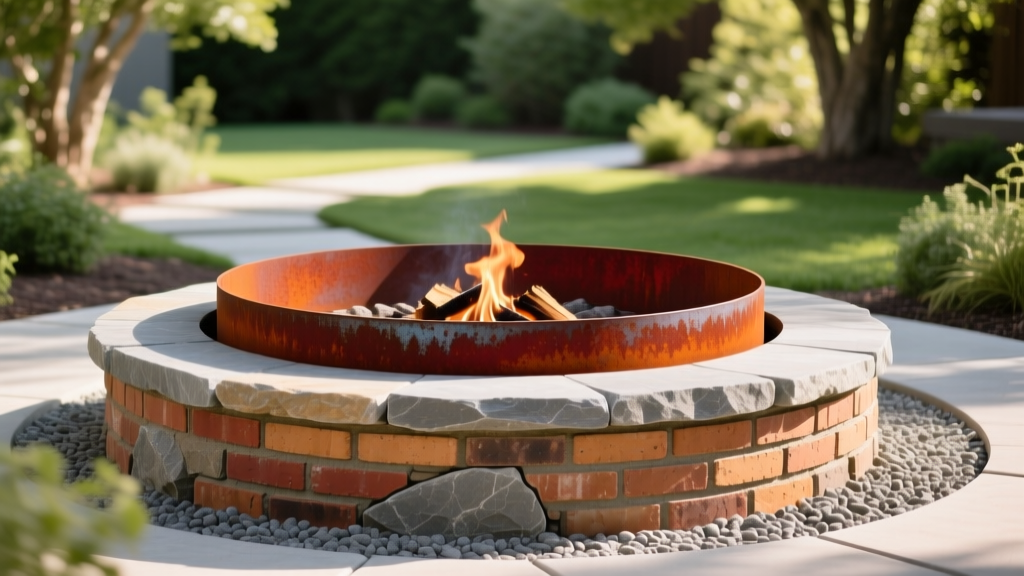
Corten (weathering) steel has become the industry standard for modern firepits due to its ability to form a stable, protective rust patina that halts further corrosion. However, the gauge thickness dictates the lifespan and cost.
- 10-Gauge Steel (0.135 inch): Priced around $150 for a 36-inch diameter ring. While affordable, 10-gauge steel will warp under high heat and typically rust through within 3 to 5 seasons of heavy use.
- 1/4-Inch Steel (0.25 inch): Priced between $400 and $650 for a custom-fabricated 36-inch ring. This thickness provides the thermal mass necessary to resist warping and will easily last 25+ years. The material cost is higher, but the cost-per-year of use is significantly lower.
Masonry Builds: The Critical Role of Refractory Liners
Building a firepit entirely out of standard clay brick, concrete blocks, or natural stone is a common and expensive mistake. Standard masonry materials contain trapped moisture and air pockets. When exposed to the direct 1,200°F heat of a wood fire, these materials undergo rapid thermal expansion, leading to spalling, cracking, and in severe cases, explosive fragmentation.
To build a safe, permanent masonry firepit, you must use a dual-wall system:
- The Outer Veneer: Standard face brick, natural fieldstone, or segmental retaining wall blocks. This layer provides the aesthetic and structural retaining wall. Mortar used here should be Type N or Type S masonry cement.
- The Inner Liner: Must be constructed using ASTM C27 Grade A Firebrick. Firebricks are manufactured from high-alumina clays and can withstand temperatures up to 2,460°F without degrading. Expect to pay $2.50 to $4.00 per firebrick.
- The Mortar: The inner liner must be laid with refractory mortar (calcium aluminate-based), not standard Portland cement. Refractory mortar costs approximately $45 to $60 per 50 lb bag but is non-negotiable for preventing joint failure. The Brick Industry Association (BIA) explicitly outlines the necessity of specialized fire-resistant masonry assemblies for high-heat applications.
Pre-Cast Concrete and Paver Kits
Pre-cast concrete firepit kits (often sold at big-box home improvement stores for $150 to $300) offer the lowest barrier to entry. However, concrete is highly susceptible to thermal shock. Without a steel drop-in ring to shield the concrete from direct flames, the aggregate inside the concrete will expand and cause the walls to crack and crumble within a few years. If opting for a paver or pre-cast build, budget an additional $150 to $250 for a heavy-gauge steel insert ring to protect the structural integrity of the concrete.
Labor, Site Prep, and Hidden Costs
Material costs only tell half the story. The site preparation required to ensure proper drainage and fire safety significantly impacts the final budget.
Base Excavation and Gravel Foundations
A firepit cannot be placed directly on topsoil or grass; the heat will scorch the earth, and shifting soil will crack masonry walls. You must excavate 6 to 8 inches of topsoil and compact a base of 3/4-inch crushed angular gravel.
Cost impact: $150 - $300 for gravel delivery and manual labor, or $500+ if hiring a landscaping crew to excavate and compact with a plate compactor.
Gas Line Conversions
Converting a wood-burning pit to natural gas or propane eliminates smoke and ash but introduces strict plumbing costs. Running a dedicated natural gas line from your meter to the backyard typically costs $25 to $45 per linear foot. A professional gas firepit installation, including the trenching, poly-pipe laying, pressure testing, and installation of a concrete fire pan and lava glass media, adds $2,000 to $4,000 to the total project cost.
Fire Safety, Code Compliance, and Air Quality
Before purchasing materials, you must verify local municipal codes regarding open burning. The National Fire Protection Association (NFPA) generally recommends a minimum 10-foot clearance from any combustible structure, though many local jurisdictions enforce a strict 25-foot setback for open-flame wood-burning pits.
Permit Requirements: Most municipalities do not require a permit for a portable, above-ground wood-burning firepit. However, if you are building a permanent masonry structure, pouring a concrete footer, or trenching a gas line, a building permit and subsequent inspection are almost universally required.
Additionally, consider the environmental impact of wood smoke. The Environmental Protection Agency (EPA) BurnWise program highlights that residential wood smoke is a significant source of fine particulate matter (PM2.5). If you live in an area prone to winter temperature inversions or burn bans, investing the extra capital into a natural gas or propane firepit ensures your outdoor space remains usable year-round without violating local air quality ordinances.
Frequently Asked Questions
Is it cheaper to buy a pre-made firepit or build one?
Buying a pre-made, factory-fabricated Corten steel or cast iron firepit is almost always cheaper than building a custom masonry pit. A high-quality, 1/4-inch thick Corten steel bowl costs between $600 and $900 delivered. Building a masonry pit of the same size with firebrick, refractory mortar, and stone veneer will easily exceed $1,500 in materials alone, not including the 15 to 20 hours of skilled labor required.
Do I need a metal ring for a stone firepit?
Yes. If you are building with natural stone, concrete pavers, or standard retaining wall blocks, a metal insert ring is mandatory. Without it, the direct flame will cause the moisture inside the stone or concrete to rapidly expand, leading to structural failure and dangerous projectile fragments. A 10-gauge or 1/4-inch steel drop-in ring acts as a thermal shield, preserving the outer masonry.
What is the best base material to put inside the bottom of a firepit?
For wood-burning pits, a 2-inch layer of coarse builder's sand or crushed lava rock at the bottom of the steel ring provides excellent drainage and insulates the underlying ground from extreme heat. Never use pea gravel or river rocks at the base of a firepit; these stones are often non-porous and trap water, which can cause them to explode when heated by a fire.
Written by
Priya KapoorPriya Kapoor is a real estate market analyst and construction economics researcher with expertise in housing affordability, development feasibility, and infrastructure investment. She holds a Master of Regional Planning from Cornell University and previously worked as a senior analyst at CBRE's Investment Properties group, where she modeled returns for $4B in mixed-use development pipelines. Priya now runs an independent research practice advising developers, municipalities, and REITs on construction cost forecasting and market timing. She publishes the quarterly "BuildMat Market Pulse" report tracking material price indices across 12 commodity categories. Based in Austin, TX, Priya serves on the board of Habitat for Humanity Austin and is a marathon runner.
More from Priya Kapoor
View all
Construction Cost
Cost to Build a 1600 Sq Ft Home in 2026: Full Breakdown
Accurate 2026 cost to build a 1600 sq ft home—material, labor, and regional pricing breakdowns included. Plan your budget with real-time estimates.
Aug 11, 2026

Wood & Lumber
Name the Types of Wood for Pressure Treatment and Preservation
Learn how to name the types of wood best suited for pressure treatment. Compare species treatability, chemical retention levels, and 2026 preservation costs.
Aug 4, 2026

Stone & Masonry
Stone Veneer Suppliers Lindenhurst: 2026 Cost Analysis
Analyze 2026 stone veneer costs in Lindenhurst, NY. Compare local supplier pricing, delivery fees, and Suffolk County installation labor rates.
Aug 4, 2026