Fire Retardant Material for Building: A Code Compliance Guide
Navigate IBC codes for fire retardant material for building. Learn ASTM testing, FRT wood rules, and compliance documentation for the AHJ.

Decoding the IBC: Fire-Resistant vs. Fire-Retardant Assemblies
When specifying a fire retardant material for building applications, contractors and architects frequently conflate 'fire-retardant' with 'fire-resistant.' The International Building Code (IBC) treats these as fundamentally distinct concepts, and misclassifying them on submittals is a primary trigger for plan review rejections.
Fire-Resistant refers to an assembly's ability to contain a fire, maintain structural integrity, and prevent heat transmission for a specified duration (e.g., a 1-hour or 2-hour fire-resistance rating per ASTM E119). This is typically achieved through mass (concrete, heavy timber) or protective encasement (Type X gypsum board).
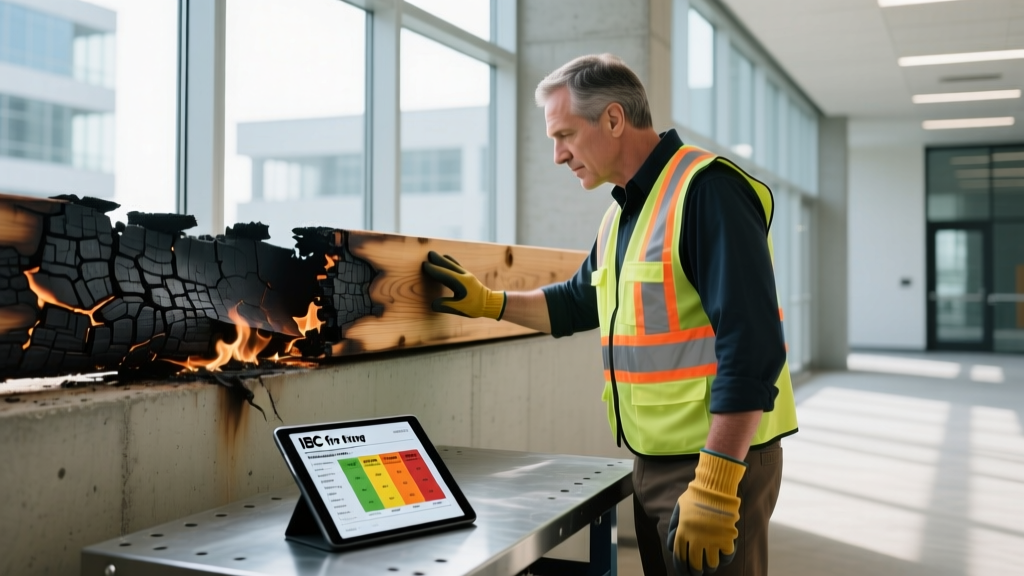
Fire-Retardant refers to chemical treatments applied to combustible materials (like wood or textiles) to reduce surface flammability, slow ignition, and limit flame spread. Fire-retardant-treated (FRT) wood does not inherently possess a fire-resistance rating (like 1-hour); rather, it achieves a Class A Flame Spread Index (FSI) of 25 or less when tested under ASTM E84.
Mandatory Testing Standards for Fire Retardant Materials
To gain approval from the Authority Having Jurisdiction (AHJ), any fire retardant material for building envelopes or interior finishes must pass rigorous, standardized testing. The three critical benchmarks include:
- ASTM E84 / UL 723 (Surface Burning Characteristics): Measures the Flame Spread Index (FSI) and Smoke Developed Index (SDI). Class A materials must score an FSI of 0-25 and SDI of 0-450. This is the baseline requirement for interior wall and ceiling finishes in Type I and II construction.
- NFPA 285 (Exterior Wall Assemblies): A critical mid-scale test evaluating vertical and lateral flame propagation over the exterior face of a multi-story building. If a building is Type I, II, III, or IV and exceeds 40 feet in height, any combustible exterior cladding, insulation, or water-resistive barrier (WRB) must pass NFPA 285. NFPA 285 compliance is non-negotiable for modern commercial facades.
- UL 1715 (Fire Test of Interior Finish Material): Evaluates the fire performance of interior wall and ceiling materials, specifically focusing on corner ignition and heat flux, often required for specialized interior architectural treatments.
Top Code-Compliant Fire Retardant Materials & Cost Matrix
Selecting the right product requires matching the material to the specific IBC section governing its application. Below is a breakdown of industry-standard fire retardant and fire-resistant materials, their compliance pathways, and current market pricing.
| Material Type | Product Example | Primary Code Application | Est. Cost (Material Only) |
|---|---|---|---|
| FRT Plywood | Perma-Chem D-Blaze® | IBC Sec. 2303.2 (Interior roof/wall sheathing) | $55 - $75 / 4x8 sheet |
| Intumescent Coating | Sika® Unitherm® Platinum | IBC Sec. 705 (Structural steel protection) | $9.00 - $14.00 / sq ft |
| Type X Gypsum Board | USG Firecode® C | IBC Sec. 716 (1-Hour / 2-Hour shaft enclosures) | $20 - $28 / 4x8 sheet |
| Fire-Retardant Paint | FlameOFF® Intumescent Paint | IBC Sec. 803 (Interior finish retrofits) | $1.80 - $2.50 / sq ft |
Navigating IBC Section 2303.2: FRT Wood Requirements
When utilizing Fire-Retardant-Treated (FRT) wood, compliance extends far beyond simply purchasing treated lumber. IBC Section 2303.2 dictates strict manufacturing, labeling, and environmental parameters that contractors must enforce on-site.
1. Mandatory AWPA and ICC-ES Labeling
Every piece of FRT wood delivered to the job site must bear a physical label indicating compliance with AWPA Standard U1. Furthermore, the label must include an ICC-ES Evaluation Report number (e.g., ESR-1620). If the lumber arrives without these tags, the building inspector will red-tag the framing, requiring costly third-party verification or total replacement. AWPA Standard U1 governs the exact chemical retention levels required for different end-uses.
2. The Humidity and Heat Degradation Factor
Early generations of FRT wood (pre-2000s) suffered from severe structural degradation when exposed to high temperatures and humidity, notably failing in plywood roof decks. Modern polymer-based and advanced borate treatments (like D-Blaze or Dricon) have mitigated this, but IBC Section 2303.2.4 still requires that FRT wood be designed with adjusted structural values. Engineers must apply the specific 'design value adjustment factors' provided in the manufacturer's ICC-ES report, which often reduce the allowable shear and bending stresses by 10% to 20%.
3. Field Cutting and Re-treatment
A common job-site violation occurs when carpenters cut FRT plywood to fit around HVAC penetrations. According to code, any cut or drilled surface that exposes untreated wood must be field-treated with a compatible fire-retardant coating approved by the original manufacturer. Failing to brush-on the specified field treatment voids the Class A flame spread rating at that penetration.
Exterior Wall Assemblies: The NFPA 285 Hurdle
The most complex compliance landscape for fire retardant materials exists on the exterior envelope of Type I, II, III, and IV buildings. IBC Section 1407 mandates that exterior wall assemblies containing any combustible components (including foam plastic insulation, wood-composite cladding, or combustible WRBs) must pass the NFPA 285 test if the building exceeds 40 feet in height.
Common Code Violations & Inspector Red Flags
To ensure smooth inspections, avoid these frequent compliance failures related to fire retardant and fire-resistant materials:
- Missing Firestop at Top Plates: Using FRT wood for top plates does not eliminate the need for fireblocking or draftstopping per IBC Section 718. Inspectors will look for intumescent firestop caulking (e.g., Hilti CFS-S) where pipes penetrate FRT top plates.
- Improper Fastener Corrosion: Certain chemical fire retardants (particularly older borate or phosphate formulations) can be corrosive to standard galvanized nails and joist hangers. Always verify the required fastener coating (often hot-dip galvanized or stainless steel) in the FRT manufacturer's technical data sheet.
- Over-application of Intumescent Paint: Applying intumescent paint thicker than the tested mil thickness does not increase the fire rating; it can actually cause the char layer to spall off prematurely during a fire, exposing the substrate. Inspectors use dry mil thickness gauges to verify exact application rates.
Step-by-Step: Documenting Compliance for the AHJ
Proactive documentation is the most effective way to prevent job-site delays. Compile a dedicated 'Fire Protection Submittal Package' containing the following before framing or finishing begins:
- Product Data Sheets (PDS): Include the current PDS for every fire retardant material, highlighting the ASTM E84 or E119 test results.
- ICC-ES Evaluation Reports: Download the active ESR reports for FRT wood, firestop collars, and intumescent coatings. Highlight the specific design conditions applicable to your project.
- UL Directory Design Numbers: For fire-rated wall and floor/ceiling assemblies, list the exact UL Design Number (e.g., UL U336) on the architectural plans and in the submittal package.
- Special Inspector Sign-offs: If your jurisdiction requires special inspections for fireproofing or firestop penetrations (per IBC Section 1705), include the signed verification forms from the certified third-party inspector.
Mastering the code requirements for fire retardant materials requires moving beyond generic product claims and anchoring every specification in tested, listed, and documented assembly data. By aligning your material selections directly with IBC chapters 7, 14, and 23, you ensure both life safety and seamless regulatory approval.
Written by
Priya KapoorPriya Kapoor is a real estate market analyst and construction economics researcher with expertise in housing affordability, development feasibility, and infrastructure investment. She holds a Master of Regional Planning from Cornell University and previously worked as a senior analyst at CBRE's Investment Properties group, where she modeled returns for $4B in mixed-use development pipelines. Priya now runs an independent research practice advising developers, municipalities, and REITs on construction cost forecasting and market timing. She publishes the quarterly "BuildMat Market Pulse" report tracking material price indices across 12 commodity categories. Based in Austin, TX, Priya serves on the board of Habitat for Humanity Austin and is a marathon runner.
More from Priya Kapoor
View all
Construction Cost
Cost to Build a 1600 Sq Ft Home in 2026: Full Breakdown
Accurate 2026 cost to build a 1600 sq ft home—material, labor, and regional pricing breakdowns included. Plan your budget with real-time estimates.
Aug 11, 2026

Wood & Lumber
Name the Types of Wood for Pressure Treatment and Preservation
Learn how to name the types of wood best suited for pressure treatment. Compare species treatability, chemical retention levels, and 2026 preservation costs.
Aug 4, 2026

Stone & Masonry
Stone Veneer Suppliers Lindenhurst: 2026 Cost Analysis
Analyze 2026 stone veneer costs in Lindenhurst, NY. Compare local supplier pricing, delivery fees, and Suffolk County installation labor rates.
Aug 4, 2026