ASTM E119 Standard Fire Tests of Building Construction and Materials Guide
Master the ASTM E119 standard fire tests of building construction and materials. Learn time-temperature curves, pass/fail criteria, and certified assemblies.

The Benchmark for Fire Resistance: Understanding ASTM E119
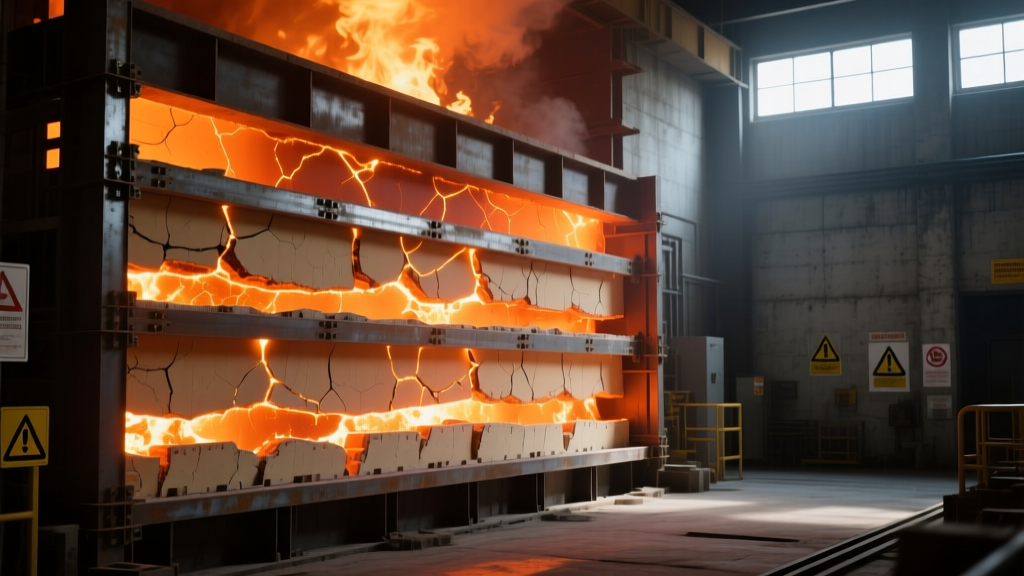
When architects, engineers, and building officials evaluate fire-rated assemblies, the ASTM E119 standard fire tests of building construction and materials serves as the definitive benchmark in North America. This standard dictates the precise laboratory conditions under which walls, floors, roofs, columns, and beams are subjected to controlled fires to determine their hourly fire-resistance ratings (FRR). Unlike surface burning characteristics (like ASTM E84), which measure flame spread and smoke development, ASTM E119 evaluates the structural integrity and insulating properties of an entire assembly under extreme thermal stress.
Compliance with the International Building Code (IBC) inherently relies on ASTM E119 data. If an assembly cannot demonstrate its ability to contain a fire, maintain structural load-bearing capacity, and prevent heat transmission as defined by this standard, it cannot be legally specified for use in Type I or Type II fire-resistive construction.
The Standard Time-Temperature Curve: Engineering the Inferno
The core of the ASTM E119 standard fire tests of building construction and materials is the standard time-temperature curve. The test furnace is programmed to follow a specific thermal trajectory that simulates a severe, fully developed compartment fire. The temperature inside the furnace is measured by an array of shielded thermocouples, and the heat input is continuously adjusted to match the curve.
ASTM E119 Time-Temperature Data Points
- 5 Minutes: 1,000°F (538°C)
- 30 Minutes: 1,550°F (843°C)
- 1 Hour: 1,700°F (927°C)
- 2 Hours: 1,850°F (1,010°C)
- 4 Hours: 2,000°F (1,093°C)
- 8 Hours: 2,300°F (1,260°C)
For an assembly to achieve a specific hourly rating (e.g., 1-hour, 2-hour), it must survive the furnace exposure up to that exact time mark while simultaneously passing three distinct failure criteria.
Pass/Fail Criteria: What Actually Makes an Assembly "Fire-Rated"?
Surviving the furnace is only the first hurdle. The ASTM E119 standard fire tests of building construction and materials imposes three strict limits on the test specimen. Failure of any single criterion results in an immediate downgrade of the assembly's fire rating.
1. Heat Transmission (The Insulation Criterion)
For walls, floors, and roofs, the unexposed (cold) side of the assembly must not transmit excessive heat. Thermocouples are attached to the unexposed surface to monitor temperature rise. The assembly fails if:
- The average temperature rise across all monitoring points exceeds 250°F (139°C) above the initial ambient temperature.
- Any single point exceeds a 325°F (181°C) rise above ambient.
This criterion ensures that combustible materials on the unexposed side (like furniture or wall coverings) will not auto-ignite from radiant or conducted heat.
2. Flame and Gas Penetration (The Integrity Criterion)
During the test, inspectors periodically hold a standard cotton pad near any cracks, joints, or fissures that appear on the unexposed side of the assembly. If the escaping hot gases ignite the cotton pad, the assembly fails the integrity criterion. This simulates the danger of toxic smoke and flames bypassing the fire barrier through structural gaps.
3. The Hose Stream Test (The Structural Criterion)
This is the most physically punishing phase of the ASTM E119 standard fire tests of building construction and materials. Following the furnace exposure, the assembly (or a duplicate specimen fired for half the duration) is subjected to a high-pressure water stream from a standard fire hose.
- Pressure: 30 psi (207 kPa) at the nozzle.
- Duration: 1.5 minutes for every hour of fire rating (e.g., a 2-hour rated wall gets a 3-minute hose stream).
- Objective: To simulate the thermal shock and mechanical impact of firefighting operations. If the water stream breaches the assembly, creating holes that allow light to pass through, the test fails.
ASTM E119 vs. UL 263 vs. NFPA 251: Clearing the Alphabet Soup
Specifiers frequently encounter UL 263 and NFPA 251 in project manuals alongside ASTM E119. It is critical to understand that in North America, these three standards are technically harmonized and identical in their test methodologies.
| Standard Designation | Issuing Body | Application & Nuance |
|---|---|---|
| ASTM E119 | ASTM International | The foundational standard referenced directly by the IBC and most architectural specifications. |
| UL 263 | Underwriters Laboratories | UL's proprietary designation for the exact same test. Used when referencing UL's Product iQ certified designs. |
| NFPA 251 | National Fire Protection Association | Historically maintained by NFPA, now largely withdrawn in favor of direct references to ASTM E119 and UL 263 to eliminate redundancy. |
For a comprehensive breakdown of certified assemblies tested under these harmonized standards, the Gypsum Association's Fire Resistance Design Manual (GA-600) remains the most heavily utilized industry reference for light steel and wood framing.
Real-World Material Performance Under ASTM E119
Understanding how specific materials behave under the ASTM E119 standard fire tests of building construction and materials allows specifiers to optimize assembly thickness and cost.
Type X Gypsum Board Assemblies
Standard 1/2-inch gypsum board offers minimal fire resistance. To achieve a 1-hour rating in a steel-stud partition, specifiers must use 5/8-inch Type X gypsum board (such as USG Sheetrock Firecode C or CertainTeed Fire-Shield). Type X contains glass fibers and specialized core additives that prevent the calcined gypsum core from shrinking and cracking when the chemically bound water is driven off at 212°F (100°C). For a 2-hour rating, two layers of 5/8-inch Type X are required on each side, with the base and face layers staggered and fastened according to exact screw-spacing matrices.
Structural Steel and Intumescent Coatings
Bare structural steel loses roughly 50% of its yield strength at 1,100°F (593°C)—a temperature reached in just minutes during an ASTM E119 furnace test. To protect steel columns and beams, intumescent coatings (like Sherwin-Williams FIRETEX or Nullifire) are applied. When exposed to heat, these coatings swell up to 50 times their original thickness, forming an insulating carbonaceous char. The required dry-film thickness (DFT) is strictly calculated based on the steel's W/D (heated perimeter divided by cross-sectional area) ratio to achieve a specific hourly rating.
Concrete and Masonry
Concrete relies on mass and aggregate type for fire resistance. Siliceous aggregate concrete requires greater thickness to achieve the same rating as carbonate or lightweight aggregate concrete due to differences in thermal conductivity and spalling tendencies. For example, a 2-hour fire rating typically requires a minimum equivalent thickness of 4.6 inches for siliceous concrete, but only 3.5 inches for lightweight concrete.
⚠ Critical Warning: The "Weakest Link" Rule
An ASTM E119 rated assembly is only as strong as its weakest penetration. If a 2-hour rated wall is penetrated by an unlisted electrical conduit or HVAC duct without a properly tested and listed through-penetration firestop system (per ASTM E814), the entire wall's legal fire rating is voided. Always pair E119 wall designs with compatible, UL-listed firestop systems for every penetration.
Sourcing and Verifying Certified Assemblies
You cannot arbitrarily combine materials and claim an ASTM E119 rating. Assemblies must be tested and listed exactly as designed. To verify a system, professionals use databases like UL's Fire Resistance Directory and Product iQ platform. When specifying a wall, you will reference a specific UL Design Number (e.g., U419 for a standard steel-stud gypsum partition). This design number dictates the exact stud gauge, stud spacing, gypsum brand, screw type, screw spacing, and joint compound requirements. Deviating from the UL Design Number—even by using a different brand of joint tape—technically invalidates the certification.
Frequently Asked Questions (FAQ)
Can an assembly tested to ASTM E119 be used for exterior walls?
ASTM E119 tests the assembly's ability to resist an interior fire. However, for exterior walls, building codes also require testing for fire propagation from the outside (e.g., NFPA 285 for non-combustible construction). An ASTM E119 rating does not automatically satisfy exterior fire propagation requirements.
Does the hose stream test apply to all ASTM E119 specimens?
Yes, but with a caveat. For load-bearing assemblies (like columns and beams), the hose stream test is generally not applied; instead, they must sustain their design load throughout the furnace test. The hose stream test is mandatory for non-load-bearing walls and partitions, and for load-bearing walls where the duplicate specimen method is utilized.
How do restrained vs. unrestrained conditions affect floor/celling ratings?
In ASTM E119 floor and roof tests, "restrained" conditions mean the assembly is locked into surrounding structure, preventing thermal expansion from causing buckling. "Unrestrained" means the assembly is free to expand. Assemblies tested under unrestrained conditions yield more conservative (and universally applicable) fire ratings, while restrained ratings are often higher but require specific structural connections in the field to be valid. Always verify the structural engineer's assumptions match the UL design's restraint classification.
Written by
Elena RodriguezElena Rodriguez is a civil engineer and technical writer specializing in concrete technology, masonry systems, and ASTM/ACI compliance. She earned her B.S. in Civil Engineering from Texas A&M University and spent a decade at a materials testing laboratory, performing over 2,000 concrete compressive strength tests and masonry prism evaluations. Elena is an ACI-certified Field Testing Technician (Grade I) and a member of ASTM Committee C12 on Natural Building Stone. She currently consults on forensic engineering cases involving concrete failures and moisture intrusion. Based in San Antonio, TX, Elena is a proud member of the Society of Women Engineers (SWE) and coaches her daughter's FIRST Robotics team.
More from Elena Rodriguez
View all
Walls & Panels
Cost Analysis: Light Gauge Steel Framing Advantages and Disadvantages
Evaluate light gauge steel framing advantages and disadvantages through a strict cost analysis lens, comparing material, labor, and lifecycle expenses.
Aug 4, 2026

Walls & Panels
Gypsum Board Types: Exact Specifications, Thickness & Dimensions
Compare standard, Type X, and moisture-resistant gypsum board types. Get exact specifications, thicknesses, dimensions, and ASTM standards for your project.
Aug 4, 2026

Fire Resistance
Best Fire-Resistant Outdoor Decking Materials: 2026 Buyer Guide
Discover the best fire-resistant outdoor decking materials for 2026. Compare Class A PVC, aluminum, and hardwood options for WUI compliance and safety.
Aug 4, 2026