What Materials Are Fire Resistant? IBC Code Compliance Guide
Discover what materials are fire resistant under IBC codes. Compare gypsum, concrete, and intumescent coatings for 1-hour to 4-hour fire ratings.

Decoding Fire Resistance: Beyond the "Fireproof" Myth
When architects and contractors ask, "what materials are fire resistant?", the answer requires a shift in terminology. Under the International Building Code (IBC) and NFPA 251 testing standards, no building material is truly "fireproof." Instead, materials and assemblies are classified by their fire-resistance rating—the duration (in hours) they can withstand a standard time-temperature curve (ASTM E119) while maintaining structural integrity, limiting heat transmission, and preventing flame passage.
Understanding what materials are fire resistant is not just about selecting a single product; it is about specifying tested, listed assemblies. A 2-hour fire-rated wall is only compliant if the specific stud spacing, fastener type, insulation, and board thickness match the exact Underwriters Laboratories (UL) or Intertek design number approved by the Authority Having Jurisdiction (AHJ).
The Compliant Roster: What Materials Are Fire Resistant?
To achieve code compliance across Type I through Type V construction, builders rely on a specific roster of materials. Below is a deep dive into the primary fire-resistant materials used in modern commercial and multi-family construction, including specific product types, performance metrics, and current material costs.
Type X and Type C Gypsum Board
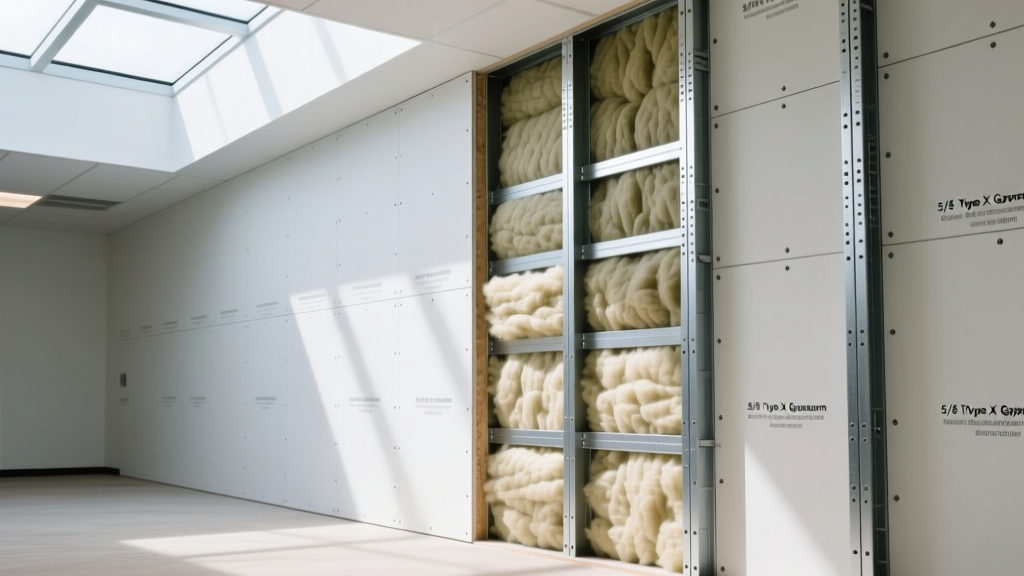
Gypsum board is the backbone of interior fire-resistive assemblies. The core of the board contains chemically combined water (calcium sulfate dihydrate). When exposed to fire, this water calcines (turns to steam) at 212°F, absorbing massive amounts of heat and delaying temperature transfer to the structural framing behind it.
- Type X (5/8-inch): The industry standard for 1-hour and 2-hour walls. It contains minimum 1% glass fibers by weight to hold the calcined core together under thermal stress. A standard 1-hour wall (e.g., UL Design U419) requires one layer of 5/8-inch Type X on each side of 2-1/2-inch, 20-gauge steel studs. Material cost: $0.45 to $0.65 per sq. ft.
- Type C (Enhanced Firecode): Products like USG Sheetrock Firecode C contain additional glass fibers and vermiculite. Vermiculite expands when heated, compensating for the shrinkage of the gypsum core. Type C is mandatory for many 2-hour, 3-hour, and 4-hour ceiling and shaft assemblies where core shrinkage would expose the framing. Material cost: $0.70 to $0.95 per sq. ft.
Intumescent Coatings for Structural Steel
Unprotected structural steel loses roughly 50% of its yield strength at 1,000°F, leading to catastrophic collapse. When asking what materials are fire resistant for exposed steel columns, intumescent paint is the premier aesthetic and code-compliant solution.
Products like Sherwin-Williams FIRETEX or Nullifire SC902 remain inert under normal conditions but swell up to 50 times their original thickness when exposed to temperatures exceeding 400°F. This creates a dense, carbonaceous char that insulates the steel.
- Application Specifics: Achieving a 1-hour rating typically requires 20 to 40 dry mils of thickness, applied via airless spray. A 2-hour rating may require 80+ dry mils.
- Cost Reality: Intumescent coatings are expensive. Expect to pay $3.50 to $6.00 per square foot for professional application, plus the cost of a mandatory epoxy primer and polyurethane topcoat for UV and moisture protection.
Concrete and Masonry Assemblies
Concrete and concrete masonry units (CMU) possess inherent fire resistance due to their low thermal conductivity and non-combustible nature. The fire rating is dictated by the "equivalent thickness" of the assembly and the type of aggregate used.
- Normal Weight Concrete (Siliceous aggregate): Requires approximately 4.5 inches of thickness to achieve a 2-hour fire rating.
- Lightweight Concrete (Expanded shale or clay): Achieves the same 2-hour rating at just 3.5 inches of thickness due to superior insulating air pockets.
- Carbonate Aggregates (Limestone): Offer the best fire performance among normal-weight options, undergoing an endothermic reaction (calcination) that absorbs heat similarly to gypsum.
Fire-Rated Glazing and Ceramics
Glass is traditionally a weak point in fire-rated assemblies. When selecting fire-rated glazing, you must distinguish between fire-protective and fire-resistive ratings.
- Wired Glass and Specialty Tempered Glass (e.g., Pilkington Pyroclear): These meet NFPA 257 for fire-protection. They block flames and smoke but allow massive amounts of radiant heat to pass through. They are restricted by the IBC in hazardous exit enclosures.
- Multi-Layer Ceramic Glass with Intumescent Interlayers (e.g., Pilkington Pyrostop): These meet ASTM E119 for true fire-resistance. They block flames, smoke, and radiant heat, keeping the unexposed side below 250°F above ambient. They are rated up to 3 hours and can be used in full-vision exit corridors.
IBC Construction Types and Required Ratings
The International Code Council (ICC) categorizes buildings into five primary construction types, dictating the minimum fire-resistance ratings required for structural elements. Understanding what materials are fire resistant is only useful if you know the target rating required by your building's classification.
| Construction Type | Structural Frame | Bearing Walls | Non-Bearing Walls (Exterior) | Floor Construction |
|---|---|---|---|---|
| Type I-A | 3 Hours | 3 Hours | 0 Hours (unless proximity requires) | 2 Hours |
| Type I-B | 2 Hours | 2 Hours | 0 Hours | 1 Hour |
| Type II-A | 1 Hour | 1 Hour | 0 Hours | 1 Hour |
| Type III-A | 1 Hour | 2 Hours | 2 Hours | 1 Hour |
| Type IV (Mass Timber) | Varies (Char calc) | 2 Hours | 2 Hours | 2 Hours |
| Type V-A | 1 Hour | 1 Hour | 0 Hours | 1 Hour |
The number one reason a fire-rated assembly fails an AHJ inspection is unsealed penetrations. If a plumber drills a 4-inch hole through a 2-hour rated CMU shaft wall for a PVC pipe and seals it with standard polyurethane foam, the wall's fire rating is legally reduced to zero. You must use a listed, tested firestop system (e.g., Hilti CP 606 elastomeric sealant or 3M Fire Barrier Pillows) that matches the exact pipe material, diameter, and wall type specified in the UL directory. Maintain a detailed firestop inspection log for the final AHJ walkthrough.
Decision Matrix: Selecting Materials by Assembly Application
Use this matrix to rapidly identify the most cost-effective and code-compliant material choice for specific building elements.
| Assembly Application | Required Rating | Optimal Material Choice | Key Code / Standard Reference |
|---|---|---|---|
| Elevator Hoistway Shaft | 2 Hours | 3 layers of 5/8" Type X Gypsum on steel studs, or 6" grouted CMU. | IBC Section 713 / UL U419 |
| Exit Access Corridor Wall | 1 Hour | 1 layer 5/8" Type X Gypsum on 3-5/8" steel studs with mineral wool. | IBC Section 1020 |
| Exposed Steel Columns (Lobby) | 2 Hours | Thin-film Intumescent Coating (epoxy primer + intumescent + urethane topcoat). | IBC Section 704 / ASTM E119 |
| Stairwell Enclosure Doors | 90 Minutes | Mineral core steel doors with automatic drop-down smoke seals. | NFPA 80 / IBC Section 716 |
Navigating the Latest IBC Updates on Fire Safety
As of the 2024 and 2026 IBC cycles, the most significant shift in fire-resistant materials involves Mass Timber and Cross-Laminated Timber (CLT). The IBC introduced new Type IV-A, IV-B, and IV-C construction categories, allowing mass timber in high-rise applications previously restricted to concrete and steel.
However, mass timber is combustible. Its fire resistance relies on the predictable charring rate of wood (approximately 1.5 inches per hour). To comply with Type IV-A (the most restrictive, allowing up to 18 stories), the CLT panels must be entirely encapsulated by non-combustible materials—typically multiple layers of Type X gypsum board—to prevent the timber from contributing to the fire load. Type IV-B allows partial exposure, relying on the inherent char layer to protect the structural core, but requires rigorous sprinkler integration and strict limits on unprotected openings.
For comprehensive guidance on wood and gypsum assemblies, the Gypsum Association's Fire Design Manual remains the definitive industry resource for matching board configurations to updated code requirements.
Inspection Realities: What the AHJ Looks For
Knowing what materials are fire resistant is only half the battle; proving it to the building inspector is the other. To ensure your project passes final fire and life safety inspections, implement these site-level protocols:
- Stencil the UL Design Number: Require your drywall subcontractor to stencil the specific UL or Intertek design number (e.g., "U419") on the top plate of every fire-rated wall before the ceiling grid is installed. Inspectors look for this to verify the correct assembly was built.
- Head-of-Wall Firestopping: Where a fire-rated wall meets a non-rated floor deck above, you must install a listed head-of-wall firestop system that accommodates dynamic movement (seismic or wind deflection) without breaking the fire seal.
- Damper Verification: Ensure that every HVAC duct penetrating a fire-rated wall or floor is equipped with the correct UL-listed fire damper (for walls) or combination fire/smoke damper (for floors), and that the access door in the drywall is clearly labeled and unobstructed for annual maintenance.
Written by
Priya KapoorPriya Kapoor is a real estate market analyst and construction economics researcher with expertise in housing affordability, development feasibility, and infrastructure investment. She holds a Master of Regional Planning from Cornell University and previously worked as a senior analyst at CBRE's Investment Properties group, where she modeled returns for $4B in mixed-use development pipelines. Priya now runs an independent research practice advising developers, municipalities, and REITs on construction cost forecasting and market timing. She publishes the quarterly "BuildMat Market Pulse" report tracking material price indices across 12 commodity categories. Based in Austin, TX, Priya serves on the board of Habitat for Humanity Austin and is a marathon runner.
More from Priya Kapoor
View all
Construction Cost
Cost to Build a 1600 Sq Ft Home in 2026: Full Breakdown
Accurate 2026 cost to build a 1600 sq ft home—material, labor, and regional pricing breakdowns included. Plan your budget with real-time estimates.
Aug 11, 2026

Wood & Lumber
Name the Types of Wood for Pressure Treatment and Preservation
Learn how to name the types of wood best suited for pressure treatment. Compare species treatability, chemical retention levels, and 2026 preservation costs.
Aug 4, 2026

Stone & Masonry
Stone Veneer Suppliers Lindenhurst: 2026 Cost Analysis
Analyze 2026 stone veneer costs in Lindenhurst, NY. Compare local supplier pricing, delivery fees, and Suffolk County installation labor rates.
Aug 4, 2026