Flame Retardant Building Materials: Fire Ratings & Classes Explained
Decode fire ratings for flame retardant building materials. Learn ASTM E84, NFPA 286 testing, FSI/SDI classes, and how to specify code-compliant assemblies.
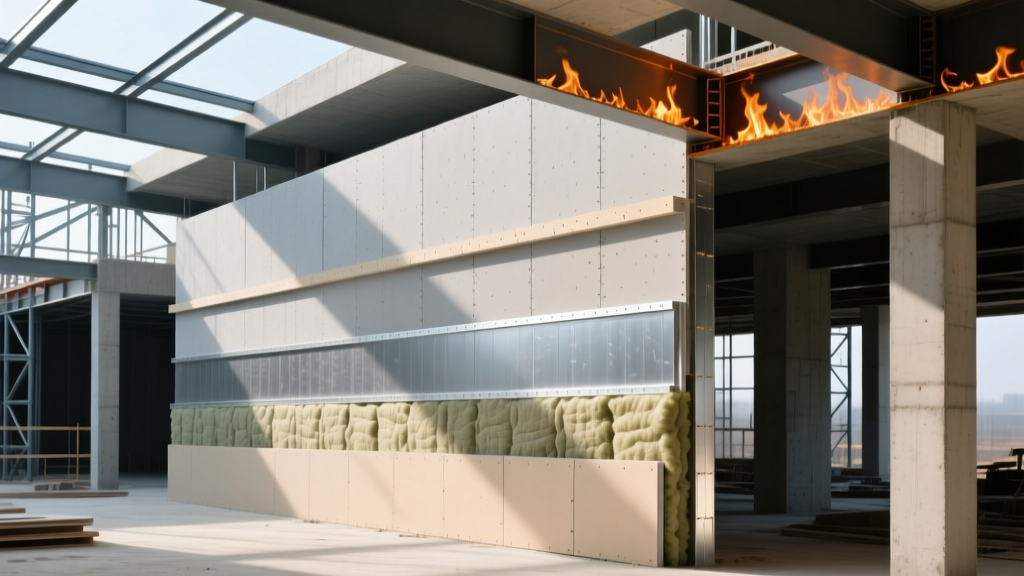
The Critical Distinction: Fire-Resistant vs. Flame Retardant
The construction industry frequently conflates "fire-resistant" and "flame retardant," but from an engineering and code-compliance perspective, they describe fundamentally different material behaviors. Fire-resistant materials (like concrete, masonry, and heavy timber) possess inherent mass and thermal properties that allow them to survive high temperatures without structural failure. Flame retardant building materials, conversely, rely on chemical or physical interventions to actively inhibit, resist, or delay the combustion process. Understanding how these materials are tested, rated, and specified is critical for passing International Building Code (IBC) inspections and ensuring life safety.

The Core Testing Standards: ASTM E84 vs. NFPA 286
To specify flame retardant building materials accurately, you must understand the testing protocols that govern their ratings. The two most prevalent standards in North America are ASTM E84 and NFPA 286.
ASTM E84 / UL 723: The Steiner Tunnel Test
The ASTM E84 Standard measures the surface burning characteristics of building materials. A 20-inch wide, 25-foot long sample is mounted on the ceiling of a Steiner Tunnel and exposed to a controlled gas flame. Sensors track two critical metrics:
- Flame Spread Index (FSI): How far and fast the flames travel down the tunnel compared to red oak (FSI 100) and cement board (FSI 0).
- Smoke Developed Index (SDI): The opacity of the smoke generated, measured by light obscuration.
NFPA 286: The Room Corner Test
While ASTM E84 is excellent for flat, homogeneous surfaces, it fails to predict fire behavior in complex, multi-layered exterior wall assemblies or materials with thermoplastic melting points (like EPS/XPS foam). The NFPA 286 Room Corner Test evaluates fire propagation characteristics of interior or exterior non-load-bearing wall assemblies. It subjects a full-scale two-story corner mock-up to a severe, multi-stage fire exposure, measuring heat flux, flame extension, and falling debris.
Decoding the Class A, B, and C Rating System
Based on ASTM E84 results, materials are categorized into three distinct classes. Building codes typically mandate Class A for high-occupancy egress routes, stairwells, and commercial corridors.
| Rating Class | Flame Spread Index (FSI) | Smoke Developed Index (SDI) | Common Applications |
|---|---|---|---|
| Class A | 0 - 25 | Max 450 | Egress corridors, commercial ceilings, Type I/II construction |
| Class B | 26 - 75 | Max 450 | Residential interiors, non-critical commercial spaces |
| Class C | 76 - 200 | Max 450 | Utility rooms, concealed spaces, some residential finishes |
Top Flame Retardant Building Materials & Specifications
1. Intumescent Coatings for Structural Steel
Unprotected structural steel loses 50% of its yield strength at 1,100°F (593°C), which can occur in as little as 5 minutes during a flashover. Intumescent coatings like Sherwin-Williams FIRETEX FX5120 or Nullifire SC902 act as passive fire protection. When exposed to temperatures exceeding 392°F (200°C), the chemical matrix undergoes an endothermic reaction, swelling up to 50 times its original dry film thickness (DFT). This creates a dense, carbonaceous char that insulates the steel.
- Specification: Typically applied at 15 to 45 mils DFT depending on the required hourly rating (1-hour vs. 2-hour) and the W/D (heated perimeter to cross-sectional area) ratio of the steel member.
- Cost Factor: Professional application ranges from $4.50 to $8.00 per square foot, heavily dependent on the required mil thickness and surface prep (SSPC-SP6 commercial blast).
2. Fire-Retardant-Treated (FRT) Wood
FRT lumber, such as Hoover Treated Wood Products Dricon FRS, is pressure-impregnated with water-soluble salts (often ammonium polyphosphate or borate-based formulations). When heated, these salts release non-combustible gases and water vapor, diluting the oxygen and combustible pyrolysis gases at the wood surface.
3. Type X Gypsum Board
While standard gypsum contains chemically bound water (calcium sulfate dihydrate) that releases steam when heated, Type X gypsum (e.g., USG Sheetrock Brand Firecode X) incorporates fiberglass reinforcement into the core. As the gypsum calcines and shrinks under fire exposure, the glass fibers hold the board together, preventing it from cracking and falling off the framing.
- Specification: Must be a minimum of 5/8-inch thick with a core weight of at least 15 pounds per 4x8 sheet to achieve a standard 1-hour fire-resistance rating on wood or steel stud assemblies.
The Hidden Trap: Smoke Developed Index (SDI) and Toxicity
"In commercial fires, smoke inhalation accounts for the vast majority of fatalities, not direct flame contact. Specifying a material with an FSI of 15 but an SDI of 600 is a critical life-safety failure, even if it technically passes the flame spread requirement."
Many older halogenated flame retardants (brominated or chlorinated) achieved excellent FSI scores but produced dense, highly toxic smoke. Modern building codes cap the SDI at 450 for almost all interior applications. When specifying chemical treatments or synthetic insulations, always demand the full ASTM E84 report to verify both indices, and prioritize non-halogenated, phosphorus-based, or mineral-based flame retardants which inherently produce lower smoke toxicity.
Decision Matrix: Selecting the Right Material for Your Assembly
Use this framework to determine the correct flame retardant intervention based on your structural substrate and code requirements:
- IF Substrate = Structural Steel & Goal = Aesthetic Exposure: Specify thin-film intumescent coatings (Class A FSI). Ensure topcoat compatibility for UV resistance if exposed to sunlight.
- IF Substrate = Exterior Wall with Foam Plastic Insulation: ASTM E84 is invalid. You must specify an NFPA 286 tested assembly. Look for polyisocyanurate boards with factory-applied cementitious or specialized fire-retardant facers.
- IF Substrate = Interior Wood Framing & Goal = 1-Hour Rating: Do not rely solely on FRT studs. Specify a double-layer 5/8" Type X gypsum enclosure or a single layer of 5/8" Type X with specific screw spacing (7" o.c. on edges, 12" o.c. in the field) per the UL Fire Resistance Directory design.
- IF Environment = High Roof Temperatures (>150°F): Avoid certain FRT wood trusses. Continuous high heat can cause premature chemical degradation, reducing the fire rating over time. Use inherently fire-resistant heavy timber or protected steel instead.
FAQ: Code Compliance & Inspection Realities
Can I paint over an intumescent coating with standard latex paint?
No. Standard architectural paints can alter the thermal conductivity and the chemical expansion trigger of the intumescent layer. You must use a topcoat specifically approved by the intumescent manufacturer's technical data sheet (TDS), applied at a strict maximum mil thickness (usually 2-3 mils DFT).
Does cutting FRT wood on-site compromise its fire rating?
Cross-cutting the ends of FRT lumber does not void the rating, as the treatment penetrates the entire cellular structure of the wood. However, ripping the board (cutting it lengthwise) exposes untreated inner core material on some lower-grade pressure treatments. Always specify "through-penetrated" or full-depth FRT lumber if ripping is required on-site.
What happens if a fire-rated assembly fails inspection?
If an inspector finds unapproved fasteners in FRT wood, missing firestopping in gypsum penetrations, or incorrect mil thickness on intumescent coatings, the assembly will be red-tagged. Remediation often requires destructive testing (e.g., ultrasonic mil-thickness gauges on steel) or complete tear-out of the non-compliant drywall. Always maintain the manufacturer's installation instructions and UL design numbers on-site for the AHJ (Authority Having Jurisdiction).
Written by
Marcus ChenMarcus Chen is a licensed structural engineer (PE) and building materials analyst with over 12 years of experience across residential, commercial, and industrial construction. He holds a Master of Science in Civil Engineering from UC Berkeley and spent six years at Thornton Tomasetti before transitioning to independent consulting and technical writing. Marcus specializes in material selection for seismic-prone regions, concrete reinforcement strategies, and lifecycle cost analysis. His work has been cited by the American Concrete Institute (ACI) and the Structural Engineers Association of California (SEAOC). When he is not on a job site or at his desk, you will find him hiking the Sierra Nevada or restoring a 1920s craftsman bungalow in Oakland, CA.
More from Marcus Chen
View all
Construction Cost
How Much Did the Eiffel Tower Cost to Build?
How much did the Eiffel Tower cost to build in 1889? We adjust for inflation and compare its budget to modern skyscraper construction.
Aug 4, 2026

Fire Resistance
What Is a Fire Resistant Material? Testing & Certification Guide
Discover what is a fire resistant material through ASTM and UL testing. Learn how fire ratings, certifications, and assemblies work in construction.
Aug 4, 2026

Construction Cost
How Much Did the Burj Khalifa Cost to Build?
How much did the Burj Khalifa cost to build? We break down the $1.5B project and extract 5 money-saving strategies for your next build.
Jul 30, 2026