What Material Is Fire Resistant? Decoding ASTM and UL Certifications
Discover what material is fire resistant by exploring ASTM and UL testing standards, assembly ratings, and how to verify certifications for your build.

The Myth of the Absolute "Fireproof" Material
When architects, engineers, and contractors ask, "what material is fire resistant?", the underlying assumption is often that certain building products are impervious to combustion. In the realm of commercial construction and code compliance, the term "fireproof" is largely a misnomer. Instead, the industry relies on fire-resistance ratings, which measure a material or assembly's ability to contain a fire, maintain structural integrity, and limit heat transmission for a specific duration—typically expressed in hours (e.g., 1-hour, 2-hour, or 4-hour ratings).
Understanding what material is fire resistant requires looking past marketing claims and examining the rigorous testing and certification frameworks governed by organizations like ASTM International, Underwriters Laboratories (UL), and the National Fire Protection Association (NFPA). This guide decodes the specific testing standards that dictate fire resistance and provides a framework for verifying these certifications on the job site.
The Two Pillars of Fire Testing: ASTM E119 and ASTM E84
To determine how a material behaves under fire conditions, testing laboratories subject products to two fundamentally different types of evaluations. Confusing these two tests is one of the most common errors in material specification.
1. ASTM E119 / UL 263: Fire Tests of Building Construction and Materials
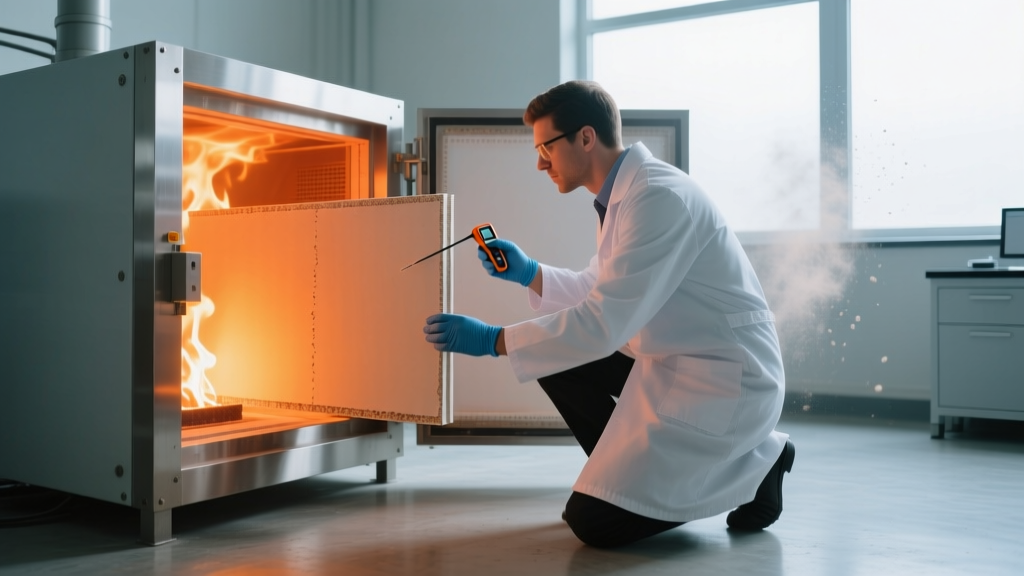
This is the gold standard for determining the fire-resistance rating of structural assemblies (walls, floors, columns, and roofs). According to the ASTM E119 standard, a test specimen is placed in a specialized furnace where temperatures are raised along a strict time-temperature curve, reaching 1,000°F (538°C) at 5 minutes and 2,000°F (1,093°C) at 2 hours.
To pass and achieve a specific hourly rating, the assembly must meet three criteria:
- Heat Transmission: The unexposed side of the assembly must not rise more than 250°F (139°C) above its initial ambient temperature.
- Structural Integrity: The assembly must continue to support its applied load without collapsing.
- Flame/Gas Passage: No flames or hot gases can penetrate through cracks or fissures to the unexposed side.
2. ASTM E84 / UL 723: Surface Burning Characteristics
While ASTM E119 tests structural endurance, ASTM E84 evaluates how quickly flames spread across the surface of a material and how much smoke it generates. This test yields two critical metrics:
- Flame Spread Index (FSI): Rated from 0 to 100+. Class A materials (required for most commercial egress routes) must have an FSI of 0-25.
- Smoke Developed Index (SDI): Measures smoke opacity. Class A materials must have an SDI of 450 or less.
Note: A material with a Class A surface burning rating (ASTM E84) does not automatically possess a 1-hour fire-resistance rating (ASTM E119). They measure entirely different properties.
Certification Matrix: What Material Is Fire Resistant?
The table below breaks down common building materials, the specific tests they undergo, their typical certified ratings, and the critical failure points observed during laboratory testing.
| Material Category | Specific Product Example | Primary Test Standard | Typical Certified Rating | Critical Failure Point / Limitation |
|---|---|---|---|---|
| Gypsum Board | 5/8" Type X Gypsum | ASTM E119 (in assembly) | 1-Hour (Wall/Ceiling) | Calcination of the gypsum core; paper facing ignites if exposed directly. |
| Gypsum Board | 5/8" Type C Gypsum | ASTM E119 (in assembly) | 2-Hour (Multi-layer) | Core shrinkage at extreme temperatures; requires specific glass-fiber reinforcement. |
| Concrete | Normal Weight Concrete (4.5") | ASTM E119 | 2-Hour (Load-bearing) | Spalling due to trapped moisture expanding into steam under rapid heating. |
| Steel Protection | Intumescent Coating (e.g., FIRETEX) | UL 263 / ASTM E119 | 1 to 3-Hour (Depends on mil thickness) | Failure to achieve exact dry-film thickness (DFT); improper primer compatibility. |
| Mineral Wool | High-Density Stone Wool Batt | ASTM E84 / E119 | Class A (Surface) / Non-combustible | Melting of the binder resin at high heat, though the stone fibers remain intact. |
The Assembly Trap: Why Material Certifications Mislead Builders
A common and costly mistake in construction is assuming that buying a "1-hour fire-rated drywall" guarantees a 1-hour fire-rated wall. Fire-resistance ratings apply to assemblies, not individual materials.
When a testing laboratory like UL certifies a wall, they assign it a specific Design Number (e.g., UL Design U419). This design dictates every single component of the assembly:
- The exact gauge and spacing of the steel studs (e.g., 3-5/8" 20-gauge studs at 24" on center).
- The specific type, thickness, and number of layers of gypsum board.
- The exact brand and type of fasteners (screw length and spacing).
- The specific joint compound and taping method used.
If a contractor substitutes 20-gauge studs for 25-gauge studs to save money, or uses a different brand of joint compound that wasn't part of the original test, the entire fire-resistance rating is legally and physically void. When specifying what material is fire resistant for a project, architects must specify the complete UL or ULC Design Number, and site supervisors must enforce strict adherence to that bill of materials.
The Hose-Stream Test: The Ultimate Certification Killer
Many innovative fire-resistant materials pass the initial furnace test of ASTM E119, only to fail spectacularly during the final phase: the hose-stream test.
Immediately after a test specimen is removed from the furnace—while it is still glowing red-hot and structurally compromised—it is blasted with a high-pressure fire hose (typically 30 psi at the nozzle for a 1.5-inch hose). This test evaluates two things:
- Thermal Shock Resistance: Can the material withstand the rapid contraction caused by cold water hitting superheated surfaces without shattering?
- Erosion Resistance: Will the water pressure wash away the charred or calcined protective layers, exposing the unburned core to the elements?
Materials like standard lightweight concrete often suffer severe spalling during this test as trapped moisture rapidly expands. Conversely, intumescent coatings that form a rigid, stable char tend to perform exceptionally well. Understanding the hose-stream test is vital when selecting materials for environments where active firefighting will occur, as a material that crumbles under water pressure offers zero real-world protection.
Actionable Framework: Verifying Certifications on the Job Site
Knowing what material is fire resistant is only half the battle; verifying that the delivered materials match the certified specifications is critical for liability and life safety. Follow this protocol on the job site:
Step 1: Utilize UL Product IQ
Do not rely solely on the manufacturer's marketing brochures. Use the UL Solutions Fire Resistance directory (often accessed via UL Product IQ). Search for the specific UL Design Number (e.g., U419 for walls, D900 for floor-ceiling assemblies) to pull up the exact, up-to-date PDF of the certified assembly. Cross-reference every component listed in the "Materials" section against your submittals.
Step 2: Inspect Physical Labels and Stampings
Fire-rated materials are required to bear physical proof of certification.
- Gypsum Board: Check the end tape of every sheet. It must explicitly state "Type X" or "Type C" and list the UL classification. Standard 1/2" drywall without this tape is not fire-rated, regardless of what the supplier claims.
- Firestop Sealants: Look for the UL Classification mark on the cartridge or pail. Ensure the specific sealant matches the exact F-rating and T-rating required by the penetration firestop system (e.g., UL Design HW-0001).
- Structural Steel: For intumescent coatings, the applicator must provide dry-film thickness (DFT) readings using a magnetic or ultrasonic thickness gauge. A 2-hour rating might require exactly 45 mils of wet film thickness, which cures to a specific DFT. Under-application by even 5 mils can result in a failed inspection.
Step 3: Audit the Penetrations
A 2-hour fire-rated wall is reduced to a 0-hour wall if an electrical conduit or HVAC duct penetrates it without a certified firestop system. Verify that the firestop putty, pillows, or collars used are explicitly listed for the exact pipe material (e.g., PVC vs. cast iron) and the specific size of the penetration.
Frequently Asked Questions
Can wood be considered a fire-resistant material?
Yes, but with caveats. Heavy timber and mass timber (like Cross-Laminated Timber, or CLT) exhibit predictable charring rates (typically 1.5 inches per hour). Engineers calculate this char layer to protect the inner structural core, allowing mass timber to achieve 1-hour or 2-hour ratings under ASTM E119. However, standard dimensional lumber (2x4s) does not possess inherent fire-resistance ratings without the addition of protective assemblies like Type X gypsum.
What is the difference between fire-resistant and fire-retardant?
Fire-resistant refers to a material's inherent physical properties or its tested ability to withstand fire and limit heat transfer (e.g., concrete, masonry, Type X gypsum). Fire-retardant refers to chemical treatments applied to combustible materials (like wood or fabrics) to slow down ignition and reduce surface flame spread (ASTM E84). Fire-retardant treatments degrade over time, especially when exposed to moisture, whereas fire-resistant materials maintain their properties indefinitely.
How do I find the fire rating of an existing building material?
If the original construction documents or UL Design numbers are missing, you cannot visually determine a material's fire rating. You must hire a fire protection engineer to conduct a destructive investigation, analyze the assembly layers, and cross-reference them with historical UL directories or conduct in-situ testing. Never assume a rating based on material thickness alone.
Written by
Sarah WhitfieldSarah Whitfield is a chartered quantity surveyor (MRICS) and construction cost analyst with 15 years of experience in material pricing, procurement strategy, and project budgeting. She earned her degree in Construction Management from the University of Reading (UK) and has worked on projects ranging from $2M custom homes to $180M mixed-use developments across North America and Europe. Sarah currently leads cost estimating for BuildMat Insight, maintaining a proprietary database of 4,000+ material price points updated quarterly. She is a frequent contributor to RSMeans cost data panels and has presented at the International Cost Engineering Council (ICEC) congress. Based in Denver, CO, Sarah is an avid trail runner and volunteer mentor for Women in Construction.
More from Sarah Whitfield
View all
Wood & Lumber
What Are the Different Types of Wood? A Builder's Guide
Compare structural softwoods, finish hardwoods, and engineered lumber. Analyze Janka ratings, MOE values, and 2026 pricing for construction.
Aug 4, 2026

Walls & Panels
Steel Framing vs Wood Framing: Corrosion and Moisture Defense
Compare steel framing vs wood framing for moisture resistance. Learn about galvanized coatings, condensation risks, and corrosion protection strategies.
Jul 21, 2026

Stone & Masonry
How to Cut Stone Veneer: Wet Saw vs Grinder Comparison
Compare the best tools for cutting stone veneer. We review wet saws, angle grinders, and chop saws to help you achieve clean, chip-free cuts.
Jul 21, 2026