Choosing the Right Fire Resistant Material for Fireplace Safety
Discover the best fire resistant material for fireplace surrounds and hearths. Compare costs, heat ratings, and code compliance for safe installations.

The Anatomy of Fireplace Fire Safety and Clearances
Selecting the correct fire resistant material for fireplace surrounds, mantels, and hearths is not merely an aesthetic choice; it is a critical life-safety decision. According to the National Fire Protection Association (NFPA), heating equipment is a leading cause of home fire deaths, with improper clearances and combustible facing materials acting as primary catalysts for structural ignition.
The foundational concept in fireplace safety is the clearance to combustibles. For traditional masonry fireplaces, NFPA 211 mandates a minimum 2-inch air space between the fireplace chimney and any wood framing, and a 36-inch clearance from the firebox opening to unprotected combustible walls. However, modern zero-clearance (factory-built) fireplaces, tested to UL 127 standards, allow for significantly reduced clearances—often zero inches—provided the surrounding materials are strictly non-combustible and installed exactly to the manufacturer's specifications.
Wood framing exposed to continuous low-level heat (as low as 150°F to 200°F) over months or years undergoes pyrophoric carbonization. This chemical process lowers the wood's ignition temperature from its standard 400°F+ down to roughly 200°F. Never assume that a 1-inch gap without proper non-combustible shielding is sufficient to protect hidden wooden studs.
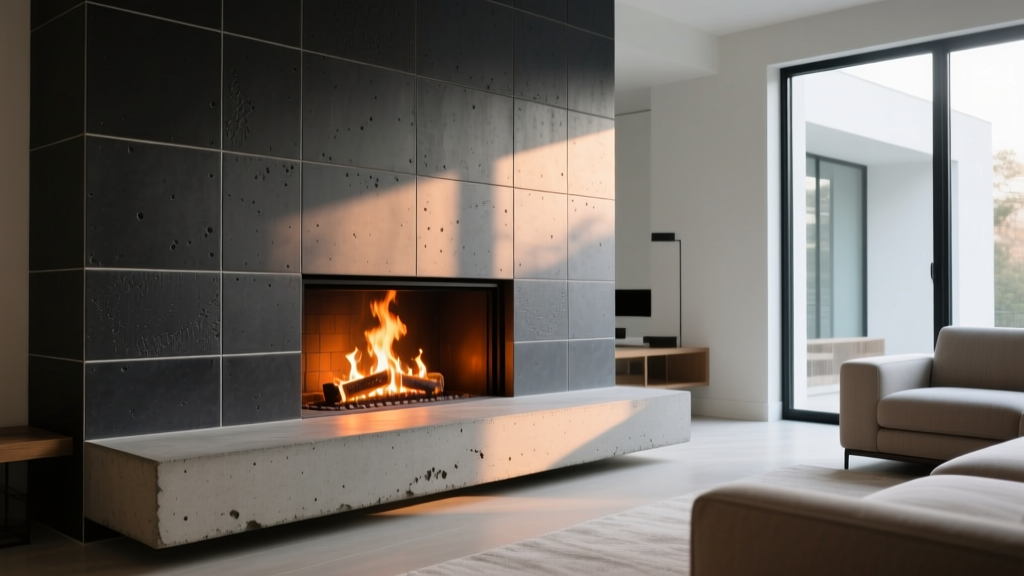
Top Fire Resistant Materials for Fireplace Applications
When builders and homeowners search for a fire resistant material for fireplace projects, they must differentiate between "fire-retardant" (which slows combustion) and "non-combustible" (which will not ignite or contribute fuel to a fire). Below are the industry-standard non-combustible materials used in modern hearth construction.
1. Calcium Silicate Boards (e.g., Skamol Skamotec 225, Promat SUPALUX)
Calcium silicate boards represent the gold standard for high-heat fireplace surrounds and chimney breast enclosures. These boards are engineered from silica and calcium oxide, offering exceptional thermal insulation and structural integrity at extreme temperatures. Skamotec 225, for instance, can withstand continuous temperatures up to 1,800°F (982°C). Unlike cement boards, calcium silicate is lightweight, easily machined with standard woodworking tools, and possesses a very low thermal conductivity (k-value), meaning it prevents heat transfer to the concealed framing behind it.
2. Fire-Rated Cement Boards (e.g., USG Durock, James Hardie HardieBacker 500)
Cement boards are the most common substrate for tiled fireplace surrounds. Composed of Portland cement and reinforced fiberglass mesh, they are entirely non-combustible and pass ASTM E136 testing for non-combustibility. While they do not offer the same thermal insulation properties as calcium silicate, they provide a rock-solid, moisture-resistant backing for heavy stone or ceramic veneers. Durock Next Gen is highly favored for its reduced weight and ease of scoring.
3. Refractory Firebrick and Cast Concrete
For the interior firebox and the immediate hearth extension, standard masonry is insufficient. Refractory firebricks, made from alumina-silicate clays, are engineered to withstand direct flame impingement and thermal shock up to 2,500°F without spalling. For the exterior hearth pad, poured cast concrete or pre-cast concrete slabs provide the necessary thermal mass to absorb and dissipate radiant heat and falling embers.
4. Natural Stone, Brick, and Ceramic Tile
While stone and tile are inherently non-combustible, their fire resistance is entirely dependent on the adhesive and backing used. A natural stone veneer applied directly to a combustible substrate with organic adhesive is a severe fire hazard. When paired with a cement board substrate and high-heat mortar, stone and tile form an impenetrable, Class A fire-rated exterior finish.
Material Comparison Matrix: Heat Tolerance, Cost, and Application
| Material | Max Continuous Temp | Avg. Cost (Per Sq Ft) | Weight | Primary Use Case |
|---|---|---|---|---|
| Calcium Silicate Board | 1,800°F | $4.50 - $7.00 | Light | Insulating chimney breasts, zero-clearance enclosures |
| Cement Board (1/2") | 400°F (Substrate) | $1.50 - $3.00 | Heavy | Tile and stone veneer backing |
| Refractory Firebrick | 2,500°F+ | $3.00 - $5.00 (Per brick) | Very Heavy | Interior firebox lining |
| Cast Concrete Hearth | 1,200°F | $8.00 - $15.00 | Extremely Heavy | Hearth extensions and ember protection |
Step-by-Step Installation Framework for Non-Combustible Surrounds
Proper installation of your chosen fire resistant material for fireplace surrounds requires strict adherence to thermal expansion and moisture management protocols. Follow this framework to ensure code compliance and structural longevity.
- Establish the Air Gap and Framing: For masonry fireplaces, maintain the mandated 2-inch air gap between the masonry and wood framing. Do not stuff this gap with fiberglass insulation; it must remain open for air circulation to cool the masonry. For zero-clearance units, frame exactly to the manufacturer's specified dimensions, typically using 20-gauge steel studs rather than wood to eliminate combustible framing entirely.
- Install the Primary Substrate: Secure 1/2-inch cement board or calcium silicate board to the framing using corrosion-resistant, high-heat rated screws (such as ceramic-coated cement board screws) spaced every 8 inches along the studs. Leave a 1/8-inch gap between board edges to allow for thermal expansion.
- Tape and Mud the Seams: Apply alkali-resistant fiberglass mesh tape over all seams. Embed the tape using a high-heat, latex-Portland cement thinset mortar. Never use standard drywall joint compound, which will crack and degrade under thermal cycling.
- Apply the Veneer with Correct Adhesive: When installing tile or stone, use a polymer-modified, latex-Portland cement thinset rated for high temperatures (e.g., Custom Building Products MegaLite or LATICRETE 254 Platinum). Apply using the appropriate notched trowel to ensure 95% mortar coverage, eliminating air pockets that could cause the stone to pop off during heating.
Common Failure Modes and How to Avoid Them
Even when the correct fire resistant material for fireplace projects is purchased, installation errors can compromise the entire assembly's fire rating. The Hearth, Patio & Barbecue Association (HPBA) frequently highlights the following installation failures in field inspections:
- The Mastic Mistake: Organic mastic (pre-mixed tile adhesive in a bucket) contains petroleum-based solvents and polymers that degrade, soften, and lose adhesion at temperatures as low as 150°F. Using mastic on a fireplace surround will inevitably result in tiles falling off and exposing the substrate to direct heat. Always use powder-based, cementitious thinset.
- The "Fire-Retardant" Wood Fallacy: Some builders mistakenly use pressure-treated or fire-retardant-coated wood for mantels or facing, assuming it meets non-combustible codes. Fire-retardant wood is still combustible; it simply ignites at a slightly higher temperature and chars slower. It cannot be used within the zero-clearance zone of a factory-built fireplace.
- Omitting the Hearth Extension: The hearth extension (the non-combustible floor area in front of the firebox) is legally required to catch popping embers. For fireboxes under 6 square feet, the extension must project at least 16 inches to the front and 8 inches to the sides. Using a combustible rug or standard hardwood flooring up to the firebox edge is a direct code violation.
- Using Type X Drywall as a Facing: While 5/8-inch Type X gypsum board provides a 1-hour fire rating in wall assemblies, the paper facing is combustible. It is strictly prohibited as a direct-facing material for fireplace surrounds unless covered entirely by a non-combustible veneer and separated by an approved air space.
Code Compliance and Testing Standards
When specifying materials, ensure they carry the appropriate testing certifications. Look for products that explicitly state compliance with ASTM E136 (Standard Test Method for Assessing Combustibility of Materials Using a Vertical Tube Furnace at 750°C). For factory-built fireplaces, the entire unit and its specified facing materials must be tested together under UL 127 (Standard for Safety for Factory-Built Fireplaces). Always cross-reference the material's technical data sheet with the fireplace manufacturer's installation manual; using a non-listed facing material on a zero-clearance unit will void the UL listing and your home insurance policy.
Frequently Asked Questions
Can I use standard drywall behind a stone fireplace veneer?
No. Standard drywall and even moisture-resistant "green board" have combustible paper facings and gypsum cores that degrade under continuous heat. You must use a certified non-combustible substrate like cement board or calcium silicate board directly behind any stone or tile veneer.
How thick does a concrete hearth pad need to be?
A non-combustible hearth extension must have a minimum thickness of 2 inches if it is made of solid masonry or concrete. If you are using a manufactured hearth pad (like a micore board topped with tile), it must meet the specific "k-value" (thermal conductivity) and "R-value" (thermal resistance) requirements outlined in your fireplace manufacturer's manual, which often allows for thinner, engineered assemblies.
Is stainless steel a good fire resistant material for fireplace surrounds?
Yes, stainless steel (specifically 304 or 316 grade) is entirely non-combustible and highly resistant to heat warping and oxidation. However, metal is a highly effective thermal conductor. If used as a surround, it must be mounted on standoffs with a ventilated air gap behind it to prevent the transfer of heat to the wall framing.
Written by
Priya KapoorPriya Kapoor is a real estate market analyst and construction economics researcher with expertise in housing affordability, development feasibility, and infrastructure investment. She holds a Master of Regional Planning from Cornell University and previously worked as a senior analyst at CBRE's Investment Properties group, where she modeled returns for $4B in mixed-use development pipelines. Priya now runs an independent research practice advising developers, municipalities, and REITs on construction cost forecasting and market timing. She publishes the quarterly "BuildMat Market Pulse" report tracking material price indices across 12 commodity categories. Based in Austin, TX, Priya serves on the board of Habitat for Humanity Austin and is a marathon runner.
More from Priya Kapoor
View all
Construction Cost
Cost to Build a 1600 Sq Ft Home in 2026: Full Breakdown
Accurate 2026 cost to build a 1600 sq ft home—material, labor, and regional pricing breakdowns included. Plan your budget with real-time estimates.
Aug 11, 2026

Wood & Lumber
Name the Types of Wood for Pressure Treatment and Preservation
Learn how to name the types of wood best suited for pressure treatment. Compare species treatability, chemical retention levels, and 2026 preservation costs.
Aug 4, 2026

Stone & Masonry
Stone Veneer Suppliers Lindenhurst: 2026 Cost Analysis
Analyze 2026 stone veneer costs in Lindenhurst, NY. Compare local supplier pricing, delivery fees, and Suffolk County installation labor rates.
Aug 4, 2026