Basement Crawl Space Vapor Barrier: Mil Specs & ASTM Ratings
Compare basement crawl space vapor barrier performance ratings, mil thickness, ASTM E1745 standards, and permeance specs for code compliance.
Decoding Vapor Barrier Performance Metrics
Selecting the correct basement crawl space vapor barrier requires moving beyond marketing terminology and examining standardized performance ratings. Building inspectors and structural engineers evaluate these materials based on permeance, tensile strength, and puncture resistance rather than arbitrary 'heavy-duty' labels. Understanding the exact specifications mandated by the International Residential Code (IRC) and ASTM International ensures your encapsulation project passes inspection, mitigates mold risks, and prevents long-term moisture migration from the soil substrate.
According to the U.S. Environmental Protection Agency, controlling moisture in crawl spaces is the primary defense against structural rot and indoor air quality degradation. However, not all plastic sheeting performs equally under the stress of backfill, foot traffic during HVAC maintenance, or hydrostatic pressure. This guide breaks down the critical performance specifications you must verify before purchasing or specifying a crawl space liner.
Permeance Ratings and IRC Classifications
The fundamental metric for any moisture retarder is its permeance rating, measured in 'perms' according to ASTM E96 (Standard Test Methods for Gravimetric Determination of Water Vapor Transmission Rate of Materials). A perm measures the number of grains of water vapor that pass through one square foot of material per hour, per inch of mercury vapor pressure difference. The lower the perm rating, the more effective the barrier.
The IRC and the U.S. Department of Energy classify vapor retarders into three distinct tiers based on these test results. For a basement crawl space vapor barrier to meet modern encapsulation standards, it must qualify as a Class I retarder.
| Classification | Permeance Rating (ASTM E96) | Common Materials | Crawl Space Suitability |
|---|---|---|---|
| Class I (Vapor Impermeable) | ≤ 0.1 perms | Polyethylene (6+ mil), Foil-backed woven, Rubberized membranes | Required for full encapsulation and radon mitigation |
| Class II (Semi-Impermeable) | 0.1 to 1.0 perms | Kraft-faced fiberglass, certain painted drywalls | Unacceptable for ground cover; used in wall assemblies |
| Class III (Semi-Permeable) | 1.0 to 10 perms | Latex paints, standard housewraps | Fails building code for crawl space soil coverage |
The 'Mil' Myth vs. Actual Puncture Resistance
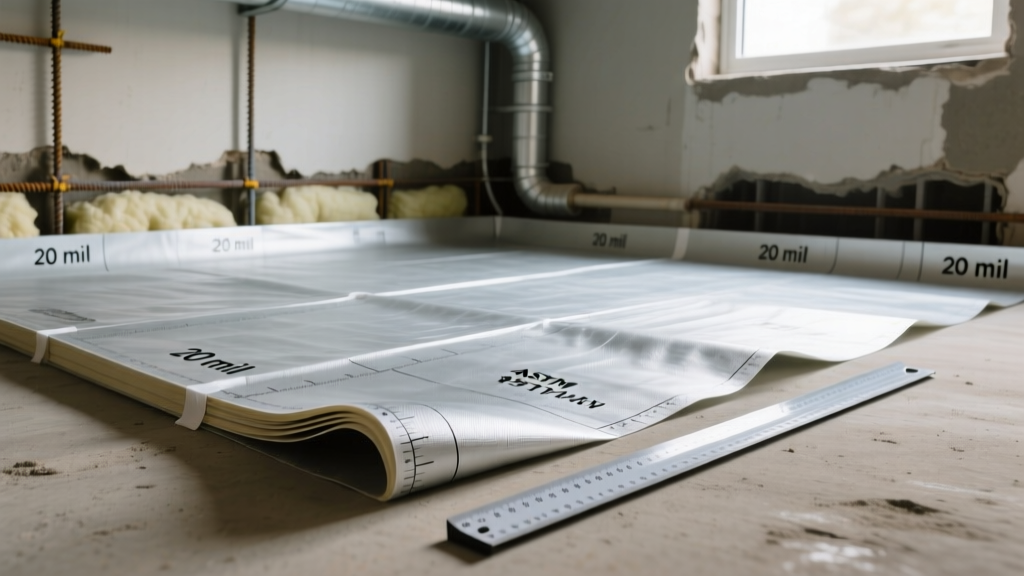
Contractors and homeowners often fixate on 'mil thickness' (one-thousandth of an inch) as the sole indicator of quality. While a 20-mil barrier is physically thicker than a 10-mil barrier, thickness does not linearly correlate with puncture resistance or tensile strength. The manufacturing process and material composition dictate real-world durability far more than caliper measurements.
Dart Drop Impact and Tensile Strength
To evaluate true durability, engineers rely on ASTM D1709 (Standard Test Methods for Impact Resistance of Plastic Film by the Free-Falling Dart Method) and ASTM D882 (Standard Test Method for Tensile Properties of Thin Plastic Sheeting). A non-woven, extruded 15-mil virgin polyethylene sheet might score lower on a dart drop test than a 12-mil woven, cross-laminated barrier reinforced with polyester scrim.
- Non-Woven Polyethylene (6 to 15 mil): Manufactured by extruding molten plastic. Prone to tearing along stress lines if punctured. Best suited for low-traffic crawl spaces with smooth, graded soil substrates.
- Woven / Cross-Laminated (10 to 22 mil): Integrates a high-density polyethylene (HDPE) woven scrim between layers of low-density polyethylene (LDPE). If punctured, the weave prevents the tear from propagating. Highly recommended for crawl spaces requiring frequent HVAC or plumbing access.
- Foil-Backed Composite (10 to 18 mil): Features an aluminum foil core sandwiched between poly layers. Offers a near-zero perm rating (often ≤ 0.01 perms) and reflects radiant heat, but the foil core can be compromised by highly alkaline soils if not properly buffered.
Radon Mitigation Specifications: Virgin vs. Recycled Poly
If the property is located in EPA Zone 1 or Zone 2 for radon potential, or if a sub-membrane depressurization system is being installed, the material specification changes drastically. Recycled polyethylene is manufactured from post-consumer or post-industrial plastic waste. During the melting and re-extrusion process, microscopic impurities and inconsistent melt flows create weak points and micro-fissures in the sheeting.
While these micro-fissures might not allow liquid water or bulk soil moisture to pass, they are highly permeable to radon gas molecules. For radon-rated basement crawl space vapor barriers, specifications must explicitly state 100% Virgin Polyethylene. ASTM E1745 (Standard Specification for Plastic Soil Gas Retarders) outlines the rigorous testing required for soil gas retarders, including a mandatory water vapor transmission rate of less than 0.3 perms and specific tensile requirements to withstand the vacuum pressure of a radon fan system without stretching or tearing at the fastener points.
Termination, Overlap, and Fastener Specifications
The highest-performing membrane will fail if the installation specifications are ignored. Moisture and soil gases exploit the path of least resistance, which is almost always at the seams and perimeter terminations. The following specifications represent the current industry baseline for professional encapsulation:
- Seam Overlap: Minimum 6-inch overlap for standard 10-12 mil materials; minimum 12-inch overlap for 20+ mil materials or installations over highly active expansive clay soils.
- Seam Tape Chemistry: Do not use standard acrylic or duct tapes. Specifications must call for double-sided butyl rubber tape or specialized low-VOC acrylic encapsulation tape (e.g., 4-inch wide seam tape with a minimum 40 oz/inch peel adhesion rating).
- Wall Termination: The barrier must extend up the foundation wall to a minimum of 6 inches above the exterior grade line, or terminate at the top of the foundation wall. Termination requires a continuous bead of polyurethane mastic or butyl sealant, mechanically fastened with a termination batten strip every 16 inches using masonry anchors.
- Pipe and Pier Penetrations: All structural piers and plumbing penetrations must be wrapped and sealed. Specifications require specialized pre-formed pipe collars or 'flash and wrap' techniques using uncured neoprene flashing tape that conforms to irregular surfaces without relying on adhesive memory.
Cost vs. Performance Matrix
Budgeting for a crawl space encapsulation requires balancing upfront material costs against the lifecycle performance of the barrier. The table below outlines the average 2026 material costs per square foot, correlated with their specific performance tiers and ideal use cases.
| Material Specification | Avg. Cost (per sq. ft.) | Perm Rating | Puncture Resistance | Best Application |
|---|---|---|---|---|
| 6-Mil Non-Woven (Recycled) | $0.05 - $0.08 | ≤ 0.06 | Low (Fails ASTM D1709 heavy dart) | Temporary construction cover; short-term resale staging |
| 10-Mil Non-Woven (Virgin) | $0.12 - $0.18 | ≤ 0.03 | Moderate | Standard code-compliant encapsulation in clean, dry crawl spaces |
| 12-Mil Woven Scrim | $0.22 - $0.30 | ≤ 0.02 | High (Scrim prevents tear propagation) | Crawl spaces with storage, HVAC access, or uneven rocky soil |
| 20-Mil Woven / Foil-Core | $0.45 - $0.65 | ≤ 0.01 | Extreme | Radon mitigation systems, high-water-table zones, conditioned storage |
Investing in a 12-mil or 20-mil woven barrier adds approximately $0.15 to $0.40 per square foot to the material budget compared to basic 6-mil poly. However, this premium eliminates the risk of tear-induced moisture intrusion, which can cost thousands of dollars to remediate if mold develops on floor joists or subflooring. Always request the manufacturer's ASTM E96 and ASTM D1709 test reports before approving a material submittal for any performance-critical waterproofing project.