Choosing the Right Vapor Barrier Tape for Every Substrate
Match vapor barrier tape to substrates like OSB, concrete, and housewrap. Compare acrylic, butyl, and asphalt tapes for lasting airtight building seals.
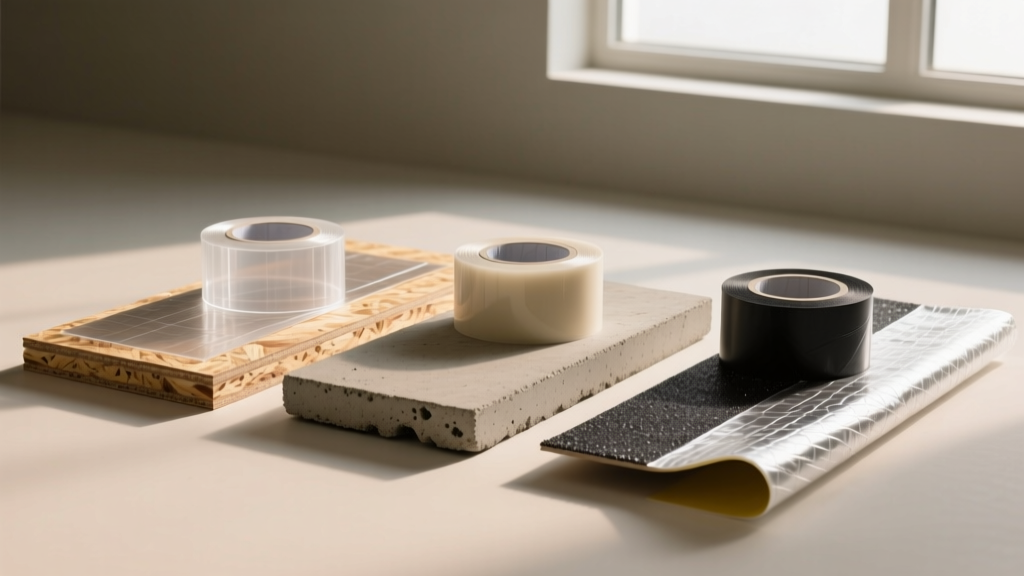
The Physics of Tape Adhesion: Why One Size Fails All
Achieving a continuous air and vapor barrier is the cornerstone of modern building envelope design, yet the weakest link is almost always the seam. Vapor barrier tape is not a monolithic product category; it is a complex matrix of chemical adhesives engineered for specific substrate interactions, temperature ranges, and moisture conditions. Applying a standard acrylic tape to a damp concrete foundation or using butyl tape over extruded polystyrene (XPS) foam will result in catastrophic delamination within months.
According to the U.S. Department of Energy, unsealed building envelope penetrations and sheathing seams can account for up to 30% of a structure's heating and cooling energy loss. To achieve the rigorous airtightness standards required by Passive House and modern IECC codes, builders must match the tape's chemical formulation to the substrate's porosity, surface energy, and thermal expansion profile. This guide breaks down the exact application-fit scenarios for the three dominant tape chemistries in the 2026 market.
Substrate-to-Tape Matching Matrix
Before purchasing materials, cross-reference your primary sheathing and barrier materials against this compatibility matrix. Mismatching chemistry is the leading cause of warranty voids in weather-resistive barrier (WRB) systems.
| Substrate Material | Recommended Chemistry | Specific Product Examples | Critical Prep / Primer |
|---|---|---|---|
| OSB / Plywood | High-Performance Acrylic or Butyl | Siga Wigluv, Huber Zip System | Must be free of sawdust; brush clean. |
| Concrete / CMU | Butyl Rubber or Primed Acrylic | 3M All Weather 8067, Pro Clima (with primer) | Requires wire brushing and concrete primer. |
| Housewrap (Tyvek) | Acrylic (Manufacturer Specified) | DuPont Tyvek Tape, Pro Clima Tescon Vana | Surface must be dry; no primer needed. |
| Rigid Foam (XPS/EPS) | Acrylic Only | Siga Wigluv, Pro Clima Tescon Vana | Wipe with isopropyl alcohol to remove mold release. |
| Metals / Flashings | Butyl Rubber | 3M All Weather 8067, Protecto Wrap | Wipe with solvent to remove factory oils. |
Chemical Breakdown: Acrylic vs. Butyl vs. Asphalt
High-Performance Acrylics (The WRB Standard)
Modern acrylic tapes, such as Pro Clima Tescon Vana and Siga Wigluv, utilize solvent-free, modified acrylic adhesive systems. Unlike cheap hardware-store acrylics, these premium formulations offer exceptional UV resistance (often rated for 6 to 12 months of direct exposure) and age-hardening resistance. They bond via a microscopic mechanical interlock with porous substrates like wood fibers and non-woven housewraps.
Application Fit: Ideal for sealing housewrap laps, OSB sheathing joints, and window buck perimeters. Siga Wigluv is specifically engineered for exterior weather-resistive barriers and can be applied in temperatures as low as 14°F (-10°C), a massive advantage for winter framing crews.
Cost: Expect to pay between $55 and $85 per 60-meter roll in current markets. While expensive upfront, the linear footage per roll and zero-failure rate in standard wood framing make it highly cost-effective.
Butyl Rubber Tapes (The Heavy-Duty Sealant)
Butyl tape, including Huber Zip System Tape and 3M All Weather Flashing Tape 8067, is a synthetic rubber that never fully cures or hardens. It remains permanently pliable, allowing it to absorb the differential thermal expansion between dissimilar materials—such as an aluminum window flange and a wood-framed wall. Its high tack allows it to conform to irregular surfaces and bond aggressively to damp substrates.
Application Fit: Mandatory for sealing sill plates to concrete foundations, integrating metal flashings to wood, and sealing around rough plumbing penetrations where moisture is present during construction. It is the only reliable choice for below-grade or high-moisture transitions.
Cost: Generally ranges from $35 to $50 per 9-inch by 75-foot roll. It is heavier and yields less linear footage than acrylics, driving up the cost per linear foot for large sheathing seams.
Rubberized Asphalt (The Below-Grade Workhorse)
Modified bitumen and rubberized asphalt tapes, like those from Protecto Wrap or Grace Construction Products, rely on a thick, black, tar-like adhesive layer backed by polyethylene or aluminum foil. They are inherently waterproof and highly resistant to soil chemicals.
Application Fit: Strictly reserved for below-grade waterproofing, foundation sill seals, and heavy-duty pan flashing in masonry veneer walls. They should never be used to seal standard housewraps or OSB sheathing above grade, as the asphalt will bleed through light-colored membranes and degrade under UV exposure.
Warning: The XPS Plasticizer Migration Trap
Never apply butyl or asphalt-based tapes directly to Extruded Polystyrene (XPS) rigid foam. The blowing agents and plasticizers used in XPS manufacturing will chemically attack the rubber and asphalt adhesives, turning them into a liquid sludge within 6 to 12 months. Always use high-performance acrylic tapes or apply a compatible primer barrier when integrating XPS into your vapor control layer.
Real-World Failure Modes and Edge Cases
Even when the correct chemistry is selected, field application errors routinely compromise the vapor barrier. Building science experts at the Building Science Corporation consistently highlight the following field failures in airtightness testing:
- Cold-Weather Delamination: Applying standard acrylic tape at 35°F (1.6°C) without a primer. The adhesive becomes glassy and fails to wet out the substrate. Fix: Use cold-weather specific tapes (e.g., Siga Wigluv) or warm the tape rolls in an insulated job-site box before use.
- The 'Thumb-Press' Fallacy: Relying on hand pressure to activate butyl tape. Butyl requires high PSI to force the adhesive into the microscopic pores of OSB or concrete. Fix: Mandate the use of a hard J-roller across every inch of the tape seam.
- UV Degradation of Butyl: Leaving butyl tape exposed to sunlight for more than 30 days. The UV rays break down the rubber polymers, causing the tape to crack and lose adhesion. Fix: Ensure butyl tape is immediately covered by cladding, flashing, or a UV-stable liquid membrane.
- Dusty Substrate Blindness: Taping over OSB that has been sanded or routed on-site. The sawdust acts as a microscopic ball bearing, preventing adhesive contact. Fix: Brush all seams with a stiff bristle brush and wipe with isopropyl alcohol before taping.
Industry Standards and Compliance
When specifying vapor barrier tapes for commercial or high-performance residential projects, ensure the products meet the AAMA 711 Standard Specification for Self-Adhering Flashing. This standard rigorously tests tapes for thermal cycling, water immersion, and artificial aging. Tapes that carry an AAMA 711 certification have proven their ability to maintain adhesion across the extreme temperature swings (-20°F to 180°F) that occur within wall cavities and behind dark-colored cladding.
Furthermore, for projects targeting Passive House certification, the tape system must contribute to an overall assembly air permeance of less than 0.02 L/(s·m²) at 50 Pa, as verified by a blower door test. Selecting tapes with documented long-term aging data (often provided by European manufacturers like Pro Clima and Siga) is critical to ensuring the 50-year durability expectations of the building envelope.
Cost Analysis: Price per Linear Foot vs. Lifetime Performance
While builders often default to the cheapest tape available at the local lumberyard to save on upfront material costs, the remediation cost of a failed vapor barrier is exponential. Re-taping a failed sheathing seam after the interior drywall and exterior cladding are installed can cost upwards of $400 per linear foot in demolition and labor.
Investing $0.45 per linear foot in a premium, substrate-matched acrylic or butyl tape, rather than $0.15 per linear foot in a generic, unbranded alternative, yields a 300% increase in material cost but reduces the risk of envelope failure to near zero. In the 2026 construction landscape, where energy codes demand blower door test results below 3.0 ACH50, the tape is no longer an accessory—it is the primary structural sealant of the building envelope.