Waterproofing Materials Compared: Membranes vs Liquids 2026
Compare top waterproofing materials for 2026. We analyze sheet membranes, liquid coatings, and bentonite systems with pricing, specs, and failure modes.

The Core Divide: Sheet Membranes vs. Liquid-Applied Systems
Selecting the correct waterproofing material requires matching the system's physical properties to the specific hydrostatic load, substrate condition, and structural movement expected over a 50-year service life. The fundamental physics of waterproofing dictate two primary approaches: relying on the manufactured consistency of sheet membranes, or achieving monolithic continuity through liquid-applied coatings. Sheet membranes offer guaranteed, uniform mil thickness straight from the factory, but their vulnerability lies entirely in the seams, penetrations, and transitions. Liquid-applied systems eliminate seams entirely, conforming to complex geometries, but their performance is entirely dependent on field application quality, substrate preparation, and ambient curing conditions.
Decision Framework: Which System to Specify?
- Specify Sheet Membranes when: You have large, open, unobstructed planes (plaza decks, below-grade walls), require blind-side application before concrete is poured, or face strict VOC regulations in enclosed spaces.
- Specify Liquid-Applied when: The substrate features complex penetrations, irregular geometries, multiple pipe racks, or when seamless integration with structural steel and existing flashings is critical.
Sheet Membranes: HDPE, TPO, and Modified Bitumen
Sheet membranes remain the baseline for high-performance below-grade and plaza deck applications. Modern formulations have moved far beyond traditional asphalt-modified bitumen, utilizing advanced polymers that bond directly to curing concrete.
Pre-Applied HDPE (High-Density Polyethylene)
Products like GCP Applied Technologies Preprufe 160R utilize a specialized pressure-sensitive adhesive layer that forms a mechanical and chemical bond with freshly poured concrete. This prevents lateral water migration between the membrane and the structural slab. HDPE sheets typically measure 48 to 60 mils thick and offer puncture resistance exceeding 200 lbs. They are the undisputed standard for blind-side waterproofing on property-line excavations where shoring prevents post-application access.
TPO and PVC Thermoplastics
For exposed plaza decks and green roofs, thermoplastic sheets like Sika Sarnafil S 327 (a 60-mil TPO membrane) provide exceptional UV and chemical resistance. TPO membranes are heat-welded at the seams using hot-air welding equipment, creating a homogenous joint that is as strong as the membrane itself. Unlike modified bitumen, TPO does not require open-flame torches, significantly reducing job-site fire risks and insurance liabilities.
Sheet Membrane Advantages
- Factory-controlled uniform thickness
- Immediate water resistance upon installation
- High puncture and tear resistance
- No curing time required before backfilling
Sheet Membrane Vulnerabilities
- Seam failures and 'fishmouths' at overlaps
- Difficult to detail around dense pipe penetrations
- Requires specialized heat-welding or primer equipment
- Vulnerable to damage from sharp backfill aggregate
Liquid-Applied Membranes: Polyurethane, PMMA, and Acrylics
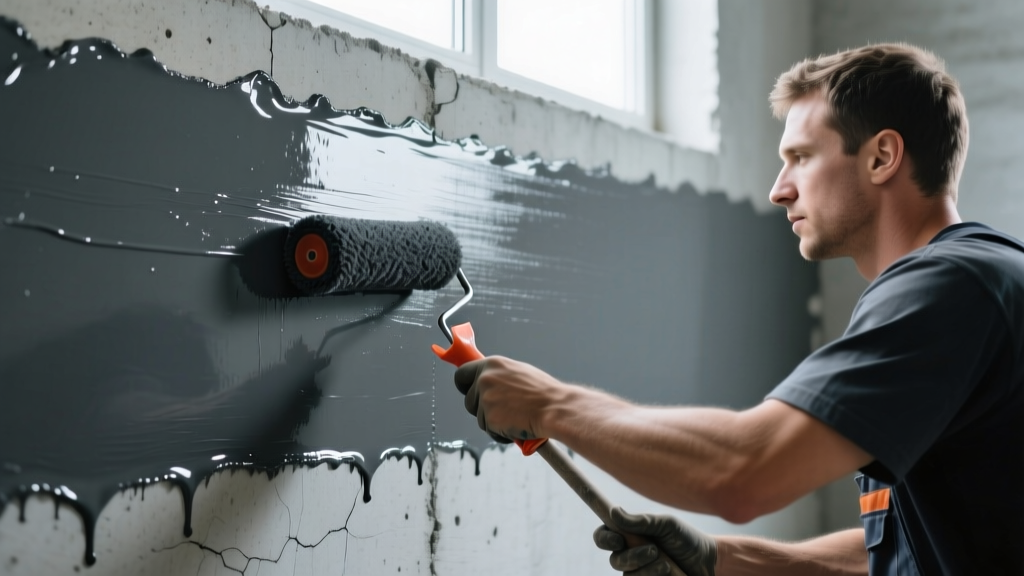
Liquid-applied systems cure in place to form a continuous, elastomeric barrier. They are categorized by their base chemistry, which dictates their cure speed, moisture tolerance, and elongation properties.
Polyurethane (PU) Systems
Two-component polyurethane systems, such as Tremco Vulkem 116, offer exceptional elongation (often exceeding 600%) and tensile strength. They are ideal for parking decks and pedestrian plazas where structural cracking and thermal movement are expected. However, standard polyurethanes are highly moisture-sensitive during application. If applied over concrete with a moisture vapor emission rate (MVER) exceeding 5 lbs per 1,000 sq ft over 24 hours, the isocyanate component reacts with the moisture to release carbon dioxide, causing blistering and delamination.
PMMA (Polymethyl Methacrylate) Rapid-Cure Systems
For fast-track projects or cold-weather applications, PMMA systems like BASF MasterSeal M 800 are unmatched. PMMA cures via a free-radical polymerization process initiated by a peroxide catalyst, achieving full cure and rain resistance in as little as 45 minutes, even at temperatures down to 20°F (-6°C). Unlike PU, PMMA is highly tolerant of damp substrates and can be applied directly to green concrete. The trade-off is cost and application complexity; the ultra-fast cure time requires specialized plural-component spray equipment and highly trained applicators.
Bentonite and Cementitious: The Niche Alternatives
Sodium bentonite clay panels, such as Volclay Ultra Seal, rely on the clay's ability to swell up to 15 times its dry volume when hydrated, creating a dense, impermeable gel. While highly effective in uniform, low-salinity soils, bentonite fails in environments with high salt content or where constant wet-dry cycling causes the clay to desiccate and shrink away from the substrate.
Integral crystalline waterproofing, like Kryton Krystol Internal Membrane (KIM), is added directly to the concrete mix. It uses proprietary chemicals that react with water and unhydrated cement particles to form needle-like crystals, blocking capillary pores. This is highly effective for water-retaining structures but cannot bridge structural cracks wider than 0.5mm that develop post-curing.
Comprehensive Material Comparison Matrix
| Material Type | Best Application | Elongation | Cure / Setup Time | 2026 Installed Cost (per sq ft) |
|---|---|---|---|---|
| Pre-Applied HDPE | Blind-side below-grade walls | 300% | N/A (Bonds to wet concrete) | $3.00 - $4.50 |
| TPO (60-mil) | Plaza decks, green roofs | 400% | Immediate (Heat welded) | $5.50 - $8.00 |
| Two-Component PU | Parking decks, podiums | 600%+ | 12 - 24 hours | $7.00 - $11.00 |
| PMMA | Fast-track balconies, cold weather | 200% | 45 minutes | $14.00 - $22.00 |
| Sodium Bentonite | Low-rise foundations, uniform soils | N/A (Swells to seal) | Requires hydration | $2.50 - $3.50 |
Common Failure Modes and Edge Cases
Understanding how waterproofing materials fail in the field is critical for specification and quality assurance. The most frequent failure modes include:
- Amine Blush in Epoxy Primers: When applying PU liquids over concrete, an epoxy primer is often used. In high humidity, the amine hardener can react with atmospheric moisture and carbon dioxide, forming a waxy 'amine blush' on the surface. If not mechanically abraded before the PU is applied, the membrane will delaminate under hydrostatic pressure.
- Pinholing from Concrete Outgassing: Liquid membranes applied to porous or newly poured concrete often suffer from pinholes. As the concrete warms in the sun, trapped air expands and escapes through the liquid coating, leaving microscopic channels. Mitigation requires applying a pore-sealing primer or applying the liquid during the cooling cycle of the concrete (late afternoon/evening).
- Fishmouths in Sheet Overlaps: When sheet membranes are lapped over an inside or outside corner, the material cannot lay flat, creating an open channel known as a fishmouth. These must be meticulously patched with compatible mastic and reinforcement fabric; otherwise, they act as direct conduits for water ingress.
Industry Standards and Quality Assurance
Specification of these materials must align with rigorous testing protocols. The ASTM Committee D08 on Roofing and Waterproofing maintains the foundational standards, including ASTM D6153 for below-grade waterproofing and ASTM C836 for high-solids content, cold liquid-applied elastomeric membranes. Compliance with these standards ensures minimum thresholds for tensile strength, adhesion to concrete, and resistance to hydrostatic pressure.
Furthermore, enclosure consultants rely on guidelines published by the National Institute of Building Sciences (NIBS) Building Enclosure Council to design redundancy into critical transitions. Field quality assurance should always include adhesion pull-tests and electronic leak detection (ELD) or flood testing prior to covering the membrane with protection courses or backfill. For complex projects, engaging a certified professional through the International Institute of Building Enclosure Consultants (IIBEC) ensures that the selected waterproofing materials are integrated correctly with the broader building envelope system, preventing costly litigation and structural degradation down the line.
Written by
Marcus ChenMarcus Chen is a licensed structural engineer (PE) and building materials analyst with over 12 years of experience across residential, commercial, and industrial construction. He holds a Master of Science in Civil Engineering from UC Berkeley and spent six years at Thornton Tomasetti before transitioning to independent consulting and technical writing. Marcus specializes in material selection for seismic-prone regions, concrete reinforcement strategies, and lifecycle cost analysis. His work has been cited by the American Concrete Institute (ACI) and the Structural Engineers Association of California (SEAOC). When he is not on a job site or at his desk, you will find him hiking the Sierra Nevada or restoring a 1920s craftsman bungalow in Oakland, CA.
More from Marcus Chen
View all
Construction Cost
How Much Did the Eiffel Tower Cost to Build?
How much did the Eiffel Tower cost to build in 1889? We adjust for inflation and compare its budget to modern skyscraper construction.
Aug 4, 2026

Fire Resistance
What Is a Fire Resistant Material? Testing & Certification Guide
Discover what is a fire resistant material through ASTM and UL testing. Learn how fire ratings, certifications, and assemblies work in construction.
Aug 4, 2026

Construction Cost
How Much Did the Burj Khalifa Cost to Build?
How much did the Burj Khalifa cost to build? We break down the $1.5B project and extract 5 money-saving strategies for your next build.
Jul 30, 2026