Basement and Crawl Space Waterproofing: Material Taxonomy
Compare membranes, coatings, and vapor barriers for basement and crawl space waterproofing. Expert material taxonomy and selection framework.
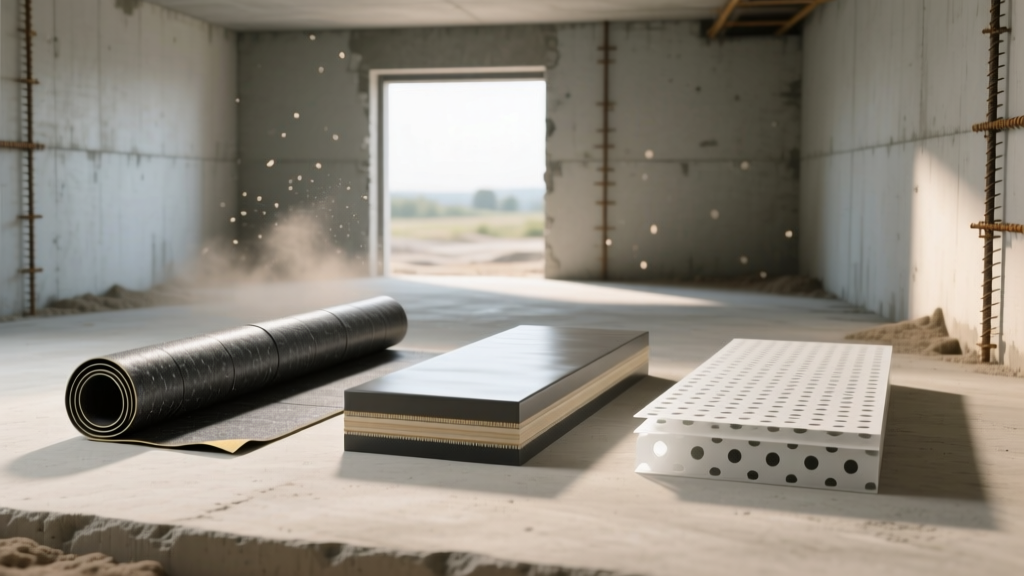
The Hydrostatic Reality: Why Material Selection Dictates System Survival
Below-grade and sub-floor environments are subjected to two distinct physical forces: hydrostatic pressure from groundwater and vapor drive from soil moisture. Treating basement and crawl space waterproofing as a single product category is a critical error in building science. A material that performs flawlessly as a vapor retarder in a ventilated crawl space will catastrophically fail when subjected to the lateral hydrostatic load of a backfilled basement wall. This taxonomy deconstructs the primary material classes, detailing specific polymer chemistries, ASTM performance standards, and real-world procurement costs to guide precise material selection.
Category 1: Exterior Below-Grade Membranes (The Primary Shield)
Exterior basement waterproofing requires materials capable of bridging hairline concrete shrinkage cracks while resisting continuous soil contact and root penetration. The industry relies on two dominant chemistries: liquid-applied polyurethanes and self-adhered modified bitumens.
Liquid-Applied Polyurethane vs. Modified Bitumen
Liquid-applied membranes (compliant with ASTM C836) are single-component, moisture-curing polyurethanes. They are sprayed or troweled onto the substrate, curing into a seamless, fully adhered elastomeric barrier. Products like Sika Sarnafil or Tremco Tremproof 2000 excel on irregular surfaces and around complex pipe penetrations. However, they require strict mil-thickness verification during application; a thin spot becomes a direct vector for water ingress.
Conversely, self-adhered polymer-modified bitumen sheets (compliant with ASTM D1970 or ASTM D4434) offer guaranteed, uniform thickness. Tremco Paraseal and Henry 790-11 feature a rubberized asphalt core bonded to a high-density polyethylene (HDPE) cross-laminated film. These sheets are highly resistant to backfill damage but require meticulous seam overlapping and primer application at cold joints.
| Material Class | Representative Products | Min. Thickness | Hydrostatic Rating | Material Cost (per sq. ft.) |
|---|---|---|---|---|
| Liquid Polyurethane | Tremco Tremproof, Sika SikaLastic | 60 mils (wet) | High (if uniform) | $2.80 - $4.20 |
| Self-Adhered Bitumen | Tremco Paraseal, Henry 790-11 | 40 mils (factory set) | Very High | $2.10 - $3.50 |
| Bentonite Clay Panels | Volclay, CETCO Waterstop | 1/4 inch panels | Moderate (requires confinement) | $1.50 - $2.20 |
Category 2: Crawl Space Encapsulation Liners (The Vapor Blockers)
Crawl space waterproofing is fundamentally about vapor retardation and air sealing, not hydrostatic resistance. The U.S. Department of Energy mandates that unvented crawl spaces utilize continuous ground vapor retarders. The material taxonomy here is defined by polyethylene manufacturing processes and reinforcement methodologies.
Cross-Laminated vs. String-Reinforced Polyethylene
Cross-Laminated Polyethylene (20-mil): Products like CrawlSeal 20 or StealthBond consist of multiple layers of virgin polyethylene laminated at opposing angles. This cross-directional orientation yields exceptional tear resistance (often exceeding 50 lbf/inch). These liners are typically white or reflective, which brightens the space and aids in pest inspection. Material costs range from $0.65 to $0.95 per square foot.
String-Reinforced Polyethylene (12 to 15-mil): These liners embed a polyester or fiberglass scrim between two layers of poly. While highly resistant to tensile tearing, the puncture resistance at the string nodes can be a weak point if sharp aggregate is present on the crawl space floor. Costs average $0.45 to $0.70 per square foot.
Category 3: Drainage Composites and Protection Boards
A waterproofing membrane is only as effective as the system's ability to relieve hydrostatic pressure. Drainage composites prevent soil from bearing directly against the membrane, creating an air gap that channels water to the footing drain.
- Dimpled HDPE Mats: Products like Delta-MS or Enkamat feature a vacuum-formed HDPE core bonded to a non-woven geotextile filter fabric. The core must have a minimum compressive strength of 5,000 psf to resist backfill compaction forces without crushing the drainage channel.
- Insulated Protection Boards: In cold climates, rigid extruded polystyrene (XPS) boards with a factory-applied drainage mat serve a dual purpose: protecting the bitumen membrane from backfill abrasion while providing R-10 to R-15 thermal insulation to the basement wall, mitigating interior condensation risks.
The Selection Matrix: Matching Material to Soil and Water Table
Selecting the correct material stack requires analyzing the site's geotechnical report. The DOE Building America Solution Center emphasizes that soil permeability and the seasonal high water table dictate the required redundancy of the waterproofing system.
| Site Condition | Soil Profile | Recommended Material Stack |
|---|---|---|
| Low Risk (Sloped site, well-draining) | Coarse sand / Gravel | Damp-proofing (asphalt emulsion) + Dimpled HDPE drainage mat. |
| Moderate Risk (Flat site, seasonal moisture) | Loam / Silty sand | Liquid-applied polyurethane (60 mils) + Geotextile-wrapped drainage board. |
| High Risk (High water table, poor drainage) | Heavy clay / Expansive soils | Self-adhered modified bitumen membrane + 4-inch rigid XPS protection board + French drain system. |
| Crawl Space (High humidity, dirt floor) | Any (unvented) | 20-mil cross-laminated poly liner, mechanically fastened to walls, with sealed seams and dehumidification. |
Critical Failure Modes and Edge Cases
Even premium materials fail when installation ignores structural realities. The Environmental Protection Agency notes that bulk water management failures are the leading cause of indoor mold proliferation. Avoid these specific failure modes:
- The Tie-Hole Vulnerability: Poured concrete walls leave snap-tie holes. If these are not patched with a non-shrink hydraulic cement (e.g., Thoroseal Hydraulic Water Stop) before membrane application, hydrostatic pressure will force water directly through the void, bypassing the membrane entirely.
- Cold Joint Delamination: The joint between the footing and the foundation wall is a primary failure point. Liquid membranes often pool and thin out at the 90-degree interior angle. Always install a pre-formed flexible sealant bead or a bitumen cant strip before applying the primary membrane.
- UV Degradation of Crawl Space Liners: If a crawl space liner is left exposed to sunlight through vents or access hatches during construction, the UV radiation will embrittle the polyethylene within 60 days. Ensure liners possess UV inhibitors if exposure is anticipated.
'Waterproofing is not a product; it is a continuous system. A membrane is merely one component of a broader hydrostatic relief and vapor management strategy. Failure to integrate the membrane with the footing drain and the interior vapor barrier guarantees eventual moisture intrusion.'
— Building Science Corporation, Below-Grade Moisture Control Guidelines
Procurement and Quality Assurance
When sourcing materials for basement and crawl space waterproofing, require manufacturer-certified technical data sheets (TDS) for every batch. Verify that liquid membranes are applied using wet-mil gauges to ensure the 60-mil minimum is achieved before curing. For crawl space encapsulations, mandate that all seams are overlapped by a minimum of 6 inches and sealed with a compatible, high-solids butyl tape or two-part polyurethane adhesive, never standard duct tape or construction adhesive, which will off-gas and fail within 24 months in high-humidity environments.