Troubleshooting Failing Waterproofing Deck Coating Material
Learn how to diagnose and fix peeling, bubbling, and cracking in your waterproofing deck coating material with our expert troubleshooting guide.

The Anatomy of Deck Coating Failures
When a waterproofing deck coating material fails, the consequences extend far beyond cosmetic blemishes. Water ingress through compromised balcony or plaza deck membranes leads to concrete spalling, rebar corrosion, and structural rot in underlying wood framing. According to the International Code Council (ICC), exterior elevated elements (EEEs) are subject to strict moisture management requirements, making the integrity of your deck coating a critical structural safeguard.
Troubleshooting requires moving past surface-level symptoms to identify the chemical or mechanical root cause. Whether you are dealing with a polyurea, polyaspartic, elastomeric acrylic, or PMMA (Polymethyl Methacrylate) system, the failure mechanisms generally fall into three categories: substrate moisture issues, improper surface preparation, or UV/thermal degradation. This guide provides a diagnostic framework and actionable remediation steps for the most common field failures.
Symptom-to-Cause Diagnostic Matrix
Accurate diagnosis requires matching the visual symptom with the environmental or mechanical stressor that caused it. Use the matrix below to identify your specific failure mode.
| Symptom | Visual Indicator | Root Cause | Immediate Action |
|---|---|---|---|
| Pinholing / Outgassing | Tiny, crater-like holes scattered across the cured surface. | Applying coating over porous concrete without a primer, or applying during peak substrate temperatures causing trapped air to expand. | Sand to 60-grit, apply a high-solids epoxy primer to seal pores, and re-topcoat. |
| Osmotic Blistering | Dome-shaped bubbles containing liquid or vapor when punctured. | Trapped moisture vapor in the concrete substrate exceeding the coating's permeability rating. | Grind out blisters, test substrate MVT, apply a moisture-mitigating epoxy primer. |
| UV Chalking | Chalky white residue on hands when touching the surface; color fading. | Use of an aromatic polyurethane or epoxy topcoat in direct sunlight without an aliphatic UV-stable finish. | Pressure wash, scuff-sand, and apply an aliphatic polyaspartic topcoat. |
| Edge Delamination | Coating peeling away from drains, railings, or termination bars. | Lack of proper detailing, missing chamfer strips, or failure to use a flexible sealant at transition joints. | Cut back peeling edges, install backer rod and polyurethane sealant, and feather-coat. |
Deep Dive: Osmotic Blistering and the MVT Factor
Osmotic blistering is the most misunderstood failure in waterproofing deck coating material applications. It occurs when water-soluble salts in the concrete substrate draw moisture vapor upward through the slab. When this vapor hits the impermeable deck coating, it condenses, creating immense hydrostatic pressure that literally pushes the coating off the concrete.
Testing for Moisture Vapor Transmission (MVT)
Before attempting any repair on a blistered deck, you must quantify the moisture vapor transmission rate. The American Concrete Institute (ACI) recommends strict adherence to standardized testing protocols before membrane installation.
- ASTM F1869 (Calcium Chloride Test): Measures the moisture vapor emitting from the surface over 72 hours. Most standard polyurethane and acrylic deck coatings require an MVT of less than 3 to 5 lbs per 1,000 square feet per 24 hours.
- ASTM F2170 (In-Situ Probe Test): Measures relative humidity deep within the concrete slab. This is vastly superior for thick plaza decks, as surface tests often yield false lows if the surface is temporarily dry but the core is saturated.
Expert Insight: If your MVT exceeds 5 lbs/1,000 sq ft, standard elastomeric acrylics will inevitably fail again. You must switch to a breathable silane/siloxane sealer for a penetrating option, or utilize a specialized moisture-mitigating epoxy primer (like a 100% solids, high-build moisture vapor barrier) before reapplying your traffic-bearing topcoat.
Step-by-Step Remediation for Delaminated Elastomeric Coatings
When large sections of your waterproofing deck coating material have lost adhesion, spot-patching is a temporary bandage. A proper remediation requires systematic removal and re-engagement with the substrate. Follow this sequence for a permanent repair.
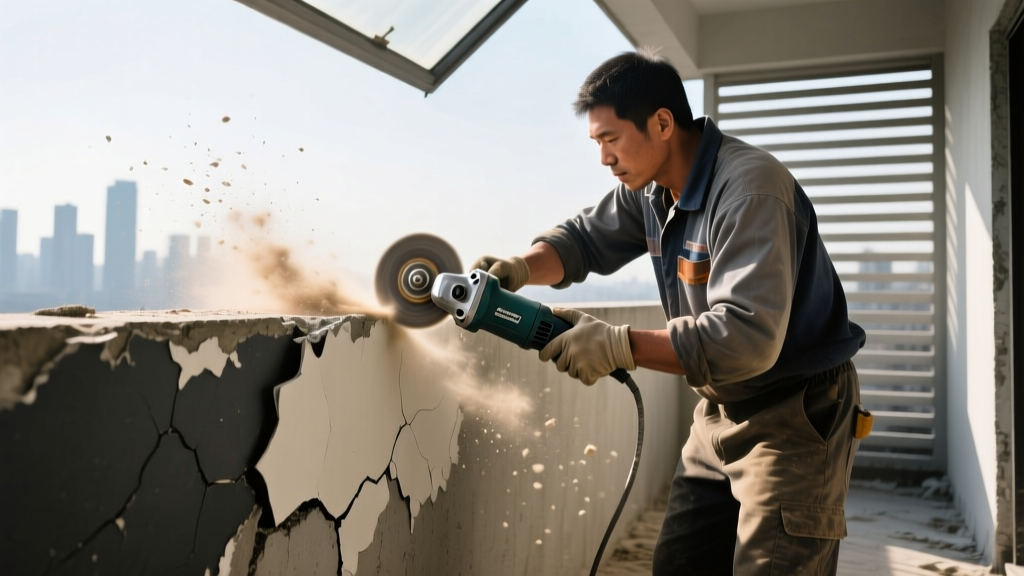
- Perimeter Cutting and Removal: Use a walk-behind concrete saw or a hand-held angle grinder to cut a clean perimeter around the delaminated area. Extend the cut at least 6 inches into the fully adhered, sound coating. Peel away the loose material.
- Mechanical Profiling: The Environmental Protection Agency (EPA) notes that proper moisture management requires sound substrates. Use a diamond cup wheel grinder to remove all residual adhesive and profile the bare concrete to a CSP-2 or CSP-3 (Concrete Surface Profile) standard. This creates the microscopic ridges necessary for mechanical adhesion.
- Solvent Wiping: Vacuum the dust, then wipe the exposed concrete and the feathered edges of the existing coating with Methyl Ethyl Ketone (MEK) or Xylene. This removes invisible silicones, oils, and release agents.
- Priming the Transition: Apply a compatible bonding primer to the bare concrete and overlap it 2 inches onto the existing sanded coating. Allow it to cure to a "tack-free" state (usually 2-4 hours depending on ambient temperature).
- Applying the Base and Topcoat: Roll on your base coat at the manufacturer's specified wet mil thickness (typically 20-30 mils). While wet, broadcast a slip-resistant aggregate (like 20-grit aluminum oxide or quartz sand) to rejection. Once cured, vacuum excess sand and apply the aliphatic polyaspartic or polyurethane topcoat to lock in the aggregate and provide UV resistance.
2026 Cost Breakdown: Repair vs. Full Replacement
Deciding between localized troubleshooting and a full tear-off depends on the percentage of failure. As a general industry rule, if more than 25% of the deck coating is compromised, the labor costs of patching, blending, and color-matching exceed the cost of a full replacement. Below are current estimated costs for professional-grade materials and labor.
| Service / Material Type | Cost per Sq. Ft. (Materials + Labor) | Expected Lifespan | Best Use Case |
|---|---|---|---|
| Spot Repair (Acrylic/Elastomeric) | $4.50 - $7.00 | 3 - 5 Years | Localized edge peeling or minor crack bridging. |
| Full Recoat (Polyurethane System) | $8.00 - $12.00 | 7 - 10 Years | High-traffic pedestrian balconies with sound substrates. |
| Full Replacement (Polyaspartic/PMMA) | $13.00 - $18.50 | 15+ Years | Commercial plazas, cold-weather applications, rapid cure needs. |
| Moisture Mitigation Primer (Add-on) | $2.50 - $4.00 | N/A (Sub-layer) | Mandatory for substrates failing ASTM F1869 MVT limits. |
Preventative Maintenance Framework
Troubleshooting is reactive; maintenance is proactive. To maximize the lifecycle of your waterproofing deck coating material, implement a bi-annual inspection protocol. Focus heavily on the "weak links" of the system: the flashing details, the drain bowls, and the termination bars where the deck meets the building envelope. Clear debris from scuppers and drains immediately, as standing water that exceeds the coating's designed hydrostatic limit will eventually find a microscopic pinhole. Finally, avoid using metal snow shovels or harsh de-icing chlorides on coated surfaces in winter; switch to plastic-blade shovels and calcium magnesium acetate (CMA) based ice melters to protect the chemical integrity of the topcoat.
Written by
Priya KapoorPriya Kapoor is a real estate market analyst and construction economics researcher with expertise in housing affordability, development feasibility, and infrastructure investment. She holds a Master of Regional Planning from Cornell University and previously worked as a senior analyst at CBRE's Investment Properties group, where she modeled returns for $4B in mixed-use development pipelines. Priya now runs an independent research practice advising developers, municipalities, and REITs on construction cost forecasting and market timing. She publishes the quarterly "BuildMat Market Pulse" report tracking material price indices across 12 commodity categories. Based in Austin, TX, Priya serves on the board of Habitat for Humanity Austin and is a marathon runner.
More from Priya Kapoor
View all
Construction Cost
Cost to Build a 1600 Sq Ft Home in 2026: Full Breakdown
Accurate 2026 cost to build a 1600 sq ft home—material, labor, and regional pricing breakdowns included. Plan your budget with real-time estimates.
Aug 11, 2026

Wood & Lumber
Name the Types of Wood for Pressure Treatment and Preservation
Learn how to name the types of wood best suited for pressure treatment. Compare species treatability, chemical retention levels, and 2026 preservation costs.
Aug 4, 2026

Stone & Masonry
Stone Veneer Suppliers Lindenhurst: 2026 Cost Analysis
Analyze 2026 stone veneer costs in Lindenhurst, NY. Compare local supplier pricing, delivery fees, and Suffolk County installation labor rates.
Aug 4, 2026