Troubleshooting the Best Waterproof Outdoor Material for Cushions
Diagnose leaking seams, mold, and failing DWR coatings. Discover the best waterproof outdoor material for cushions and exact restoration steps.

The "Waterproof" Illusion: Why Outdoor Cushions Fail
When patio cushions become waterlogged, heavy, and prone to mildew, the immediate assumption is that the fabric itself has failed. In reality, the fabric is rarely the primary point of failure. True waterproofing in outdoor soft furnishings relies on a tripartite system: the outer textile's Durable Water Repellent (DWR) coating, the structural integrity of the seams and zippers, and the internal foam core's drainage capabilities. If any single node in this system degrades, the entire cushion compromises. This troubleshooting guide isolates the exact failure points in outdoor cushion systems and details the precise material interventions required to restore or upgrade your setup using the best waterproof outdoor material for cushions available in 2026.
Diagnostic Matrix: Identifying Your Cushion Failure
Before replacing materials, accurately diagnose the ingress point. Use the following matrix to map your specific symptom to its root cause and required material fix.
| Symptom | Root Cause | Material/Action Fix |
|---|---|---|
| Fabric surface absorbs water (wets out) but interior stays dry | DWR coating degradation due to UV exposure and friction | Strip and reapply C0 (PFAS-free) DWR spray |
| Water pools inside the cushion; fabric feels dry on top | Capillary wicking through standard polyester stitching thread | Restitch with PTFE thread or apply urethane seam sealer |
| Cushion remains heavy and wet days after rain | Incorrect foam density; closed-cell foam trapping surface water | Replace core with reticulated (open-cell) polyurethane foam |
| Black spotting and musty odor emanating from inside | Trapped moisture in standard poly-fill or dacron batting | Remove batting; treat with enzymatic cleaner; upgrade core |
| Water enters exclusively through the zipper track | Standard coil zippers lack hydrostatic resistance | Replace with YKK AquaGuard or install a Velcro storm flap |
Symptom 1: The "Wet Core" Syndrome (Foam Mismatch)
The most common reason a cushion stays wet is not the fabric, but the foam. Many manufacturers use standard closed-cell polyurethane or polyester fiberfill to cut costs. When water bypasses the fabric (via a seam or zipper), closed-cell foam acts like a sponge, trapping water against the inner fabric layer, which eventually breeds mold.
Replace the internal core with reticulated (open-cell) polyurethane foam, often branded as DryFast or QuickDry foam. This material undergoes a thermal reticulation process that burns away the cell membranes, leaving a 3D skeletal structure with a 30 to 60 PPI (pores per inch) rating. Water passes straight through it rather than being absorbed. Pair this with a breathable, water-resistant bottom fabric (like a mesh or non-woven polypropylene) to allow rapid gravity drainage.
Symptom 2: Leaking Seams and Capillary Wicking
Even if you use a high-end PVC-coated polyester or solution-dyed acrylic, the needle holes created during manufacturing are physical breaches in the material. Furthermore, standard polyester thread acts as a wick. Through capillary action, water resting on a seam will be drawn through the needle holes and into the cushion core, completely bypassing the fabric's hydrostatic head rating.
Step-by-Step Seam Restoration
- Seal Existing Seams: Apply a flexible urethane-based seam sealer (such as Gear Aid Seam Grip FC) to the interior of all stitch lines. This creates a physical gasket over the needle holes.
- Restitch with PTFE: If the cushion cover requires rebuilding or repair, discard standard polyester thread. Use Gore Tenara PTFE thread. PTFE is completely inert, does not absorb water, and will not degrade under UV exposure, effectively eliminating capillary wicking.
- Upgrade Zippers: Replace standard nylon coil zippers with YKK AquaGuard water-repellent zippers, which feature a polyurethane laminate coating on the reverse side, or design an overlapping fabric storm flap secured with marine-grade hook-and-loop fasteners to shield the zipper track entirely.
Symptom 3: DWR Coating Failure (Fabric Wets Out)
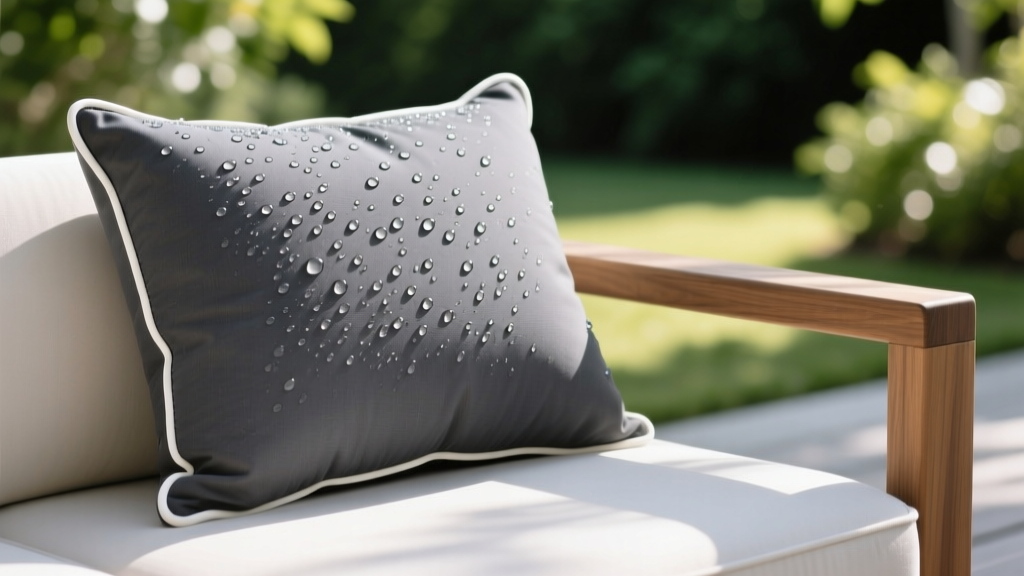
Outdoor fabrics are rarely 100% waterproof on their own; they are water-resistant textiles treated with a Durable Water Repellent (DWR) finish that causes water to bead and roll off. When the DWR degrades, the fabric "wets out," becoming heavy and losing its breathability, which leads to condensation on the inside of the cushion cover.
Due to stringent environmental regulations taking full effect in 2025 and 2026 (such as California's AB 1817 and similar EU mandates), the industry has shifted away from highly effective but toxic C8 and C6 fluorocarbon (PFAS) DWRs. Modern C0 (non-fluorinated) DWRs require more frequent maintenance but are now the industry standard.
Avoid generic hardware-store silicone waterproofing sprays. Silicone clogs the microscopic pores of breathable acrylics, trapping moisture inside and voiding manufacturer warranties. Always use a water-based, PFAS-free DWR restorer specifically formulated for technical or outdoor fabrics.
To restore the beading effect, clean the fabric thoroughly, allow it to dry completely, and apply a high-quality C0 DWR restorer like Nikwax TX.Direct Spray-On or 303 Fabric Guard. Apply two light coats rather than one heavy coat to ensure even distribution without saturating the textile.
Symptom 4: Mold and Mildew Infiltration
If your cushions smell musty, mold is actively digesting organic matter (dust, pollen, skin cells) trapped in the damp foam or fabric weave. According to the EPA's mold cleanup guidelines, porous materials that harbor deep mold growth often need to be replaced. However, outdoor textiles can usually be salvaged if caught early.
For solution-dyed acrylics (like Sunbrella), the color is extruded into the fiber itself, meaning you can use aggressive cleaning agents without stripping the color. Sunbrella's official care guidelines recommend a specific mixture for severe mold: 1 cup of bleach, 1/4 cup of mild soap (like Woolite), and 1 gallon of warm water. Spray the solution, let it soak for 15 minutes to penetrate the weave and kill the fungal roots, scrub with a soft bristle brush, and rinse thoroughly. Never use bleach on PVC-coated polyesters or marine vinyls, as it will extract the plasticizers and cause the material to crack.
Material Replacement Guide: Choosing the Right Textile
If your fabric is physically torn, delaminating, or structurally compromised, troubleshooting is no longer viable; replacement is required. When sourcing the best waterproof outdoor material for cushions, select based on your specific environmental exposure and usage patterns.
1. Solution-Dyed Acrylic (e.g., Sunbrella Marine Grade, Outdura Marine)
- Hydrostatic Head: ~400mm - 600mm (Water-resistant, not fully waterproof)
- Best For: Residential patios, high-UV environments, breathable applications.
- Pros: Unmatched UV resistance, highly breathable (prevents internal condensation), soft hand-feel, cleanable with bleach.
- Cons: Requires a DWR coating to shed water; water will eventually pass through under sustained hydrostatic pressure.
2. PVC-Coated Polyester (e.g., Stamoid, Ferrari 502)
- Hydrostatic Head: 1,500mm - 3,000mm+ (Highly waterproof)
- Best For: Marine upholstery, boat cockpits, commercial hospitality, areas with horizontal rain exposure.
- Pros: Virtually impenetrable to liquid water, easy wipe-clean surface, high tensile strength.
- Cons: Non-breathable (requires ventilation grommets to prevent internal condensation), stiff hand-feel, can become slippery when wet.
3. TPU-Laminated Nylon (e.g., Cordura with TPU backing)
- Hydrostatic Head: 3,000mm - 10,000mm
- Best For: Tactical outdoor gear, heavy-duty expedition cushions, pet-friendly outdoor beds.
- Pros: Extreme abrasion resistance, fully waterproof backing, flexible in cold temperatures.
- Cons: Degrades faster under direct, constant UV exposure compared to acrylics; heavier weight.
Preventative Maintenance Protocol
To maximize the lifespan of your waterproof outdoor material for cushions, implement a strict bi-annual maintenance schedule. In early spring, wash covers with a technical textile cleaner to remove atmospheric pollutants that degrade DWR coatings. Reapply a C0 DWR treatment annually. During winterization, do not simply cover the cushions; remove them from the outdoor environment entirely. Store them in a climate-controlled area with a desiccant pack inside the storage bin to control ambient humidity, ensuring the foam core remains entirely dry and mold-free for the following season.
Written by
Priya KapoorPriya Kapoor is a real estate market analyst and construction economics researcher with expertise in housing affordability, development feasibility, and infrastructure investment. She holds a Master of Regional Planning from Cornell University and previously worked as a senior analyst at CBRE's Investment Properties group, where she modeled returns for $4B in mixed-use development pipelines. Priya now runs an independent research practice advising developers, municipalities, and REITs on construction cost forecasting and market timing. She publishes the quarterly "BuildMat Market Pulse" report tracking material price indices across 12 commodity categories. Based in Austin, TX, Priya serves on the board of Habitat for Humanity Austin and is a marathon runner.
More from Priya Kapoor
View all
Construction Cost
Cost to Build a 1600 Sq Ft Home in 2026: Full Breakdown
Accurate 2026 cost to build a 1600 sq ft home—material, labor, and regional pricing breakdowns included. Plan your budget with real-time estimates.
Aug 11, 2026

Wood & Lumber
Name the Types of Wood for Pressure Treatment and Preservation
Learn how to name the types of wood best suited for pressure treatment. Compare species treatability, chemical retention levels, and 2026 preservation costs.
Aug 4, 2026

Stone & Masonry
Stone Veneer Suppliers Lindenhurst: 2026 Cost Analysis
Analyze 2026 stone veneer costs in Lindenhurst, NY. Compare local supplier pricing, delivery fees, and Suffolk County installation labor rates.
Aug 4, 2026