2026 Waterproof Roof Material Cost Breakdown & Installation Guide
Compare 2026 costs for top waterproof roof materials. Detailed pricing for EPDM, TPO, PVC, and liquid membranes per square foot including installation.

The True Cost of Waterproofing: Beyond the Membrane
Budgeting for a low-slope or flat roof requires looking past the per-square-foot price of the membrane itself. In 2026, the cost of a waterproof roof material is heavily influenced by energy code compliance, substrate preparation, and seam technology. While basic black rubber membranes remain the cheapest upfront option, the commercial and high-end residential sectors have shifted toward heat-welded thermoplastics and high-solids silicones to combat premature seam failure. According to the Whole Building Design Guide (WBDG), the selection of a roofing system must balance initial capital expenditure with lifecycle maintenance, particularly regarding UV degradation and thermal shock.
• Economy Tier (EPDM): $4.50 – $6.50 per sq. ft. installed
• Mid-Tier (TPO / Mod-Bit): $5.50 – $9.00 per sq. ft. installed
• Premium Tier (PVC / Silicone): $7.00 – $12.50 per sq. ft. installed
*Pricing reflects national averages for commercial/low-slope applications, including standard tear-off and R-25 polyiso insulation.
Material-by-Material Cost Matrix (2026 Pricing)
The following matrix breaks down the installed costs, material thickness standards, and primary vulnerabilities for the most common waterproof roof materials used in modern construction.
| Material Type | Standard Thickness | Material Cost / Sq Ft | Installed Cost / Sq Ft | Primary Failure Mode |
|---|---|---|---|---|
| EPDM (Black Rubber) | 60-mil | $0.55 - $0.85 | $4.50 - $6.50 | Tape/adhesive seam degradation |
| TPO (White Thermoplastic) | 60-mil to 80-mil | $0.90 - $1.40 | $5.50 - $8.50 | Membrane cracking at fasteners |
| PVC (Polyvinyl Chloride) | 50-mil to 80-mil | $1.60 - $2.50 | $7.00 - $11.00 | Plasticizer migration (brittleness) |
| Modified Bitumen (SBS) | Two-ply system | $1.20 - $1.80 | $6.00 - $9.00 | Blistering from trapped moisture |
| High-Solids Silicone Coating | 20-30 dry mils | $1.50 - $2.20 | $4.50 - $7.50* | Ponding water dirt accumulation |
*Silicone coating costs assume an overlay restoration with no structural tear-off required.
Deep Dive: Membrane Performance & Failure Modes
EPDM (Ethylene Propylene Diene Monomer)
EPDM remains a staple due to its low material cost and high elasticity in extreme cold. However, its Achilles heel is the seam. Because EPDM is a thermoset rubber, it cannot be heat-welded. Contractors must use primer, seam tape, and liquid adhesives. Over a 15-year period, UV exposure and thermal cycling cause these adhesives to dry out, leading to lap-seam separation. Cost-saving tip: If specifying EPDM, upgrade to a 90-mil fully adhered system rather than a 60-mil mechanically attached system to reduce wind uplift vulnerability and membrane billowing.
TPO (Thermoplastic Polyolefin)
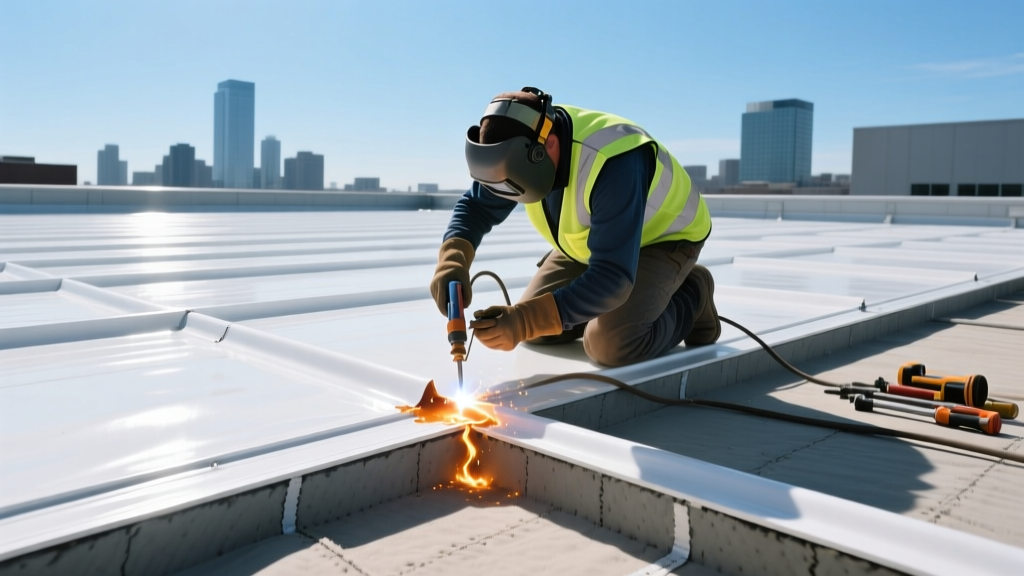
TPO dominates the commercial market because its seams are heat-welded using hot air, creating a monolithic, waterproof bond that is stronger than the membrane itself. The U.S. Department of Energy highlights white TPO for its high solar reflectance, which significantly reduces cooling loads in warmer climates. Edge Case Warning: Early generations of TPO suffered from premature cracking under high UV and thermal shock. Ensure your contractor specifies an ASTM D6878 compliant TPO with a reinforced polyester scrim and a minimum 60-mil thickness to withstand 2026 weather extremes.
PVC (Polyvinyl Chloride)
PVC is the premium choice for roofs exposed to animal fats, oils, or chemical exhaust (e.g., restaurant kitchens or manufacturing plants). Unlike TPO, PVC is inherently resistant to lipid degradation. The material cost is 40-60% higher than TPO, but the lifecycle value justifies the expense in harsh environments. Specify a minimum 50-mil thickness with a fleece-backing if installing directly over existing asphalt-based substrates to prevent chemical incompatibility.
Silicone Roof Coatings (Restoration)
When a roof deck is structurally sound but the existing membrane is failing, a high-solids silicone coating offers a massive cost advantage by eliminating tear-off and landfill fees. Silicone is moisture-cured and handles ponding water indefinitely without re-emulsifying. However, it requires rigorous infrared moisture scanning beforehand. Applying silicone over wet insulation will trap moisture, leading to deck rot. Budget $0.75 to $1.25 per square foot specifically for substrate power-washing and primer application.
Hidden Cost Drivers in Roof Waterproofing
Contractor bids often vary wildly because of how they handle the "invisible" layers of the roof assembly. When evaluating quotes, scrutinize these line items:
- Insulation Upgrades (IECC Compliance): Modern energy codes frequently mandate R-25 to R-30 continuous insulation for commercial roofs. Upgrading from a single layer of 2-inch polyiso to a staggered dual-layer (e.g., 2.5" base + 1.5" cover board) adds $1.80 to $2.60 per square foot in material and requires longer, more expensive mechanical fasteners.
- Cover Boards: Adding a 1/4-inch high-density fiberglass or gypsum cover board between the polyiso and the membrane adds $0.60 to $0.90 per square foot. This is non-negotiable for high-traffic roofs or those in severe hail zones, as it protects the fragile foam insulation from puncture.
- Flashing and Penetrations: The field of the roof rarely leaks; the penetrations do. Ensure the bid includes the replacement of all pitch pans, pipe boots, and HVAC curb flashing. Wrapping an HVAC curb with field membrane and relying on caulking is a guaranteed failure point.
- Fastener Pull-Out Testing: For mechanically attached systems, contractors must perform pre-installation fastener pull-out tests to determine the correct screw length and density pattern based on the structural deck (steel, concrete, or wood). This testing should cost $300-$500 per project and prevents catastrophic wind uplift failures.
Lifecycle Cost Analysis: Cheap Upfront vs. Long-Term Value
"A No Dollar Limit (NDL) warranty from the manufacturer is only as good as the contractor's certification. Paying a 10% premium for a factory-certified installer who uses approved adhesives and fasteners shifts the liability of material and labor defects entirely to the manufacturer, effectively capping your long-term risk."
When calculating the Total Cost of Ownership (TCO), divide the installed cost by the realistic service life. A $5.00/sq. ft. EPDM roof that requires seam maintenance at year 8 and replacement at year 15 costs $0.33/sq. ft. annually. A $9.00/sq. ft. PVC roof that lasts 30 years with zero seam maintenance costs $0.30/sq. ft. annually. The premium material actually yields a lower annualized cost while providing superior leak protection.
Actionable Budgeting & Bidding Framework
To ensure you receive accurate, comparable bids for your waterproof roof material, enforce the following framework when soliciting contractors:
- Mandate System Specifications: Do not accept bids that simply say "Install TPO." Require the exact manufacturer (e.g., Carlisle, Firestone/Holcim, Johns Manville), membrane thickness, scrim reinforcement type, and attachment method (fully adhered vs. mechanically attached).
- Require Core Cut Analysis: Before finalizing the budget, pay for 2-3 core cuts of the existing roof. This reveals the exact number of existing layers, the type of deck, and the presence of trapped moisture, eliminating contractor contingencies and change orders.
- Verify Wind Uplift Ratings: Ensure the specified assembly meets UL 580 or ASTM E1592 wind uplift ratings for your specific geographic zone. This often dictates the fastener spacing in the perimeter and corner zones of the roof.
- Demand Infrared Scanning for Overlays: If budgeting for a silicone restoration or overlay, make the contract contingent on a third-party infrared moisture survey. Any wet insulation identified must be cut out and replaced before the new material is applied.
Written by
Marcus ChenMarcus Chen is a licensed structural engineer (PE) and building materials analyst with over 12 years of experience across residential, commercial, and industrial construction. He holds a Master of Science in Civil Engineering from UC Berkeley and spent six years at Thornton Tomasetti before transitioning to independent consulting and technical writing. Marcus specializes in material selection for seismic-prone regions, concrete reinforcement strategies, and lifecycle cost analysis. His work has been cited by the American Concrete Institute (ACI) and the Structural Engineers Association of California (SEAOC). When he is not on a job site or at his desk, you will find him hiking the Sierra Nevada or restoring a 1920s craftsman bungalow in Oakland, CA.
More from Marcus Chen
View all
Construction Cost
How Much Did the Eiffel Tower Cost to Build?
How much did the Eiffel Tower cost to build in 1889? We adjust for inflation and compare its budget to modern skyscraper construction.
Aug 4, 2026

Fire Resistance
What Is a Fire Resistant Material? Testing & Certification Guide
Discover what is a fire resistant material through ASTM and UL testing. Learn how fire ratings, certifications, and assemblies work in construction.
Aug 4, 2026

Construction Cost
How Much Did the Burj Khalifa Cost to Build?
How much did the Burj Khalifa cost to build? We break down the $1.5B project and extract 5 money-saving strategies for your next build.
Jul 30, 2026