Is Nylon Material Waterproof? Construction Guide to Coated Membranes
Discover if nylon material is waterproof for construction. Learn about PVC, PU, and TPU coatings, hydrostatic ratings, and architectural membrane specs.

Specifying temporary enclosures, tensile structures, and vapor barriers requires a precise understanding of polymer behavior under environmental stress. A common question among architects and site managers is whether base nylon can withstand prolonged moisture exposure. The short answer is no: untreated nylon is hydrophilic. However, through advanced coating technologies and specific weave structures, waterproof nylon material has become a cornerstone of modern construction textiles. This guide examines the material science, coating specifications, and structural applications required to successfully integrate coated nylon into building projects.
The Reality of Nylon in Construction: Water-Resistant vs. Waterproof
To understand nylon material waterproofing, we must first look at the base polymer. Nylon (polyamide) is synthesized primarily in two forms for industrial use: Nylon 6 and Nylon 6,6. While both offer exceptional tensile strength and abrasion resistance, their molecular structure contains amide groups that attract water molecules. According to polymer science data published by ScienceDirect Materials Science, untreated nylon has a moisture regain of 4.0% to 8.0% at standard atmospheric conditions.
When exposed to liquid water, the woven gaps in standard nylon fabrics allow immediate penetration, and the fibers themselves will absorb moisture, leading to dimensional swelling and a reduction in tensile strength. Therefore, base nylon is strictly water-resistant at best. To achieve a true waterproof state suitable for construction environments, the fabric must be engineered with a continuous barrier that blocks both liquid water and water vapor.
Never specify uncoated nylon for exterior moisture barriers. Even tightly woven 1000-denier ripstop nylon will fail under sustained hydrostatic pressure. Waterproofing is achieved entirely through secondary coating or lamination processes, not the base yarn.
Engineering Waterproof Nylon Material for Building Applications
Transforming woven nylon into a reliable building membrane requires applying a continuous polymer coating or laminate to the substrate. The choice of coating dictates the fabric's hydrostatic head (HH) rating, UV stability, flame retardancy, and flexibility in sub-zero temperatures. In 2026, the industry is seeing a marked shift toward high-performance Thermoplastic Polyurethane (TPU) and bio-based Polyurethane (PU) coatings to meet stringent LEED v5 and BREEAM environmental standards, moving away from traditional plasticized PVC where possible.
Primary Coating Technologies
| Coating Type | Hydrostatic Head (HH) | UV & Weather Resistance | Approx. Cost (per sq yd) | Best Construction Use |
|---|---|---|---|---|
| Polyurethane (PU) | 3,000 - 8,000 mm | Moderate (Requires UV topcoat) | $4.50 - $7.00 | Interior vapor retarders, lightweight enclosures |
| Polyvinyl Chloride (PVC) | 8,000 - 15,000+ mm | Excellent (Inherently UV stable) | $6.00 - $12.00 | Heavy-duty scaffolding tarps, tensile canopies |
| Thermoplastic Polyurethane (TPU) | 10,000 - 20,000+ mm | High (Superior abrasion/chemical resistance) | $10.00 - $18.00 | High-stress architectural membranes, inflatable structures |
| Silicone Elastomer | 5,000 - 10,000 mm | Exceptional (Withstands extreme heat/UV) | $15.00 - $25.00 | Permanent tensile roofs, high-heat proximity zones |
Architectural and Construction Use Cases
Waterproof nylon materials are deployed across various construction phases, from temporary site protection to permanent architectural features. The specification must align with the structural demands and expected lifespan of the application.
Tensile Membrane Structures and Canopies
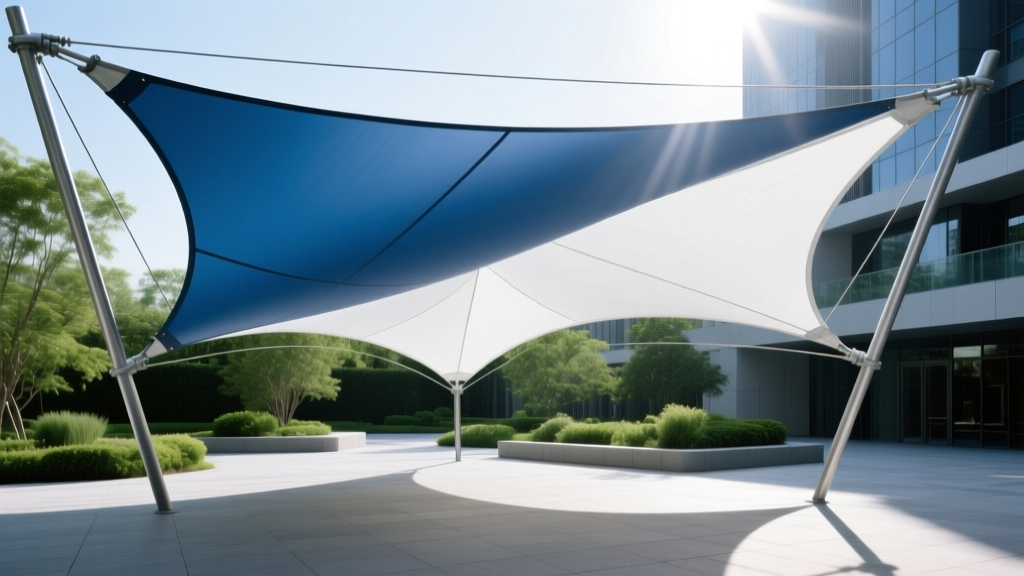
For permanent or semi-permanent tensile structures, PVC-coated high-tenacity nylon mesh is the industry standard. The Whole Building Design Guide (WBDG) notes that tensile membranes require materials with high biaxial tensile strength and minimal creep. Nylon 6,6 coated with PVC and treated with a PVDF (polyvinylidene fluoride) topcoat provides a lifespan of 15 to 25 years. The PVDF layer prevents plasticizer migration and resists dirt accumulation, maintaining the membrane's reflectivity and structural integrity under continuous solar exposure.
Heavy-Duty Site Enclosures and Scaffolding Tarps
Construction sites rely on waterproof nylon tarpaulins for weather protection and dust containment. For these applications, a 1000-denier ripstop nylon base coated with PU or PVC is specified. The ripstop weave integrates thicker reinforcement yarns at regular intervals (typically 5x5 mm or 10x10 mm grids) to halt tear propagation if the fabric is punctured by sharp scaffolding edges or wind-blown debris. Minimum weight for heavy-duty site enclosures is 18 oz per square yard, with reinforced webbing hems and brass grommets spaced every 18 inches.
Temporary Roofing and Emergency Shoring
Following structural damage or during phased roofing installations, waterproof nylon sheets serve as critical emergency barriers. These materials must be highly flexible for rapid deployment over uneven surfaces while maintaining a hydrostatic head rating sufficient to withstand wind-driven rain. TPU-coated nylon is increasingly preferred here due to its superior puncture resistance and ability to remain flexible at temperatures as low as -40°F, preventing the cracking associated with cheaper PVC alternatives in winter construction.
Specifying Waterproof Nylon: Key Metrics and Standards
Procurement teams must verify material claims against standardized testing protocols. Relying on manufacturer marketing terms like 'waterproof' without reviewing test data leads to catastrophic site failures. The primary governing body for these textiles is ASTM International.
Minimum Specification Data Block: Exterior Construction Nylon
- Hydrostatic Pressure Resistance: ASTM D751, minimum 10,000 mm for permanent exterior, 3,000 mm for temporary.
- Tongue Tear Strength: ASTM D751, minimum 80 lbs (warp and weft).
- Grab Tensile Strength: ASTM D5034, minimum 400 lbs for heavy-duty scaffolding enclosures.
- Flame Retardancy: NFPA 701 or ASTM E84 (Class A), mandatory for enclosed public spaces and high-rise scaffolding.
- Cold Crack Resistance: ASTM D2136, must pass at -20°F for year-round deployment in northern climates.
Failure Modes: Delamination and UV Degradation
Understanding how waterproof nylon fails is critical for lifecycle costing and maintenance planning. The most common failure mode is not the tearing of the base nylon, but the delamination or chemical breakdown of the waterproof coating.
Hydrolysis in PU Coatings: Standard Polyurethane coatings are susceptible to hydrolysis—a chemical reaction where water molecules break down the polymer chains of the coating over time, especially in high-heat, high-humidity environments. This results in the coating becoming sticky, peeling away from the nylon substrate, and ultimately failing. For tropical or coastal construction sites, specifiers must mandate hydrolysis-resistant PU formulations or upgrade to TPU/PVC alternatives.
Plasticizer Migration in PVC: Over time, the chemical plasticizers that keep PVC flexible can migrate to the surface and evaporate or wash away. This leaves the coating brittle, leading to micro-cracking under wind-induced tension. Specifying a PVDF or acrylic topcoat seals the plasticizers inside the PVC matrix, extending the functional life of the membrane by a factor of three.
FAQ: Nylon vs. Polyester in Exterior Applications
Why choose nylon over polyester for waterproof tarps?
Nylon offers superior abrasion resistance and higher tensile strength-to-weight ratio compared to polyester. It also exhibits better elasticity, allowing it to absorb sudden wind gusts (shock loading) without transferring destructive point-loads to the grommets and tie-downs. However, polyester has lower moisture absorption and better UV resistance, making it preferable for permanent, high-tension architectural structures where dimensional stability is paramount.
Can waterproof nylon be heat-welded on site?
Yes, but the method depends on the coating. PVC-coated nylon is easily welded using high-frequency (RF) or hot-air welding, creating seams that are as strong and waterproof as the parent material. PU and TPU can also be hot-air welded, though TPU requires precise temperature control to prevent burning the base nylon substrate. Silicone-coated nylon cannot be heat-welded and must be joined using specialized silicone adhesives or sewn-and-taped methods.
How does the denier count affect waterproofing?
Denier refers to the linear mass density of the base nylon fibers (e.g., 210D, 1000D). While a higher denier increases the physical thickness, tear strength, and puncture resistance of the fabric, it does not inherently improve the waterproof rating. The hydrostatic head is determined entirely by the coating thickness and quality. A 210D nylon with a robust TPU coating will hold back more water pressure than a 1000D nylon with a thin, degraded PU coating.
Written by
David NakamuraDavid Nakamura is a licensed architect (AIA) and construction technology writer focused on sustainable building methods, mass timber engineering, and high-performance building envelopes. He holds a Master of Architecture from the University of Washington and is a certified Passive House Consultant (CPHC). David spent eight years at the Seattle firm Mithun, where he led the design of three LEED Platinum projects, before founding his own practice specializing in net-zero residential design. He serves on the editorial advisory board of GreenBuilder Magazine and has authored peer-reviewed papers on cross-laminated timber (CLT) connections for the Journal of Structural Engineering. In his spare time, David teaches woodworking at Pratt Fine Arts Center and kayaks the Puget Sound.
More from David Nakamura
View all
Construction Cost
Labor Cost to Build a Deck Per Sq Ft: 2026 Installation Guide
Discover the exact labor cost to build a deck per sq ft in 2026. This installation guide breaks down contractor rates, complexity factors, and hidden fees.
Aug 4, 2026

Construction Cost
How Much Does It Cost to Build a 3 Bedroom House? Financing Guide
Learn exactly how much it costs to build a 3 bedroom house and explore 2026 financing options, construction loan types, and budget frameworks for your build.
Aug 4, 2026

Construction Cost
Cost to Build a Tennis Court: 2026 Guide
How much does it cost to build a tennis court in 2026? Breakdowns for asphalt, concrete, and synthetic surfaces plus fencing and lighting.
Jul 30, 2026